
[Paper Review] Probing the Anomalous Hall Transport and Magnetic Reversal of Chiral-Lattice Antiferromagnet Co$_{1/3}$NbS$_2$
This study investigates the intrinsic origin of the giant anomalous Hall effect (AHE) and anomalous Nernst effect (ANE) in exfoliated Co₁/₃NbS₂ flakes, demonstrating through Mott relation analysis that these effects arise from large intrinsic Berry curvature. Magnetic reversal is shown to be governed by domain wall motion, with a memory effect in the critical field Hc observed during consecutive magnetic sweeps, providing insight into topological and dynamic properties of chiral-lattice antiferromagnets.
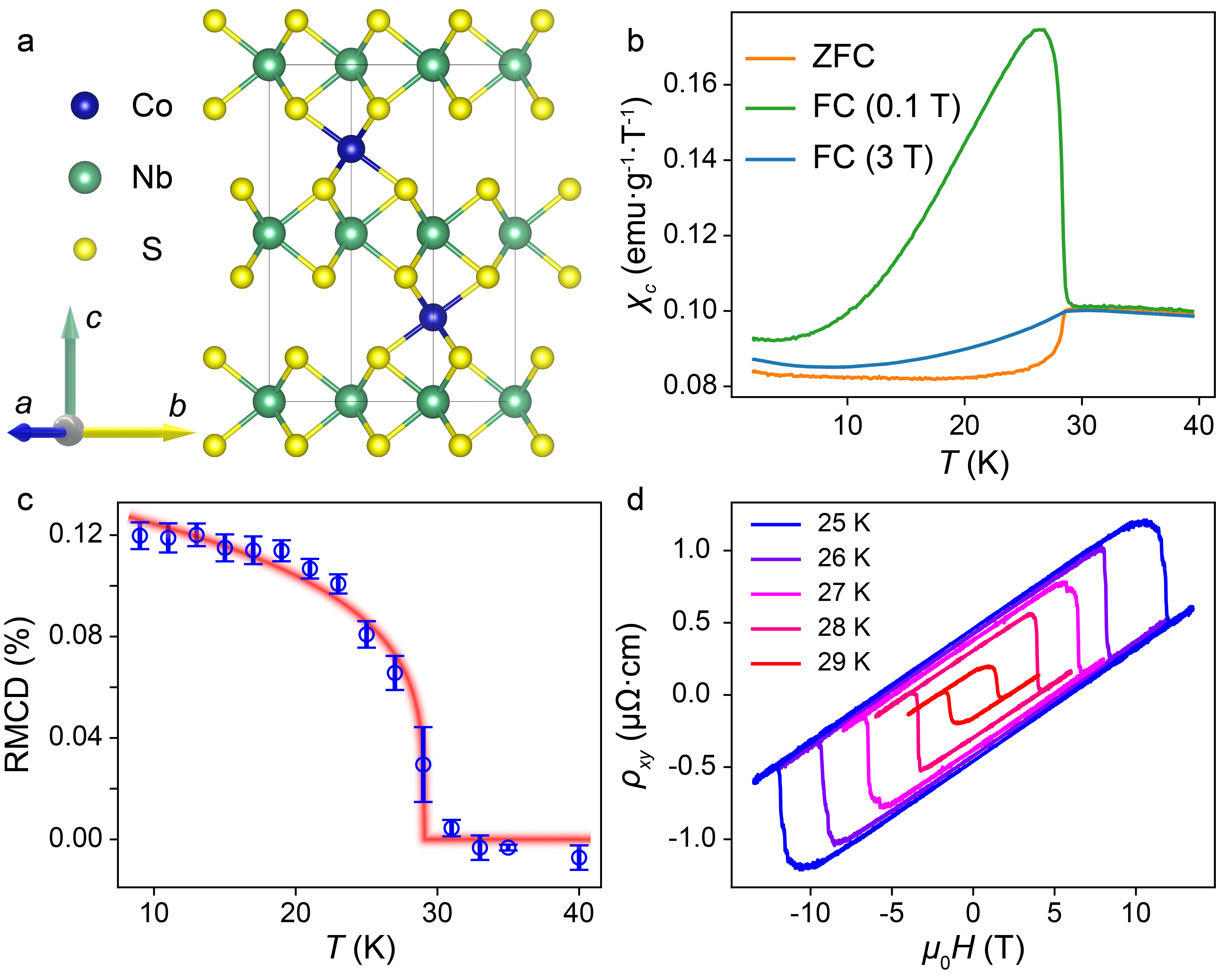
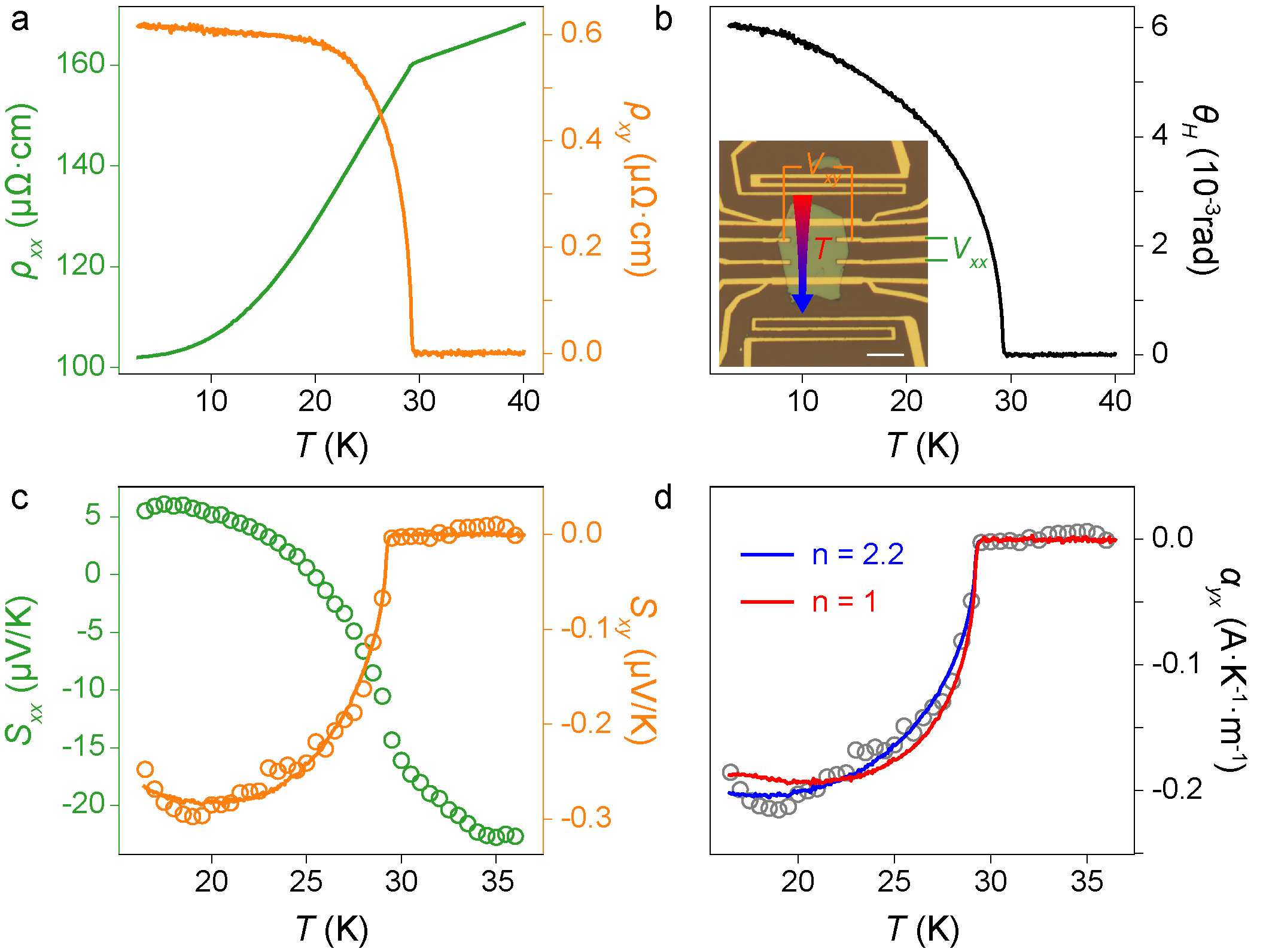
Antiferromagnets exhibiting giant anomalous Hall effect (AHE) and anomalous Nernst effect (ANE) have recently aroused broad interest, not only for their potential applications in future electronic devices, but also because of the rich physics arising from the Berry curvature near the Fermi level. $ m{Co_{1/3}NbS_2}$, by intercalating $ m{Co^{2+}}$ ions between $ m{NbS_2}$ layers, is a quasi-two-dimensional layered antiferromagnet with a chiral lattice. A large AHE has been observed in $ m{Co_{1/3}NbS_2}$, but its origin is under debate. In this letter, we report the large AHE and ANE in exfoliated $ m{Co_{1/3}NbS_2}$ flakes. By analyzing the thermoelectric data via the Mott relation, we determined that the observed large AHE and ANE primarily result from the intrinsic Berry curvature. We also observed the magnetic domains in $ m{Co_{1/3}NbS_2}$ by reflective magnetic circular dichroism measurements. Combined with electrical transport measurements, we confirmed that the magnetic reversal in $ m{Co_{1/3}NbS_2}$ is determined by domain wall motion, and the critical field ($H_c$) exhibits a memory effect of consecutive magnetic sweeps. Our work provides insight into the topological properties of $ m{Co_{1/3}NbS_2}$ and paves the way to studying the spin configuration and magnetic domain dynamics in this fascinating antiferromagnet.
Motivation & Objective
- To determine the origin of the giant anomalous Hall effect (AHE) and anomalous Nernst effect (ANE) in exfoliated Co₁/₃NbS₂ flakes.
- To clarify whether the AHE and ANE arise from intrinsic Berry curvature or extrinsic mechanisms such as disorder or skew scattering.
- To investigate the magnetic reversal mechanism in Co₁/₃NbS₂ and identify the role of domain wall motion in field-dependent magnetization.
- To explore the presence of a memory effect in the critical field Hc during repeated magnetic field sweeps.
- To provide optical evidence of magnetic domains using reflective magnetic circular dichroism (RMCD) and correlate them with transport behavior.
Proposed method
- Exfoliated single-crystalline flakes of Co₁/₃NbS₂ were fabricated using mechanical exfoliation and characterized via atomic force microscopy to confirm thickness.
- Four-point a.c. transport measurements were performed in a physical property measurement system (PPMS) with magnetic fields up to 14 T to extract ρxx, ρxy, Sxx, and Sxy.
- Thermoelectric power factor measurements were calibrated using four-probe resistance and temperature sensors, enabling accurate application of the Mott relation to link transport and thermoelectric coefficients.
- Reflective magnetic circular dichroism (RMCD) measurements were conducted at temperatures down to 1.6 K using a HeNe laser and photoelastic modulator to detect circular polarization differences in reflected light.
- RMCD mapping was performed by scanning the sample stage to spatially resolve magnetic domains.
- Magnetic field sweeps were applied consecutively to measure the evolution of the critical field Hc, revealing a non-monotonic decrease consistent with a memory effect.
Experimental results
Research questions
- RQ1What is the dominant origin of the giant anomalous Hall effect in Co₁/₃NbS₂—extrinsic scattering or intrinsic Berry curvature?
- RQ2How does the anomalous Nernst effect in Co₁/₃NbS₂ relate to the Berry curvature and electronic structure near the Fermi level?
- RQ3What is the mechanism underlying magnetic reversal in Co₁/₃NbS₂, and is it dominated by domain wall motion?
- RQ4Does the critical field Hc for magnetic reversal exhibit a memory effect during repeated field sweeps, and what does this imply about domain wall dynamics?
- RQ5Can reflective magnetic circular dichroism (RMCD) provide optical evidence of magnetic domains and their correlation with transport anomalies?
Key findings
- The Mott relation analysis of thermoelectric and transport data confirms that the large AHE and ANE in Co₁/₃NbS₂ are primarily due to intrinsic Berry curvature, not extrinsic mechanisms.
- A large RMCD signal was observed, and RMCD mapping resolved distinct magnetic domains, providing optical evidence of non-collinear spin textures and large Berry curvature.
- Magnetic reversal in Co₁/₃NbS₂ is dominated by domain wall motion, as confirmed by the field-dependent Hall resistance and hysteresis behavior.
- The critical field Hc for magnetic reversal decreases monotonically with consecutive magnetic field sweeps, indicating a memory effect likely tied to chiral domain wall dynamics or exchange bias.
- The observed large AHE and ANE values are consistent with a non-coplanar spin structure, supporting theoretical models involving scalar spin chirality and fictitious magnetic fields.
- Low-temperature anomalies in transport and thermoelectric data suggest the presence of large magnetic fluctuations or electronic transitions near the Fermi level.
Read this paper
Open the full text in the Nubint reader and ask about any passage as you read.
Read this paper on NubintThis review was generated by AI from the original paper. Please check the paper before citing it.