
[Paper Review] Prompt a Robot to Walk with Large Language Models
This paper proposes a novel framework that uses few-shot textual prompts with GPT-4 to directly generate low-level control commands for robot walking, without task-specific fine-tuning. The method enables LLMs to act as feedback controllers in high-dimensional robotic systems, achieving successful dynamic walking across multiple robots and terrains in simulation with a 0.721 normalized walking time and 0.6% success rate on challenging terrain.
Large language models (LLMs) pre-trained on vast internet-scale data have showcased remarkable capabilities across diverse domains. Recently, there has been escalating interest in deploying LLMs for robotics, aiming to harness the power of foundation models in real-world settings. However, this approach faces significant challenges, particularly in grounding these models in the physical world and in generating dynamic robot motions. To address these issues, we introduce a novel paradigm in which we use few-shot prompts collected from the physical environment, enabling the LLM to autoregressively generate low-level control commands for robots without task-specific fine-tuning. Experiments across various robots and environments validate that our method can effectively prompt a robot to walk. We thus illustrate how LLMs can proficiently function as low-level feedback controllers for dynamic motion control even in high-dimensional robotic systems. The project website and source code can be found at: https://prompt2walk.github.io/ .
Motivation & Objective
- To investigate whether large language models (LLMs) can function as low-level feedback controllers for dynamic robot walking without task-specific fine-tuning.
- To address the challenge of grounding LLMs in physical robot control by using few-shot prompts collected from real robot trajectories.
- To explore whether LLMs can generate stable, dynamic walking behaviors through in-context learning rather than imitation or reinforcement learning.
- To validate the framework across diverse robots, terrains, and simulation environments.
Proposed method
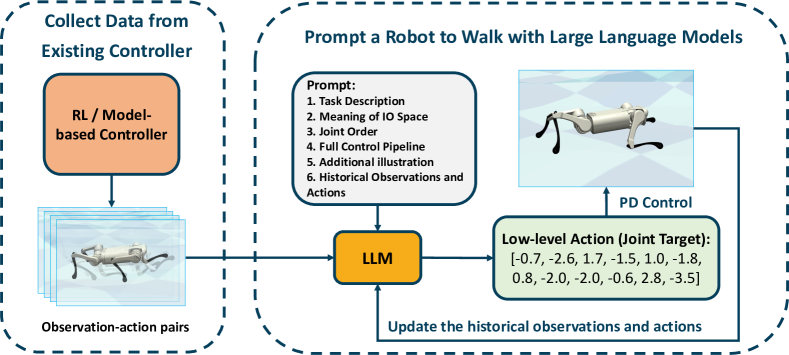
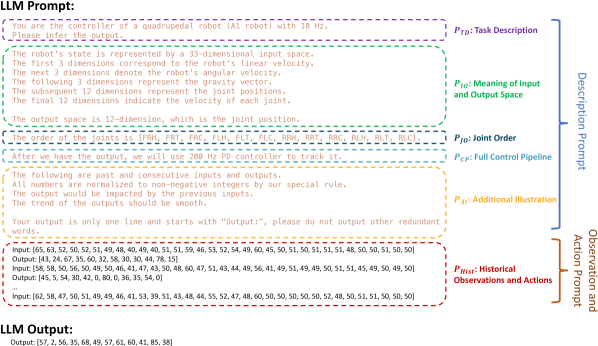
- The method uses a few-shot prompt paradigm with GPT-4, where the prompt includes a description prompt and an observation-action history sequence.
- Control commands are generated as normalized target joint positions, which are tracked by a PD controller at 200 Hz, while the LLM infers at 10 Hz.
- The prompt is dynamically updated after each inference loop with new observations and actions to maintain context.
- The framework is initialized using data from a pre-trained reinforcement learning policy to provide realistic demonstrations in the prompt.
- Text prompts are carefully designed to include task descriptions, environmental observations, and action sequences to guide the LLM’s in-context learning.
- The approach avoids fine-tuning and instead relies on the LLM’s in-context learning capability to generalize to new walking tasks.
Experimental results
Research questions
- RQ1Can LLMs serve as low-level feedback controllers for dynamic robot walking without any task-specific fine-tuning?
- RQ2How effective is in-context learning with few-shot prompts in enabling LLMs to generate stable, dynamic walking behaviors?
- RQ3To what extent does the design of the text prompt, including description and observation-action sequences, influence the success of robot walking?
- RQ4Can the proposed prompting framework generalize across different robotic platforms and terrains?
Key findings
- The method achieved a normalized walking time (NWT) of 0.721 on uneven terrain, indicating effective long-term walking performance.
- The success rate on the most challenging terrain (E5) was 0.6%, demonstrating feasibility in complex environments despite low success rates.
- The LLM policy generated joint trajectories with a regular, biomechanically plausible pattern, differing significantly from those of a reinforcement learning baseline.
- The description prompt was critical for success, as LLMs failed to walk when only numerical observations and actions were provided.
- The framework generalized across multiple robots (A1 and ANYmal), simulators (MuJoCo and Isaac Gym), and terrains, validating its cross-environment robustness.
- The prompt design was fragile—minor changes significantly affected performance—highlighting the need for better prompt engineering in LLM-based control.
Read this paper
Open the full text in the Nubint reader and ask about any passage as you read.
Read this paper on NubintThis review was generated by AI from the original paper. Please check the paper before citing it.