
[Paper Review] Prompting Multilingual Large Language Models to Generate Code-Mixed Texts: The Case of South East Asian Languages
This paper investigates the capability of multilingual large language models (LLMs) to generate natural-sounding code-mixed texts in seven South East Asian languages—Indonesian, Malay, Chinese, Tagalog, Vietnamese, Tamil, and Singlish—through zero-shot prompting. It finds that while models like ChatGPT show inconsistent performance, with fluent outputs only in specific language pairs like English-Singlish, most models fail to produce grammatically correct or semantically meaningful code-mixed text, especially when generating across diverse language families, and often introduce unintended languages or incorrect script systems, highlighting the need for extensive human validation before use in NLP research.
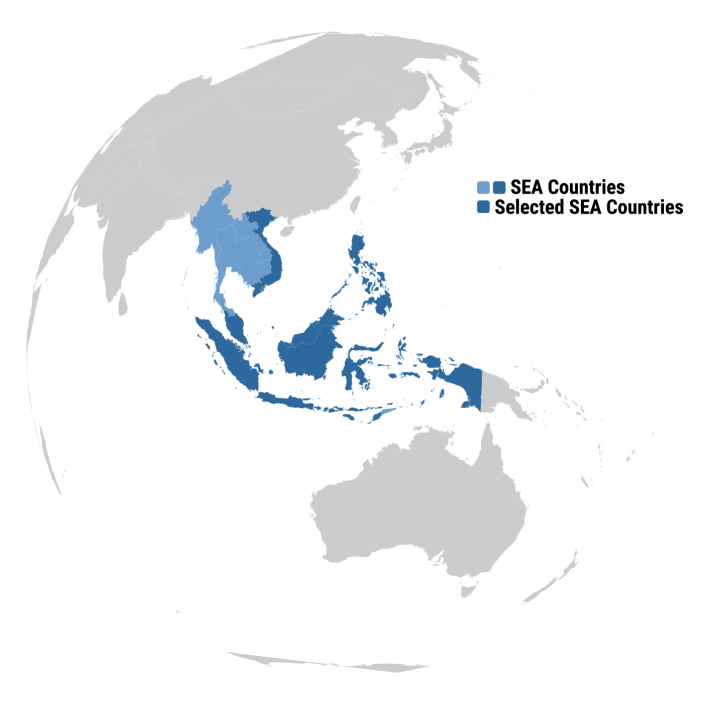
While code-mixing is a common linguistic practice in many parts of the world, collecting high-quality and low-cost code-mixed data remains a challenge for natural language processing (NLP) research. The recent proliferation of Large Language Models (LLMs) compels one to ask: how capable are these systems in generating code-mixed data? In this paper, we explore prompting multilingual LLMs in a zero-shot manner to generate code-mixed data for seven languages in South East Asia (SEA), namely Indonesian, Malay, Chinese, Tagalog, Vietnamese, Tamil, and Singlish. We find that publicly available multilingual instruction-tuned models such as BLOOMZ and Flan-T5-XXL are incapable of producing texts with phrases or clauses from different languages. ChatGPT exhibits inconsistent capabilities in generating code-mixed texts, wherein its performance varies depending on the prompt template and language pairing. For instance, ChatGPT generates fluent and natural Singlish texts (an English-based creole spoken in Singapore), but for English-Tamil language pair, the system mostly produces grammatically incorrect or semantically meaningless utterances. Furthermore, it may erroneously introduce languages not specified in the prompt. Based on our investigation, existing multilingual LLMs exhibit a wide range of proficiency in code-mixed data generation for SEA languages. As such, we advise against using LLMs in this context without extensive human checks.
Motivation & Objective
- To assess the feasibility of using zero-shot prompting to generate high-quality, natural-sounding code-mixed text in under-resourced Southeast Asian languages.
- To identify the limitations of current multilingual LLMs in generating linguistically accurate and semantically coherent code-mixed utterances across diverse language pairs.
- To evaluate the reliability of LLMs in generating synthetic code-mixed data for NLP research, especially given the scarcity of high-quality annotated datasets in this domain.
- To provide empirical evidence on the performance variability of models like ChatGPT, BLOOMZ, and Flan-T5-XXL in code-mixed generation across different language families and code-mixing levels.
Proposed method
- Zero-shot prompting of five multilingual LLMs—ChatGPT, InstructGPT, BLOOMZ, and Flan-T5-XXL—using diverse prompt templates to generate code-mixed text in English paired with six Southeast Asian languages.
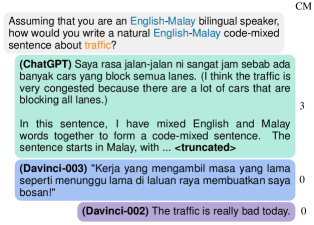
- Designing prompt templates that simulate bilingual speakers or mimic specific speech styles to elicit code-mixed responses.
- Collecting and annotating model outputs using native speakers to evaluate naturalness and code-mixing level across multiple dimensions: grammaticality, semantic coherence, and script system accuracy.
- Classifying code-mixing levels into four categories: no code-mixing, loanwords, topic-related nouns, and full linguistic elements.
- Conducting qualitative and quantitative analysis of errors, including grammatical mistakes, semantic confusion, incorrect script usage, and unintended language introduction.
- Comparing model outputs across language pairs and code-mixing types to identify patterns in failure modes and performance variability.
Experimental results
Research questions
- RQ1To what extent can multilingual LLMs generate natural-sounding code-mixed text in zero-shot settings for under-resourced Southeast Asian languages?
- RQ2How do different LLMs (e.g., ChatGPT, BLOOMZ, Flan-T5-XXL) vary in their ability to produce grammatically correct and semantically meaningful code-mixed utterances across diverse language pairs?
- RQ3What are the most common error types in LLM-generated code-mixed text, such as incorrect grammar, semantic incoherence, or script system mismatches?
- RQ4Why do some language pairs (e.g., English-Singlish) yield more fluent outputs than others (e.g., English-Tamil), and what linguistic or structural factors contribute to this disparity?
- RQ5To what extent do LLMs introduce unintended languages or fail to adhere to specified language pairings in their outputs?
Key findings
- ChatGPT generates fluent and natural-sounding code-mixed text only in specific language pairs, such as English-Singlish, but performs poorly in others, like English-Tamil, where outputs are often grammatically incorrect or semantically meaningless.
- BLOOMZ and Flan-T5-XXL are largely incapable of generating any form of code-mixed text, producing only monolingual or non-idiomatic utterances even with strong prompting.
- Many model outputs exhibit significant naturalness issues, including unnatural phrasing, incorrect verb forms, improper use of possessive markers, and semantic contradictions, such as claiming to have arrived while still being stuck in traffic.
- A substantial number of outputs contain script system inconsistencies, such as mixing Latin transliteration with native scripts (e.g., Tamil script and Latin letters), or using Pinyin instead of Chinese characters in Chinese-English code-mixing.
- LLMs frequently introduce languages not specified in the prompt, such as Hokkien or other regional variants, leading to unintended linguistic contamination in the output.
- The performance of LLMs varies widely across language families, with higher error rates observed in pairs involving Dravidian (e.g., Tamil) and Austro-Asiatic (e.g., Vietnamese) languages compared to Austronesian or Sino-Tibetan languages.
Read this paper
Open the full text in the Nubint reader and ask about any passage as you read.
Read this paper on NubintThis review was generated by AI from the original paper. Please check the paper before citing it.