
[Paper Review] Propagate Yourself: Exploring Pixel-Level Consistency for Unsupervised Visual Representation Learning
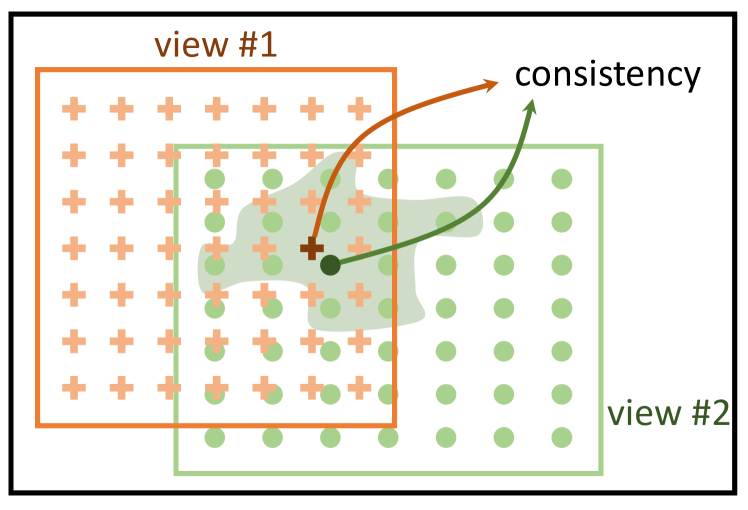
This paper proposes PixPro, a novel unsupervised visual representation learning method that introduces pixel-level pretext tasks—specifically, pixel-to-propagation consistency—to learn spatially sensitive, dense feature representations. By encouraging consistency between a standard feature and a smoothed, propagated version of the same pixel’s features, PixPro achieves state-of-the-art transfer performance on downstream dense prediction tasks, outperforming instance-level contrastive methods by 2.6 AP on Pascal VOC and 0.8–1.0 mAP on COCO.
Contrastive learning methods for unsupervised visual representation learning have reached remarkable levels of transfer performance. We argue that the power of contrastive learning has yet to be fully unleashed, as current methods are trained only on instance-level pretext tasks, leading to representations that may be sub-optimal for downstream tasks requiring dense pixel predictions. In this paper, we introduce pixel-level pretext tasks for learning dense feature representations. The first task directly applies contrastive learning at the pixel level. We additionally propose a pixel-to-propagation consistency task that produces better results, even surpassing the state-of-the-art approaches by a large margin. Specifically, it achieves 60.2 AP, 41.4 / 40.5 mAP and 77.2 mIoU when transferred to Pascal VOC object detection (C4), COCO object detection (FPN / C4) and Cityscapes semantic segmentation using a ResNet-50 backbone network, which are 2.6 AP, 0.8 / 1.0 mAP and 1.0 mIoU better than the previous best methods built on instance-level contrastive learning. Moreover, the pixel-level pretext tasks are found to be effective for pre-training not only regular backbone networks but also head networks used for dense downstream tasks, and are complementary to instance-level contrastive methods. These results demonstrate the strong potential of defining pretext tasks at the pixel level, and suggest a new path forward in unsupervised visual representation learning. Code is available at \url{https://github.com/zdaxie/PixPro}.
Motivation & Objective
- Address the limitation of current instance-level contrastive learning methods, which produce representations suboptimal for dense prediction tasks like object detection and semantic segmentation.
- Explore whether defining pretext tasks at the pixel level can yield more spatially sensitive representations than image-level methods.
- Develop a self-supervised learning framework that pre-trains not only backbone networks but also head networks used in dense prediction tasks.
- Investigate the complementarity between pixel-level and instance-level pretext tasks for improved downstream transfer performance.
- Demonstrate the effectiveness of pixel-level pre-training in low-data regimes, especially for semi-supervised learning.
Proposed method
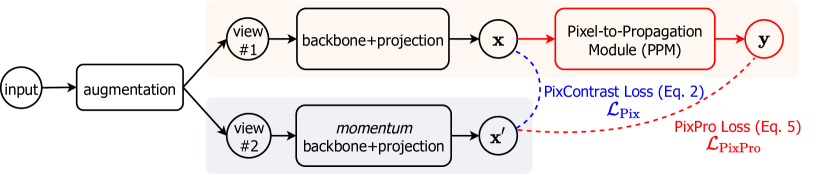
- Propose PixContrast, a pixel-level contrastive learning method where each pixel is treated as a unique class, and positive pairs are formed from features of the same pixel across two random crops.
- Introduce PixPro, a pixel-to-propagation consistency method that uses two asymmetric streams: one with a standard backbone and another with a pixel propagation module that smooths features using similar pixels.
- Design a propagation module that computes feature weights based on similarity between pixels, filtering and smoothing features to create a consistent positive pair with the original feature.
- Train the model using a contrastive loss that encourages feature consistency between the standard and propagated representations, avoiding the need to explicitly model negative pairs.
- Combine the proposed pixel-level pretext task with instance-level contrastive learning (e.g., SimCLR*) to leverage complementary strengths in spatial sensitivity and categorization ability.
- Pre-train both backbone and head networks (e.g., FPN and detection head) using the same pixel-level pretext task, enabling better initialization for downstream dense prediction tasks.
Experimental results
Research questions
- RQ1Can defining pretext tasks at the pixel level lead to better representations for dense prediction tasks such as object detection and semantic segmentation?
- RQ2How does pixel-to-propagation consistency compare to direct pixel-level contrastive learning in terms of downstream performance and representation quality?
- RQ3To what extent can pixel-level pretext tasks improve pre-training of head networks, which are typically not pre-trained in instance-level contrastive learning?
- RQ4Does combining pixel-level and instance-level pretext tasks lead to synergistic improvements in transfer performance?
- RQ5How effective is pixel-level pre-training in semi-supervised learning settings with limited labeled data?
Key findings
- PixPro achieves 60.2 mAP on Pascal VOC object detection (Faster R-CNN R50-C4), outperforming the previous best method by 2.6 AP.
- On COCO object detection, PixPro achieves 41.4 mAP (FPN) and 40.5 mAP (C4), surpassing the previous state-of-the-art by 0.8 and 1.0 mAP, respectively.
- When combined with instance-level contrastive learning (SimCLR*), the method achieves 58.7 mAP on Pascal VOC and 40.9 mAP on COCO, demonstrating complementary gains.
- Pre-training the head network (including FPN and detection head) leads to a 1.2 mAP improvement on FCOS for COCO object detection, showing the benefit of end-to-end pre-training.
- Semi-supervised object detection on COCO with 1% labeled data yields 14.8 mAP using PixPro, a +3.9 mAP gain over prior unsupervised methods.
- Additional pre-training on COCO using the pixel-level task boosts performance by +0.7 mAP (1% data) and +0.2 mAP (10% data), indicating strong benefit in low-data regimes.
Read this paper
Open the full text in the Nubint reader and ask about any passage as you read.
Read this paper on NubintThis review was generated by AI from the original paper. Please check the paper before citing it.