
[Paper Review] Provably Convergent Schrödinger Bridge with Applications to Probabilistic Time Series Imputation
This paper presents the first convergence analysis of the Schrödinger bridge problem (SBP) with approximated projections, introducing the approximate IPF (aIPF) algorithm for probabilistic time series imputation. By minimizing transport cost through SBP, the method achieves state-of-the-art performance on healthcare and environmental datasets while effectively modeling both temporal and feature-wise dependencies in missing data recovery.
The Schrödinger bridge problem (SBP) is gaining increasing attention in generative modeling and showing promising potential even in comparison with the score-based generative models (SGMs). SBP can be interpreted as an entropy-regularized optimal transport problem, which conducts projections onto every other marginal alternatingly. However, in practice, only approximated projections are accessible and their convergence is not well understood. To fill this gap, we present a first convergence analysis of the Schrödinger bridge algorithm based on approximated projections. As for its practical applications, we apply SBP to probabilistic time series imputation by generating missing values conditioned on observed data. We show that optimizing the transport cost improves the performance and the proposed algorithm achieves the state-of-the-art result in healthcare and environmental data while exhibiting the advantage of exploring both temporal and feature patterns in probabilistic time series imputation.
Motivation & Objective
- To address the lack of theoretical convergence guarantees in practical Schrödinger bridge algorithms that rely on approximated projections.
- To improve probabilistic time series imputation by leveraging SBP to model complex temporal and feature dependencies in missing data.
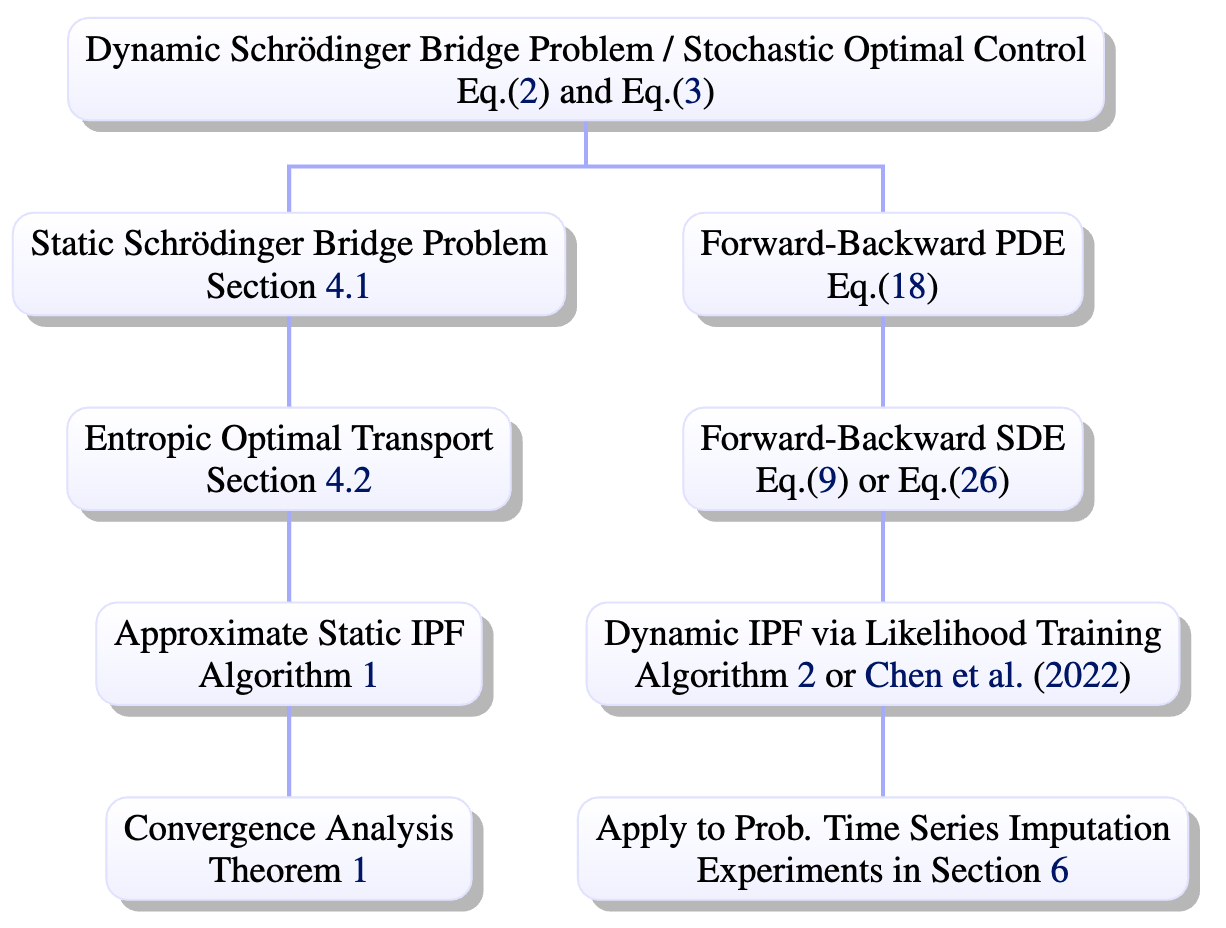
- To establish a theoretical link between approximate IPF and likelihood training of forward-backward SDEs.
- To demonstrate that minimizing transport cost enhances imputation performance, especially in real-world healthcare and environmental datasets.
Proposed method
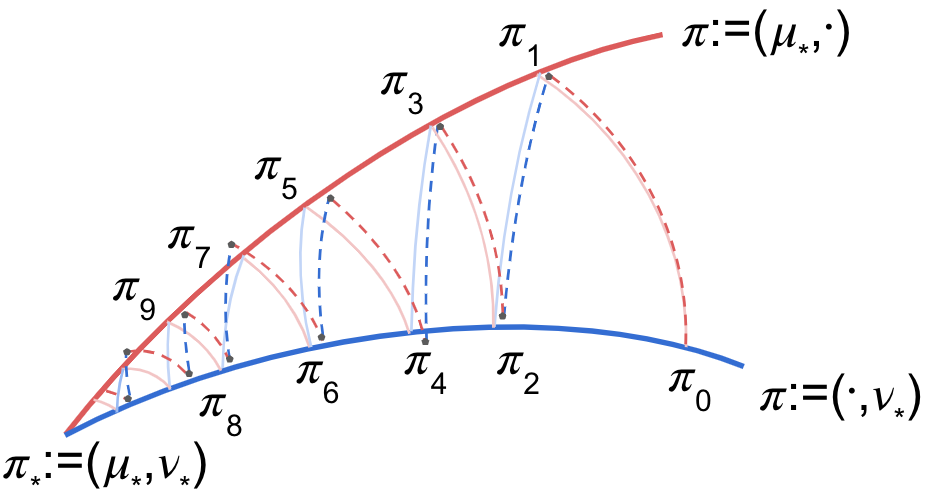
- Proposes the approximate IPF (aIPF) algorithm, an extension of the iterative proportional fitting procedure that allows for approximated projections in the Schrödinger bridge framework.
- Applies the aIPF algorithm to probabilistic time series imputation by conditioning on observed data and generating missing values through backward diffusion from a prior distribution.
- Uses a variational inference setup with forward and backward stochastic differential equations (FB-SDEs) to model the diffusion process, enabling end-to-end training.
- Employs a divergence-based likelihood objective for training the score functions approximated by deep neural networks, improving transport cost minimization.
- Integrates both temporal and feature-level dependencies by modeling multivariate time series as a joint distribution conditioned on observed masks.
- Adapts the model for time series prediction by reusing the same architecture with modified masks to distinguish context and target windows.
Experimental results
Research questions
- RQ1Does the aIPF algorithm with approximated projections converge, and what is the relationship between training error and iteration count?
- RQ2How does minimizing the transport cost in SBP affect the performance of probabilistic time series imputation?
- RQ3Can SBP-based models outperform existing score-based generative models like CSDI in imputation benchmarks?
- RQ4What is the theoretical connection between aIPF and likelihood training of forward-backward SDEs?
- RQ5How well does the model generalize across diverse time series patterns with irregular missingness?
Key findings
- The aIPF algorithm achieves provable convergence with a theoretical bound on training error that decreases with the number of iterations, establishing a foundation for provably convergent SBP methods.
- Optimizing the transport cost in SBP leads to significant performance improvements on synthetic data, demonstrating the effectiveness of cost minimization in generative modeling.
- The proposed method achieves state-of-the-art results on real-world healthcare (PhysioNet) and environmental (PM2.5) datasets, outperforming existing baselines including CSDI and GP-copula models.
- The model generalizes across diverse missing data patterns, including irregular and high-ratio missingness (up to 50%), maintaining reliable uncertainty estimates via 80% confidence intervals.
- The framework is adaptable to time series prediction tasks by reusing the same architecture with different mask configurations, maintaining consistent performance across both imputation and prediction.
- Empirical results show that the model effectively captures both temporal dynamics and cross-feature correlations, leading to more accurate and coherent imputations.
Read this paper
Open the full text in the Nubint reader and ask about any passage as you read.
Read this paper on NubintThis review was generated by AI from the original paper. Please check the paper before citing it.