
[Paper Review] PyFlyt -- UAV Simulation Environments for Reinforcement Learning Research
PyFlyt is a modular, open-source UAV simulation platform built on the Bullet physics engine with native Gymnasium API support, enabling flexible configuration of diverse UAV types and standardized benchmarking of reinforcement learning (RL) algorithms. It demonstrates successful training of RL agents in both dense and sparse reward settings across quadrotor and fixed-wing UAV environments, establishing a reproducible, extensible framework for UAV RL research.
Unmanned aerial vehicles (UAVs) have numerous applications, but their efficient and optimal flight can be a challenge. Reinforcement Learning (RL) has emerged as a promising approach to address this challenge, yet there is no standardized library for testing and benchmarking RL algorithms on UAVs. In this paper, we introduce PyFlyt, a platform built on the Bullet physics engine with native Gymnasium API support. PyFlyt provides modular implementations of simple components, such as motors and lifting surfaces, allowing for the implementation of UAVs of arbitrary configurations. Additionally, PyFlyt includes various task definitions and multiple reward function settings for each vehicle type. We demonstrate the effectiveness of PyFlyt by training various RL agents for two UAV models: quadrotor and fixed-wing. Our findings highlight the effectiveness of RL in UAV control and planning, and further show that it is possible to train agents in sparse reward settings for UAVs. PyFlyt fills a gap in existing literature by providing a flexible and standardised platform for testing RL algorithms on UAVs. We believe that this will inspire more standardised research in this direction.
Motivation & Objective
- To address the lack of standardized, extensible simulation environments for benchmarking reinforcement learning (RL) algorithms on UAVs.
- To provide a flexible, modular framework for designing UAVs of arbitrary configurations using components like motors, lifting surfaces, and gimbals.
- To enable standardized, reproducible RL training through Gymnasium-compatible environments with both dense and sparse reward functions.
- To support diverse UAV types, including quadrotor, fixed-wing, rocket, and future models like quadplane and hexacopter.
- To improve usability and adoption through deterministic simulations, CI testing, PyPI packaging, and comprehensive documentation.
Proposed method
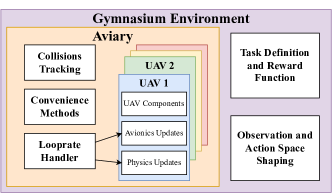
- PyFlyt uses the Bullet physics engine to simulate realistic UAV dynamics, including collisions, control loop rates, and multi-UAV environments.
- It implements modular components (motors, lifting surfaces, gimbals, cameras) that can be combined to construct UAVs of arbitrary configurations.
- The platform provides prebuilt UAV models (e.g., QuadX, Fixedwing, Rocket) with corresponding Gymnasium-compatible environments for RL training.
- Reward functions are defined with multiple components: distance-based penalties, velocity-based rewards near targets, and terminal rewards for success or failure.
- Sparse reward training is enabled via bootstrapping from policies pre-trained with dense rewards using algorithms like CCGE and AWAC.
- The system supports deterministic simulation via random seed initialization and integrates continuous integration (CI) and PyPI packaging for reproducibility and distribution.

Experimental results
Research questions
- RQ1Can a modular, physics-based UAV simulation platform enable standardized benchmarking of RL algorithms across diverse UAV configurations?
- RQ2To what extent can RL agents be successfully trained in sparse reward environments for complex UAV tasks like rocket landing or waypoint navigation?
- RQ3How effective are modern off-policy RL algorithms (e.g., SAC, CCGE, AWAC) in training UAV control policies within a unified, extensible simulation framework?
- RQ4Can the platform support diverse UAV types, including non-standard configurations like rockets and fixed-wing aircraft, with consistent and realistic dynamics?
- RQ5How does the integration of Gymnasium API and CI/PyPI workflows improve reproducibility and adoption in UAV RL research?
Key findings
- PyFlyt successfully trained SAC agents on the PyFlyt/QuadX-Waypoints-v0 and PyFlyt/Fixedwing-Waypoints-v0 environments with dense rewards, demonstrating stable learning curves across multiple random seeds.
- The platform enabled successful training of agents in sparse reward settings using CCGE and AWAC, with policies bootstrapped from pre-trained SAC policies, proving viability in low-supervision scenarios.
- The Rocket-Landing-v0 environment required only 1% of total fuel, making it highly challenging, yet agents achieved safe landings with low velocity and precise touchdown positioning.
- The reward function in the Rocket-Landing-v0 environment combined distance penalties, velocity-based rewards, and terminal success/failure rewards, effectively guiding agents toward safe landings.
- Learning curves for all environments showed consistent interquartile means with bootstrapped confidence intervals, indicating reliable and reproducible training outcomes.
- The platform’s modular design and support for multi-agent RL via PettingZoo are planned, with additional aerodynamic features like Dryden turbulence and downwash modeling in development.
Read this paper
Open the full text in the Nubint reader and ask about any passage as you read.
Read this paper on NubintThis review was generated by AI from the original paper. Please check the paper before citing it.