
[Paper Review] Query-by-example Spoken Term Detection using Attention-based Multi-hop Networks
This paper proposes an end-to-end attention-based multi-hop network for query-by-example spoken term detection (STD), enabling direct acoustic matching without transcription. The model uses attention to localize query terms in audio segments and multiple hops to refine representations, achieving performance comparable to DTW with significantly lower runtime complexity, especially in unsupervised settings where it mimics DTW using no labeled data.
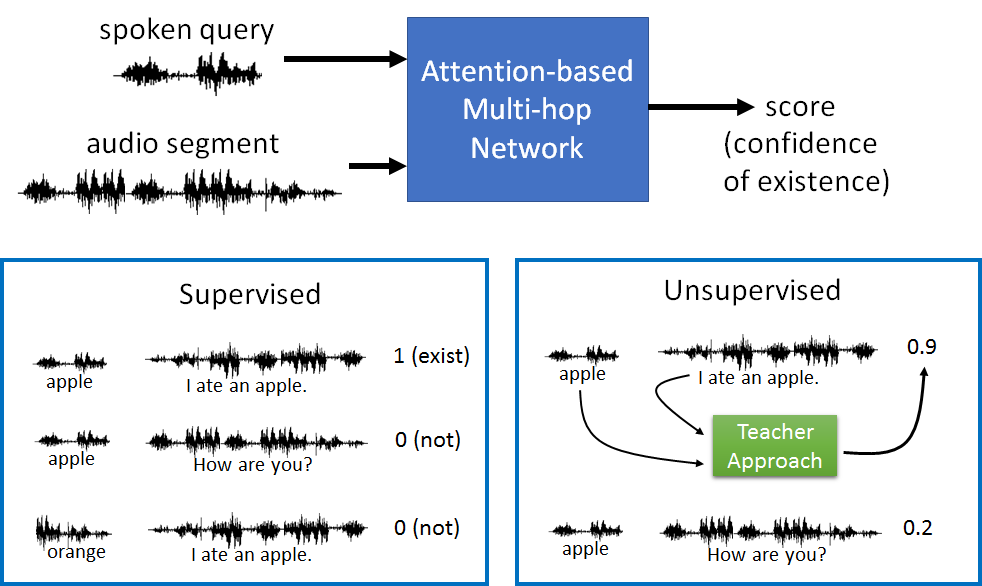
Retrieving spoken content with spoken queries, or query-by- example spoken term detection (STD), is attractive because it makes possible the matching of signals directly on the acoustic level without transcribing them into text. Here, we propose an end-to-end query-by-example STD model based on an attention-based multi-hop network, whose input is a spoken query and an audio segment containing several utterances; the output states whether the audio segment includes the query. The model can be trained in either a supervised scenario using labeled data, or in an unsupervised fashion. In the supervised scenario, we find that the attention mechanism and multiple hops improve performance, and that the attention weights indicate the time span of the detected terms. In the unsupervised setting, the model mimics the behavior of the existing query-by-example STD system, yielding performance comparable to the existing system but with a lower search time complexity.
Motivation & Objective
- Develop an end-to-end deep learning model for query-by-example spoken term detection (STD) that operates directly on acoustic signals without transcription.
- Address the limitations of dynamic time warping (DTW), such as high computational complexity and lack of trainable parameters, by replacing it with a learnable neural network.
- Enable both supervised and unsupervised training scenarios, allowing model improvement through user feedback or distillation from DTW in the absence of labels.
- Use attention mechanisms to localize the time span of the query term within longer audio segments, eliminating the need for pre-segmented word boundaries.
- Improve generalization and performance through multi-hop reasoning, where the query representation is iteratively updated using information from the audio segment.
Proposed method
- Represent the spoken query and audio segment using MFCC acoustic features as input to the model.
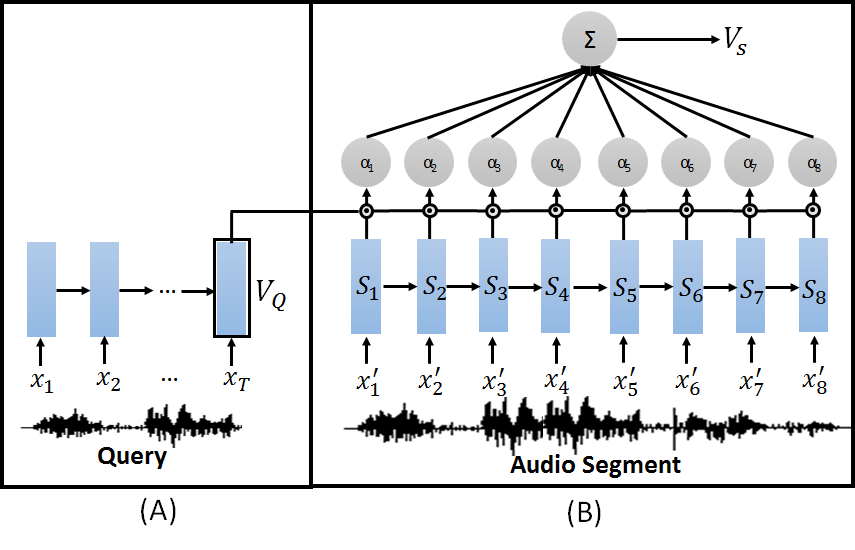
- Use a unidirectional LSTM encoder to embed the spoken query into a fixed-dimensional vector.
- Apply an attention mechanism that computes alignment scores between the query vector and each time step of the audio segment, producing attention weights that highlight relevant regions.
- Implement a multi-hop mechanism where the query representation is updated iteratively using context-aware information from the audio segment, improving representation quality over multiple hops.
- Use a key term detector (a feedforward network) to produce a confidence score indicating whether the query term exists in the audio segment.
- Train the model in a supervised setting using binary cross-entropy loss on labeled data, and in an unsupervised setting by distilling similarity scores from DTW as regression targets.
Experimental results
Research questions
- RQ1Can an end-to-end attention-based multi-hop network outperform traditional DTW in query-by-example spoken term detection while reducing computational complexity?
- RQ2To what extent do attention mechanisms improve localization accuracy and performance in STD, and can they reveal the time span of detected terms?
- RQ3Does multi-hop reasoning enhance model generalization, especially when training and testing data are mismatched?
- RQ4Can a neural network trained in an unsupervised manner using DTW as a teacher achieve performance comparable to DTW with lower inference time?
- RQ5How complementary are DTW and the proposed attention-based model in ensemble settings?
Key findings
- The proposed attention-based multi-hop network achieves a mean average precision (MAP) of 0.6676 on test set 1 in the supervised setting, outperforming single-hop and baseline DTW methods.
- Attention weights localize the end of the query term with high precision: 25% of predictions have an error of less than one second, and most attention peaks fall within 0.1–0.5 seconds of the true end time.
- Multi-hop networks improve generalization, with 3-hop models achieving the best performance on test sets 2 and 3, showing a MAP of 0.6404 and 0.5837 respectively.
- In the unsupervised setting, the 3-hop attention model outperforms DTW on test sets 2 and 3 (MAP: 0.5964 and 0.5702 vs. 0.5778 and 0.5678), demonstrating superior generalization without labeled data.
- The model is 7 times faster than DTW during inference, with time complexity O(M×n) vs. O(M×N), where n is the number of hops and N is the query length, making it suitable for real-time applications.
- Ensembling the DTW output with the 3-hop attention model yields further improvement, achieving a MAP of 0.6789 on test set 1, confirming the complementary nature of the two approaches.
Read this paper
Open the full text in the Nubint reader and ask about any passage as you read.
Read this paper on NubintThis review was generated by AI from the original paper. Please check the paper before citing it.