
[Paper Review] Quest for CMB spectral distortions to probe the scalar-induced gravitational wave background interpretation of pulsar timing array data
The paper studies how CMB spectral distortions (SDs) and anisotropies can constrain scalar-induced gravitational wave backgrounds suggested by recent PTA data, using a Bayesian analysis with a lognormal PPS peak and PIXIE-like forecasts.
Gravitational Waves (GW) sourced by second-order primordial curvature fluctuations are among the favored models fitting the recent pulsar timing array (PTA) measurement of a stochastic GW background (SGWB). We study how spectral distortions (SDs) and anisotropies of the cosmic microwave background (CMB) can constrain such scalar fluctuations. Whereas COBE FIRAS data have no sufficient sensitivity to probe the PTA log-normal hypothesis, we show how future PIXIE-like experiments can detect the CMB SDs from the scalar-induced interpretation of the SGWB in PTA data. We finally show how the transformative synergy between PTA data and future CMB SD measurements is important for reconstructing primordial fluctuations at these small scales.
Motivation & Objective
- Assess whether SDs and anisotropies can constrain scalar-induced SGWB explanations of PTA data.
- Use a lognormal peak in the primordial power spectrum to model small-scale fluctuations.
- Forecast SD signals (μ and y) for FIRAS and PIXIE sensitivities.
- Explore the synergy between PTA results and CMB SD measurements in constraining PPS at small scales.
Proposed method
- Adopt a lognormal peak parameterization for the primordial power spectrum: P_LN(k) = (A_ζ)/(√(2π)Δ) exp[ - (ln(k/k_*)^2)/(2Δ^2) ].
- Compute CMB μ- and y-type spectral distortions using the Green’s function method for thermalization, via the CLASS extension with PCA-based visibility functions.
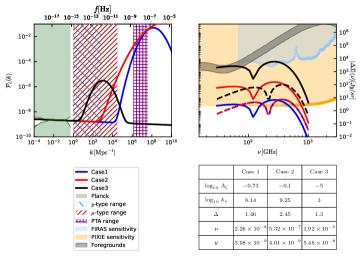
- Forecast SD signals for three fiducial cases drawn from PTA analyses (Case 1: PTA-like ML sample; Case 2: within 68% CL; Case 3: peak within FIRAS/PIXIE windows).
- Marginalize over foregrounds and reionization effects to obtain posterior constraints on LN parameters.
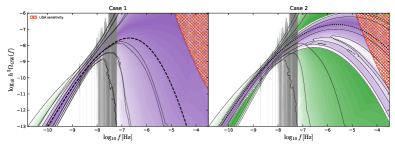
- Compare constraints to FIRAS and Planck data, and present predictive PPS distributions.
Experimental results
Research questions
- RQ1Can future CMB spectral distortions detect or constrain a peak in the PPS invoked to explain the PTA SGWB signal?
- RQ2How do foregrounds and reionization affect the SD-based constraints on the small-scale PPS?
- RQ3To what extent do PIXIE-like observations improve constraints when combined with Planck and PTA priors?
- RQ4How does the LN peak in P(k) map to observable μ and y distortions across the relevant k-range?
- RQ5What is the synergy between PTA data and CMB SD measurements in reconstructing primordial fluctuations at small scales?
Key findings
- FIRAS data provide limited constraints on the LN PPS peak.
- PIXIE-like forecasts improve constraints and can detect large SD signals when Case 3 is realized.
- Foregrounds degrade the nominal SD sensitivity and can hinder detection even if μ is large.
- Case 2 shows that PIXIE+Planck+NG15 can recover and constrain LN parameters, though not always detecting a clear PPS bump.
- Case 3 yields strong detections: μ ≈ (1.92 ± 0.02)×10^-5 and y ≈ (4.9^{+1.7}_{-3.1})×10^-8 at 68% CL, significantly excluding a near-scale-invariant PPS in the tested range (k ∈ [10^2, 10^4] Mpc^-1).
- Synergy between SDs and PTA can robustly probe deviations from a simple power-law PPS not accessible to either probe alone.
Read this paper
Open the full text in the Nubint reader and ask about any passage as you read.
Read this paper on NubintThis review was generated by AI from the original paper. Please check the paper before citing it.