
[Paper Review] Read and Reap the Rewards: Learning to Play Atari with the Help of Instruction Manuals
This paper proposes Read and Reward, a framework that enhances sample-efficient reinforcement learning on Atari games by leveraging human-written instruction manuals. It uses zero-shot question-answering to extract key gameplay rules and reasoning with large language models to generate auxiliary rewards, achieving up to 112× faster training and 60% performance gain on Skiing with 1,000× fewer frames than SOTA.
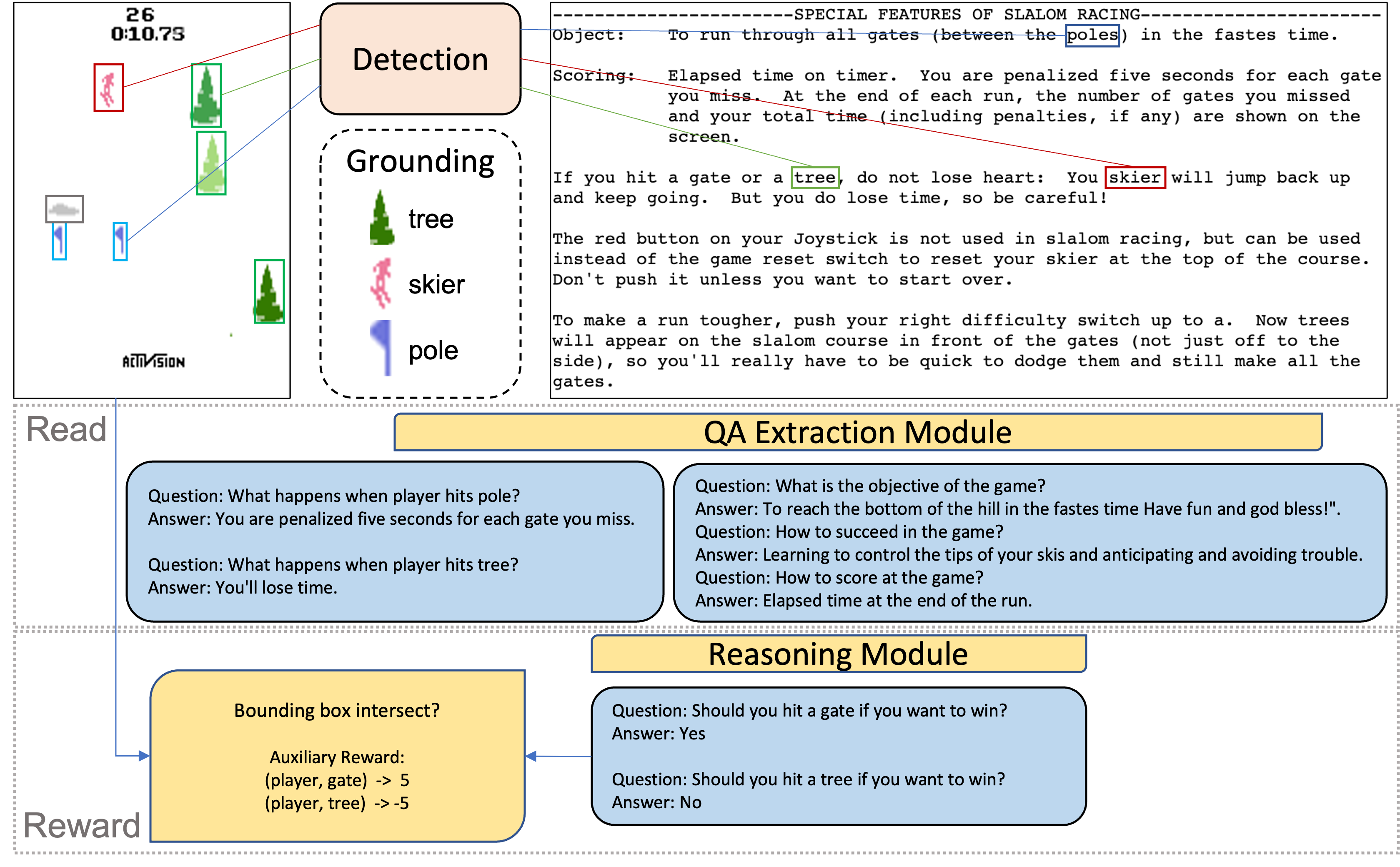
High sample complexity has long been a challenge for RL. On the other hand, humans learn to perform tasks not only from interaction or demonstrations, but also by reading unstructured text documents, e.g., instruction manuals. Instruction manuals and wiki pages are among the most abundant data that could inform agents of valuable features and policies or task-specific environmental dynamics and reward structures. Therefore, we hypothesize that the ability to utilize human-written instruction manuals to assist learning policies for specific tasks should lead to a more efficient and better-performing agent. We propose the Read and Reward framework. Read and Reward speeds up RL algorithms on Atari games by reading manuals released by the Atari game developers. Our framework consists of a QA Extraction module that extracts and summarizes relevant information from the manual and a Reasoning module that evaluates object-agent interactions based on information from the manual. An auxiliary reward is then provided to a standard A2C RL agent, when interaction is detected. Experimentally, various RL algorithms obtain significant improvement in performance and training speed when assisted by our design.
Motivation & Objective
- To address the high sample complexity of reinforcement learning in Atari games by incorporating human-readable instruction manuals as external knowledge.
- To improve learning efficiency and performance of standard RL agents without requiring task-specific reward shaping or synthetic data.
- To develop a generalizable, end-to-end framework that reads real-world manuals designed for humans and translates them into actionable rewards for RL agents.
- To demonstrate that unstructured natural language documents can significantly accelerate RL training while maintaining robustness across different manual sources.
Proposed method
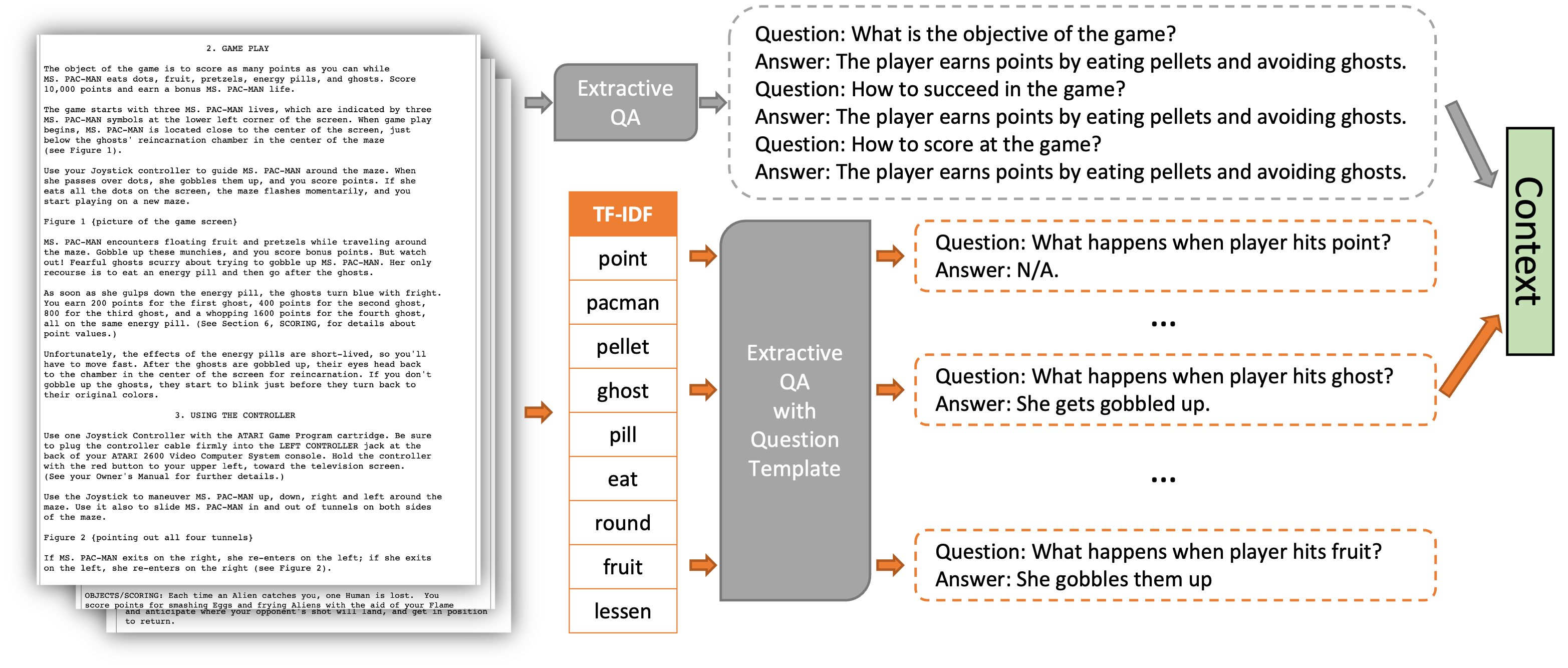
- A zero-shot extractive QA module extracts and summarizes relevant information from game manuals, focusing on objectives, rules, and interactions.
- A reasoning module powered by a large language model evaluates detected in-game object interactions using extracted manual content.
- Object detection and localization are used to identify proximity-based interactions (e.g., hitting obstacles), which are then mapped to auxiliary rewards.
- The auxiliary reward is computed as +5 or -5 based on whether the interaction aligns with manual-specified rules (e.g., 'avoid obstacles' or 'collect pellets').
- The framework is integrated with standard A2C and Agent57 RL agents, enabling plug-and-play improvement without retraining.
- The system generalizes across different manual sources, including official developer manuals and Wikipedia gameplay sections, with consistent performance.
Experimental results
Research questions
- RQ1Can RL agents benefit from reading human-written instruction manuals to improve sample efficiency in Atari games?
- RQ2How effective is zero-shot QA and reasoning over natural language manuals in extracting actionable game rules for RL?
- RQ3Does the framework generalize across different sources of manuals, such as official developer guides and Wikipedia articles?
- RQ4To what extent can auxiliary rewards derived from unstructured text accelerate learning compared to standard RL baselines?
- RQ5Can the framework improve performance without requiring explicit training on synthetic or curated text data?
Key findings
- On the Skiing game, Read and Reward achieved a 60% performance improvement over the baseline using 1,000× fewer training frames.
- Agent57 with Read and Reward required up to 112× fewer training steps to reach the same performance as the baseline when using delayed rewards.
- The framework achieved consistent performance improvements across both official game manuals and Wikipedia gameplay sections, demonstrating robust generalization.
- Even when key objects like 'energy pills' were not explicitly grounded, the framework still improved performance, indicating resilience to incomplete detection.
- Without delayed rewards, Read and Reward still improved training speed by up to 112×, though game score gains were not observed, confirming the role of reward shaping.
- The QA extraction module successfully retrieved all critical gameplay information—such as avoiding ghosts and collecting pellets—across multiple games.
Read this paper
Open the full text in the Nubint reader and ask about any passage as you read.
Read this paper on NubintThis review was generated by AI from the original paper. Please check the paper before citing it.