
[Paper Review] Recommender Systems: A Primer
This paper provides a comprehensive primer on recommender systems, covering foundational concepts, classical algorithms like collaborative filtering and learning-to-rank, and modern challenges such as bias, fairness, and offline-online evaluation misalignment. It synthesizes current research trends and identifies key future directions, including conversational recommender systems and responsible AI.
Personalized recommendations have become a common feature of modern online services, including most major e-commerce sites, media platforms and social networks. Today, due to their high practical relevance, research in the area of recommender systems is flourishing more than ever. However, with the new application scenarios of recommender systems that we observe today, constantly new challenges arise as well, both in terms of algorithmic requirements and with respect to the evaluation of such systems. In this paper, we first provide an overview of the traditional formulation of the recommendation problem. We then review the classical algorithmic paradigms for item retrieval and ranking and elaborate how such systems can be evaluated. Afterwards, we discuss a number of recent developments in recommender systems research, including research on session-based recommendation, biases in recommender systems, and questions regarding the impact and value of recommender systems in practice.
Motivation & Objective
- To provide a structured overview of recommender systems as a core component of modern AI-driven online services.
- To clarify the distinction between information retrieval and recommendation, emphasizing the role of implicit queries and user profiles.
- To examine classical algorithmic paradigms, including collaborative filtering, content-based filtering, and learning-to-rank, and their evolution.
- To address emerging challenges such as bias, fairness, and the misalignment between offline evaluation and online A/B testing results.
- To identify and discuss future research directions, including conversational recommender systems and responsible AI in recommendation
Proposed method
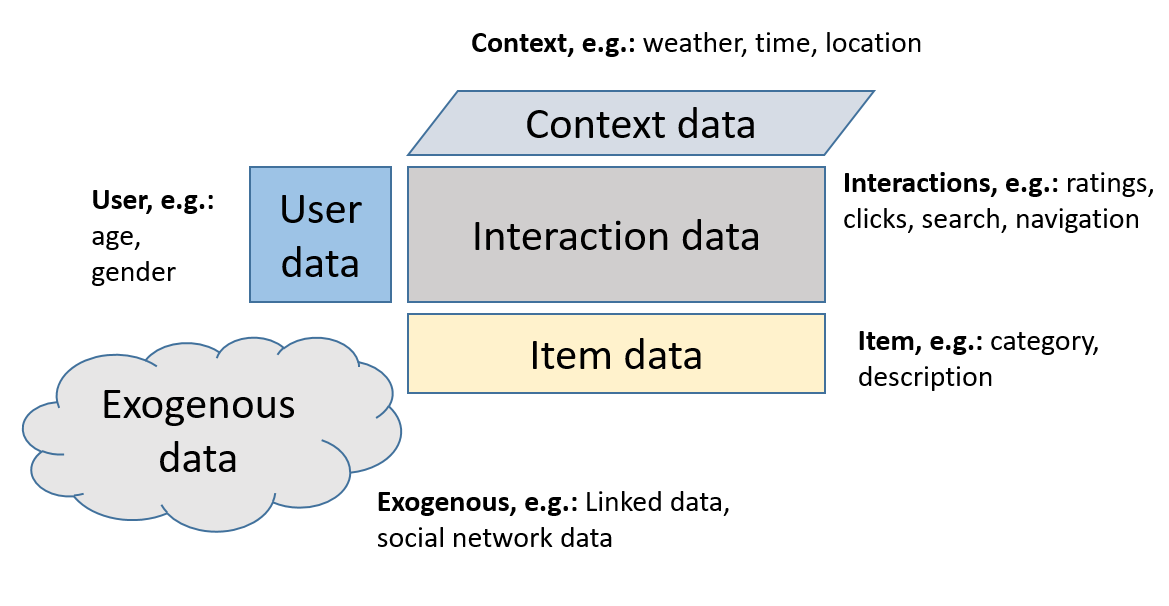
- Categorizes recommendation algorithms based on input data types, including collaborative filtering, content-based, and hybrid approaches.
- Reviews the use of matrix factorization and deep learning techniques for modeling user-item interactions.
- Outlines offline and online evaluation methodologies, including metrics like precision, recall, and NDCG.
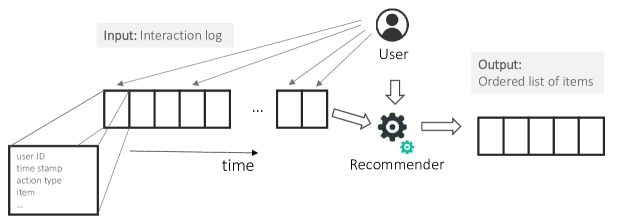
- Analyzes sequential and session-based recommendation using recurrent and transformer-based models to model user behavior over time.
- Examines fairness and bias in recommender systems through the lens of feedback loops, popularity bias, and algorithmic discrimination.
- Proposes a framework for evaluating recommender systems beyond accuracy, incorporating human-in-the-loop studies and business/consumer value assessment.
Experimental results
Research questions
- RQ1How do traditional recommender system algorithms such as collaborative filtering and learning-to-rank differ in their design and performance?
- RQ2To what extent do offline evaluation metrics align with real-world online A/B testing outcomes in industrial recommender systems?
- RQ3What are the root causes and consequences of popularity bias and feedback loops in recommendation systems?
- RQ4How can conversational recommender systems improve user interaction through natural language understanding and dialogue management?
- RQ5What are the key challenges and open problems in ensuring fairness and ethical behavior in AI-driven recommendation systems?
Key findings
- Offline evaluation metrics often show weak alignment with online A/B testing results due to metric mismatches, data bias, and pipeline complexity.
- Popularity bias and feedback loops significantly influence recommendation outcomes, often reinforcing existing inequalities in content visibility.
- Fairness in recommender systems remains a complex, multi-faceted challenge requiring both technical solutions and deeper understanding of bias mechanisms.
- Conversational recommender systems are emerging as a promising direction, enabled by advances in NLP and end-to-end learning, though hybrid architectures combining knowledge and learning are likely to dominate.
- The integration of human-in-the-loop evaluation and business value assessment reveals that recommender systems generate measurable benefits for both consumers and providers.
- Despite progress, no universal fairness metric exists, and bias awareness remains a critical first step toward mitigating unfair treatment in recommendation systems.
Read this paper
Open the full text in the Nubint reader and ask about any passage as you read.
Read this paper on NubintThis review was generated by AI from the original paper. Please check the paper before citing it.