
[Paper Review] Reconciling Methodological Paradigms: Employing Large Language Models as Novice Qualitative Research Assistants in Talent Management Research
The paper shows how Retrieval Augmented Generation (RAG) with large language models can act as novice qualitative research assistants to perform topic modeling on semi-structured interview data in talent management, outperforming other prompting methods, and offering guidelines to maintain rigor from traditional qualitative research.
Qualitative data collection and analysis approaches, such as those employing interviews and focus groups, provide rich insights into customer attitudes, sentiment, and behavior. However, manually analyzing qualitative data requires extensive time and effort to identify relevant topics and thematic insights. This study proposes a novel approach to address this challenge by leveraging Retrieval Augmented Generation (RAG) based Large Language Models (LLMs) for analyzing interview transcripts. The novelty of this work lies in strategizing the research inquiry as one that is augmented by an LLM that serves as a novice research assistant. This research explores the mental model of LLMs to serve as novice qualitative research assistants for researchers in the talent management space. A RAG-based LLM approach is extended to enable topic modeling of semi-structured interview data, showcasing the versatility of these models beyond their traditional use in information retrieval and search. Our findings demonstrate that the LLM-augmented RAG approach can successfully extract topics of interest, with significant coverage compared to manually generated topics from the same dataset. This establishes the viability of employing LLMs as novice qualitative research assistants. Additionally, the study recommends that researchers leveraging such models lean heavily on quality criteria used in traditional qualitative research to ensure rigor and trustworthiness of their approach. Finally, the paper presents key recommendations for industry practitioners seeking to reconcile the use of LLMs with established qualitative research paradigms, providing a roadmap for the effective integration of these powerful, albeit novice, AI tools in the analysis of qualitative datasets within talent
Motivation & Objective
- Motivate integrating qualitative insights with scalable AI tools in talent management research.
- Demonstrate a practical RAG-based LLM workflow to analyze semi-structured interview transcripts.
- Benchmark LLM-based topic modeling against manual qualitative coding using standard metrics.
- Highlight methodological considerations to maintain rigor, trustworthiness, and transparency in AI-assisted qualitative analysis.
- Offer actionable recommendations for practitioners reconciling AI tools with qualitative paradigms.
Proposed method
- Use LangChain to craft dynamic prompts (few-shot, chain-of-thought) guiding an LLM (Anthropic Claude2) to perform topic modeling on transcripts.
- Promote four prompting strategies: zero-shot, few-shot, chain-of-thought, and retrieval-augmented generation (RAG).
- Treat the LLM as a novice researcher to ground prompts in expert guidance and iterative topic extraction.
- Provide the interview transcripts as a custom knowledge base for RAG to prevent information overload and reduce hallucinations.
- Evaluate generated topics against a manually coded gold standard using precision, recall, and F1 with cosine-based word-level matching.
- Compare embedding models (DistilBert, BERT, Roberta) across prompting strategies to assess robustness.
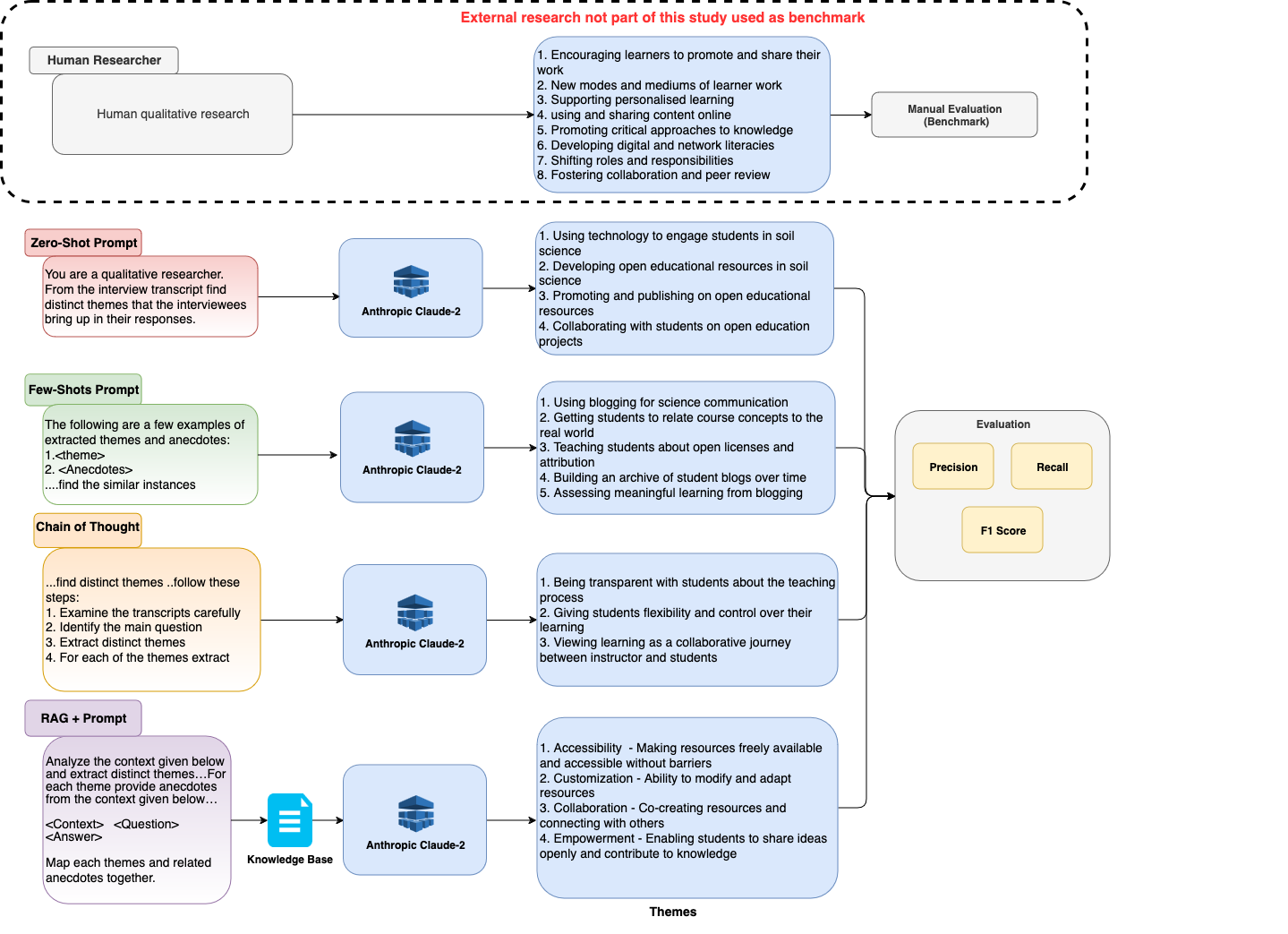
Experimental results
Research questions
- RQ1Can an LLM augmented with RAG reliably extract topics from semi-structured interview data in talent management?
- RQ2How do different prompting strategies (zero-shot, few-shot, chain-of-thought, RAG) compare in terms of precision, recall, and F1 for topic identification?
- RQ3Does treating the LLM as a novice researcher improve prompt design and topic interpretability?
- RQ4What best practices ensure rigor and trustworthiness when integrating LLMs with traditional qualitative analysis?
Key findings
- RAG consistently outperforms zero-shot, few-shot, and chain-of-thought prompting across embedding models in precision, recall, and F1.
- Roberta-large with RAG achieves the highest metrics: Precision 92%, Recall 91%, F1 91%.
- Across models, RAG yields stronger topic identification and richer contextualized themes compared to LDA-based approaches.
- Treating the LLM as a novice researcher helps in crafting prompts that better guide topic extraction and interpretation.
- Using a focused retrieval strategy mitigates information overload and hallucinations, improving alignment with the gold-standard topics.

Read this paper
Open the full text in the Nubint reader and ask about any passage as you read.
Read this paper on NubintThis review was generated by AI from the original paper. Please check the paper before citing it.