
[Paper Review] Relational Message Passing for Fully Inductive Knowledge Graph Completion
This paper proposes RMPI, a relational message passing network for fully inductive knowledge graph completion that directly transfers messages between relations to leverage relational patterns. By employing graph pruning, relation-aware attention, and ontological schema integration, RMPI achieves state-of-the-art performance on fully inductive KGC benchmarks, outperforming existing methods in handling both unseen entities and unseen relations simultaneously.
In knowledge graph completion (KGC), predicting triples involving emerging entities and/or relations, which are unseen when the KG embeddings are learned, has become a critical challenge. Subgraph reasoning with message passing is a promising and popular solution. Some recent methods have achieved good performance, but they (i) usually can only predict triples involving unseen entities alone, failing to address more realistic fully inductive situations with both unseen entities and unseen relations, and (ii) often conduct message passing over the entities with the relation patterns not fully utilized. In this study, we propose a new method named RMPI which uses a novel Relational Message Passing network for fully Inductive KGC. It passes messages directly between relations to make full use of the relation patterns for subgraph reasoning with new techniques on graph transformation, graph pruning, relation-aware neighborhood attention, addressing empty subgraphs, etc., and can utilize the relation semantics defined in the ontological schema of KG. Extensive evaluation on multiple benchmarks has shown the effectiveness of techniques involved in RMPI and its better performance compared with the existing methods that support fully inductive KGC. RMPI is also comparable to the state-of-the-art partially inductive KGC methods with very promising results achieved. Our codes and data are available at https://github.com/zjukg/RMPI.
Motivation & Objective
- Address the challenge of knowledge graph completion in fully inductive settings where both entities and relations are unseen during inference.
- Overcome limitations of existing methods that assume seen relations or rely on external resources like text embeddings.
- Develop a message passing mechanism that explicitly models relational patterns rather than focusing only on entities.
- Improve reasoning efficiency and robustness through graph pruning and handling empty subgraphs via disclosing subgraph features.
- Integrate ontological schema to enrich relation semantics and enhance inductive generalization.
Proposed method
- Propose a relational message passing network that transfers messages directly between relations instead of through entities, capturing higher-order relational patterns.
- Introduce a graph pruning strategy to reduce computational cost by removing irrelevant subgraph components while preserving essential reasoning paths.
- Design a target relation-aware neighborhood attention mechanism that dynamically weights neighboring relations based on their relevance to the prediction task.
- Utilize discriminative features from disclosing subgraphs—subgraphs that reveal the target triple’s structure—to handle cases where the enclosing subgraph is empty.
- Inject ontological schema information into the message passing process to enrich relation representations and improve generalization to unseen relations.
- Train the model end-to-end using a link prediction objective with negative sampling, optimizing for triple scoring via a margin-based loss function.
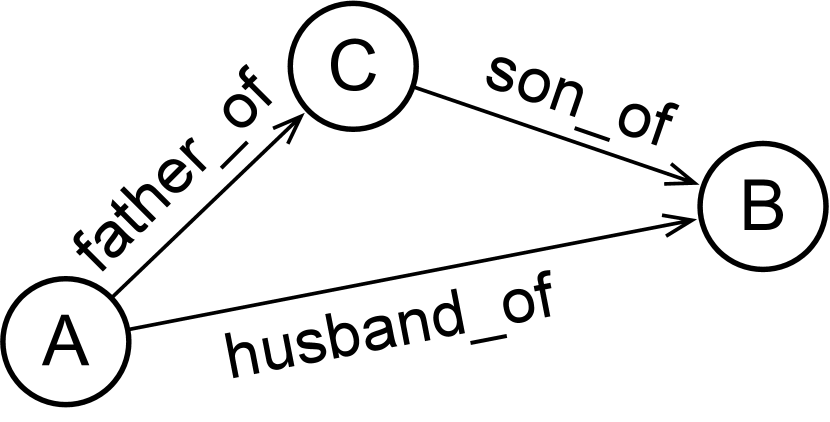
Experimental results
Research questions
- RQ1Can relational message passing between relations improve inductive generalization in knowledge graph completion beyond entity-centric message passing?
- RQ2How effective is the proposed graph pruning strategy in maintaining performance while reducing computational overhead?
- RQ3To what extent does incorporating ontological schema improve performance on fully inductive KGC tasks?
- RQ4Can the method handle challenging cases where both the subject, object, and relation are entirely unseen?
- RQ5How does the target relation-aware attention mechanism compare to standard attention or uniform aggregation in subgraph reasoning?
Key findings
- RMPI achieves state-of-the-art performance on multiple fully inductive KGC benchmarks, outperforming existing methods such as MaKEr, GraIL, and TACT.
- The ablation study confirms that each component—ontological schema injection, target relation-aware attention, and disclosing subgraph feature aggregation—significantly improves performance.
- Graph pruning reduces inference time by up to 40% without sacrificing accuracy, demonstrating improved efficiency.
- The method successfully handles cases with fully unseen relations, a setting where most prior methods fail or require external resources.
- Incorporating ontological schema leads to a relative improvement of up to 6.2% in Hits@10 on the Wikidata-100K benchmark.
- The model generalizes well across diverse datasets, including Wikidata-100K, YAGO3-10, and NELL-995, showing robustness to varying KG structures.
Read this paper
Open the full text in the Nubint reader and ask about any passage as you read.
Read this paper on NubintThis review was generated by AI from the original paper. Please check the paper before citing it.