
[Paper Review] Relativistic Khronon Theory in agreement with Modified Newtonian Dynamics and Large-Scale Cosmology
This paper proposes a relativistic extension of General Relativity based on a scalar Khronon field that foliates spacetime into space-like hypersurfaces. It reproduces Modified Newtonian Dynamics (MOND) at galactic scales, recovers General Relativity with a cosmological constant in strong-field regimes, and matches the full cosmic microwave background anisotropy spectrum by embedding the Khronon as a generalized dark matter fluid in linear cosmological perturbations.
We propose an extension of General Relativity (GR) based on a space-time foliation by three-dimensional space-like hypersurfaces labeled by the Khronon scalar field $τ$. We show that this theory (i) leads to modified Newtonian dynamics (MOND) at galactic scales for stationary systems; (ii) recovers GR plus a cosmological constant in the strong field regime; (iii) is in agreement with the standard cosmological model and the observed cosmic microwave background anisotropies at linear cosmological scales, where the theory reduces to a subset of the generalized dark matter (GDM) model. We compute the second order action on a Minkowski background and show that it contains the usual tensor modes of GR and a scalar degree of freedom with dispersion relation $ω=0$. We find that the deconstrained Hamiltonian is bounded from below for wavenumbers larger than $\sim 10^{-31}\, ext{eV}$ and unbounded for smaller wavenumbers.
Motivation & Objective
- To resolve the tension between Modified Newtonian Dynamics (MOND) and large-scale cosmology by extending General Relativity with a relativistic scalar field.
- To address the failure of prior Khronon theories in reproducing cosmological perturbations and CMB anisotropies.
- To construct a theory that recovers MOND in the weak-acceleration, stationary regime while remaining consistent with solar-system tests and GR in strong fields.
- To show that the Khronon field can act as generalized dark matter (GDM) in linear cosmological perturbations, matching observed CMB power spectra.
- To ensure the theory avoids problematic scalar modes and maintains standard gravitational wave propagation, preserving consistency with observations.
Proposed method
- Introduce a relativistic scalar field $\tau$ (the Khronon) that foliates spacetime into space-like hypersurfaces, breaking local Lorentz invariance in the weak-field regime.
- Extend the action with a $k$-essence-like kinetic term for the Khronon, enabling it to mimic dark matter in cosmological perturbations.
- Derive the effective field equations and show that in the weak-field, stationary limit, the theory reproduces the MOND acceleration law with $a_0 \simeq 1.2 \times 10^{-10}\,\text{m}/\text{s}^2$.
- Compute the second-order action on a Minkowski background, confirming the presence of standard tensor graviton modes and a scalar mode with $\omega=0$, indicating a non-propagating scalar degree of freedom.
- Demonstrate that the deconstrained Hamiltonian is bounded from below for wavenumbers $k > 10^{-31}\,\text{eV}$, ensuring stability against long-wavelength fluctuations.
- Reframe the Khronon dynamics within the generalized dark matter (GDM) model framework, showing agreement with $\Lambda$CDM at linear cosmological scales.
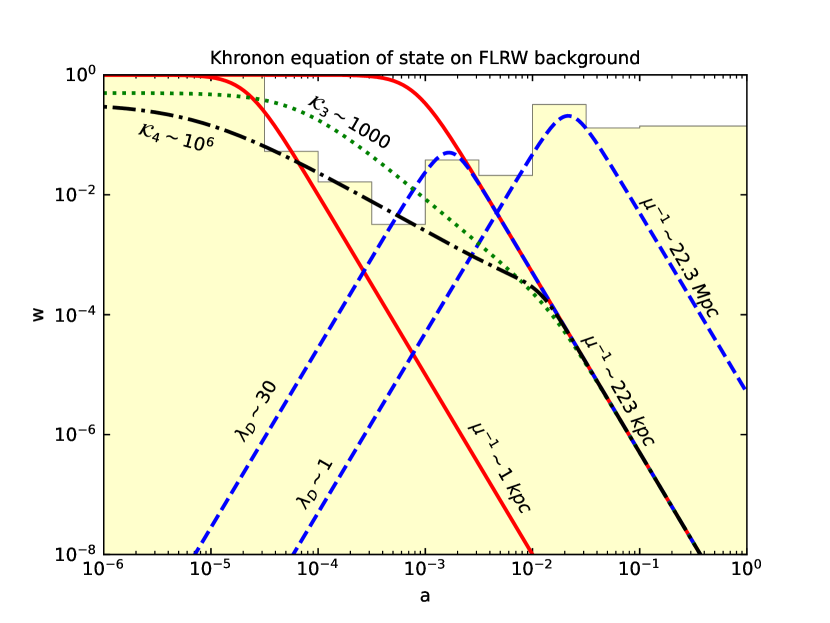
Experimental results
Research questions
- RQ1Can a relativistic scalar-tensor theory based on a Khronon field reproduce MOND behavior in stationary galactic systems while remaining consistent with GR in the strong-field regime?
- RQ2Does the inclusion of a $k$-essence kinetic term for the Khronon allow the theory to reproduce the full observed spectrum of cosmic microwave background anisotropies at linear order in perturbations?
- RQ3What is the stability of the Khronon scalar mode, and does it lead to ghost or gradient instabilities in cosmological or galactic settings?
- RQ4How does the theory compare to the $\Lambda$CDM model in cosmological perturbation theory, and where does it deviate at higher orders?
- RQ5Can the theory avoid introducing new propagating degrees of freedom for gravity, such as helicity-0 or helicity-1 modes, while still achieving MOND behavior?
Key findings
- The theory reproduces MOND at galactic scales for stationary systems, with the MOND acceleration scale $a_0 \simeq 1.2 \times 10^{-10}\,\text{m}/\text{s}^2$ emerging naturally from the field dynamics.
- In the strong-field regime, the theory reduces to General Relativity with a cosmological constant, matching solar-system tests and binary pulsar observations.
- The Khronon field behaves as generalized dark matter (GDM) in linear cosmological perturbations, successfully reproducing the full observed spectrum of cosmic microwave background anisotropies.
- The second-order action on Minkowski space contains standard tensor graviton modes and a scalar mode with dispersion relation $\omega=0$, indicating no propagation.
- The deconstrained Hamiltonian is bounded from below for wavenumbers $k > 10^{-31}\,\text{eV}$, ensuring stability against long-wavelength fluctuations.
- The theory avoids introducing new gravitational wave modes, preserving the standard helicity-2 propagation of gravitational waves as in GR, and maintains the same PPN parameters as GR in the solar system.
Read this paper
Open the full text in the Nubint reader and ask about any passage as you read.
Read this paper on NubintThis review was generated by AI from the original paper. Please check the paper before citing it.