
[Paper Review] Revealing Phase Transition in Dense Matter with Gravitational Wave Spectroscopy of Binary Neutron Star Mergers
This paper demonstrates that high-density deconfinement phase transitions in binary neutron star mergers can be probed via multimodal gravitational wave (GW) spectroscopy, specifically through the suppression of the one-armed spiral instability, which anti-correlates with the energy density gap of the phase transition. A single measurement of the signal-to-noise ratios of the $l=2,m=1$ and $l=2,m=2$ GW modes can constrain the phase transition's strength.
We use numerical relativity simulations of binary neutron star mergers to show that high density deconfinement phase transitions (PTs) to quark matter can be probed using multimodal postmerger gravitational wave (GW) spectroscopy. Hadron-quark PTs suppress the one-armed spiral instability in the remnant. This is manifested in an anti-correlation between the energy carried in the $l=2, m=1$ GW mode and energy density gap which separates the two phases. Consequently, a single measurement of the signal-to-noise ratios of the $l=2, m=1$ and $l=2, m=2$ GW modes could constrain the energy density gap of the PT.
Motivation & Objective
- To investigate whether high-density deconfinement phase transitions in neutron star mergers can be detected through gravitational wave (GW) emission patterns.
- To determine if the one-armed spiral instability—linked to non-axisymmetric dynamics—can serve as a probe for phase transitions in post-merger remnant matter.
- To establish a quantitative link between the energy carried in the $l=2,m=1$ GW mode and the energy density gap $\Delta e$ separating hadronic and quark phases.
- To assess the detectability of such phase transitions with next-generation GW detectors like Cosmic Explorer and Einstein Telescope.
Proposed method
- Performed 8 high-resolution numerical relativity simulations of binary neutron star mergers using the WhiskyTHC code with adaptive mesh refinement and the CTGamma spacetime solver.
- Used initial data from the conformal thin sandwich formalism for quasi-circular orbits and superposition of boosted stars for parabolic, eccentric encounters.
- Employed equation of state models with varying energy density gaps $\Delta e$ to simulate hadron-quark phase transitions, comparing results to purely hadronic cases.
- Analyzed post-merger gravitational wave spectra, focusing on the $l=2,m=1$ and $l=2,m=2$ modes to extract signal-to-noise ratios (SNR) under realistic detector configurations.
- Simulated detector response using the $40\text{ km}$ Cosmic Explorer configuration to estimate detectability and sensitivity in the 1–4 kHz band.
- Quantified the anti-correlation between $l=2,m=1$ GW energy and $\Delta e$ to infer phase transition strength from GW observations.
Experimental results
Research questions
- RQ1Can the presence and strength of a high-density deconfinement phase transition be detected through multimodal gravitational wave spectroscopy of post-merger signals?
- RQ2How does a phase transition affect the excitation of the one-armed spiral instability in the post-merger remnant?
- RQ3Is there a measurable anti-correlation between the energy in the $l=2,m=1$ GW mode and the energy density gap $\Delta e$ of the phase transition?
- RQ4Can future gravitational wave detectors like Cosmic Explorer resolve the suppression of the $l=2,m=1$ mode due to phase transitions?
- RQ5To what extent do other post-merger effects (e.g., magnetic fields, neutrino transport) influence the detectability of the spiral instability and phase transition signatures?
Key findings
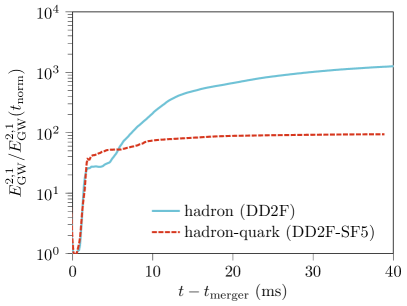
- The one-armed spiral instability is suppressed in the presence of a hadron-quark phase transition, with the suppression increasing with the energy density gap $\Delta e$.
- An anti-correlation is observed between the energy in the $l=2,m=1$ GW mode and $\Delta e$, such that larger $\Delta e$ leads to reduced GW energy in this mode.
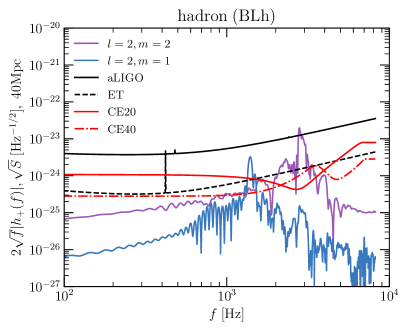
- For a $40\text{ km}$ Cosmic Explorer detector, the SNR of the $l=2,m=1$ mode drops from 2.14 (hadronic case) to 1.08 (hadron-quark case), a suppression by a factor of ~2.
- The $l=2,m=1$ GW peak (1–2 kHz) and $l=2,m=2$ peak (2–4 kHz) lie within the most sensitive frequency bands of the $40\text{ km}$ and $20\text{ km}$ Cosmic Explorer configurations, respectively.
- The suppression of the $l=2,m=1$ mode is driven by dynamical timescales (~10 ms), suggesting it is a dominant mechanism for instability suppression, independent of longer-timescale effects.
- Future work is needed to explore the combined effects of mass ratio, neutrino transport, and crossover transitions to fully validate the robustness of the observed anti-correlation.
Read this paper
Open the full text in the Nubint reader and ask about any passage as you read.
Read this paper on NubintThis review was generated by AI from the original paper. Please check the paper before citing it.