
[Paper Review] Revisiting Crowd Counting: State-of-the-art, Trends, and Future Perspectives
This paper provides a comprehensive, up-to-date survey of state-of-the-art crowd counting methods, focusing on CNN and transformer-based architectures, loss functions, evaluation metrics, and model design trends. It ranks prominent models by performance on benchmark datasets and identifies key challenges such as model complexity, domain generalization, and the trade-off between accuracy and efficiency in real-world deployment.
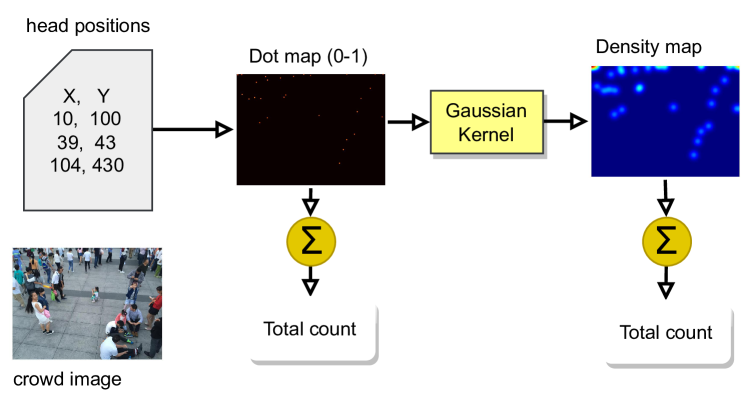
Crowd counting is an effective tool for situational awareness in public places. Automated crowd counting using images and videos is an interesting yet challenging problem that has gained significant attention in computer vision. Over the past few years, various deep learning methods have been developed to achieve state-of-the-art performance. The methods evolved over time vary in many aspects such as model architecture, input pipeline, learning paradigm, computational complexity, and accuracy gains etc. In this paper, we present a systematic and comprehensive review of the most significant contributions in the area of crowd counting. Although few surveys exist on the topic, our survey is most up-to date and different in several aspects. First, it provides a more meaningful categorization of the most significant contributions by model architectures, learning methods (i.e., loss functions), and evaluation methods (i.e., evaluation metrics). We chose prominent and distinct works and excluded similar works. We also sort the well-known crowd counting models by their performance over benchmark datasets. We believe that this survey can be a good resource for novice researchers to understand the progressive developments and contributions over time and the current state-of-the-art.
Motivation & Objective
- To provide a systematic, up-to-date review of the most impactful advancements in crowd counting from 2020 to 2023.
- To categorize and rank state-of-the-art models by performance across major benchmark datasets such as ShanghaiTech, UCSD, and Mall.
- To analyze emerging trends, including transformer-based models, novel loss functions, and evaluation metrics, beyond traditional CNNs.
- To identify critical research gaps, such as poor cross-scene generalization and increasing model complexity without proportional accuracy gains.
- To guide future research by proposing insights on application-specific model design, domain adaptation, and the feasibility of universal crowd counting models.
Proposed method
- Categorizing crowd counting works by model architecture (e.g., CNNs, transformers), learning paradigm (loss functions), and evaluation metrics.
- Selecting and analyzing only the most impactful and distinct contributions, excluding redundant or similar works.
- Benchmarking models on standard datasets (ShanghaiTech, UCSD, Mall) and ranking them by performance (MSE, MAE) to reflect current SOTA.
- Analyzing architectural trends, including deep vs. shallow models, and evaluating the trade-offs between accuracy and inference efficiency.
- Investigating the role of domain adaptation and cross-scene generalization by reviewing fine-tuning and transfer learning approaches.
- Comparing CNN-based and vision transformer-based models in terms of performance, parameter count, and computational efficiency.
Experimental results
Research questions
- RQ1What are the most significant architectural and training method advancements in crowd counting from 2020 to 2023?
- RQ2How do novel loss functions and evaluation metrics improve model performance and generalization in crowd counting?
- RQ3To what extent do transformer-based models outperform CNNs in crowd counting, and what are their efficiency trade-offs?
- RQ4Why does model complexity continue to increase despite minimal accuracy gains, and what are the implications for real-world deployment?
- RQ5Can a universal crowd counting model be developed, or is application-specific model design more effective for diverse deployment scenarios?
Key findings
- Vision transformers have not yet demonstrated substantial accuracy improvements over CNNs on large-scale crowd counting benchmarks, despite their high parameter count (e.g., ViT-base with 86M parameters).
- Shallow models perform sufficiently well on sparse crowd datasets (e.g., UCSD, Mall, ShanghaiTech Part B), suggesting deeper architectures are not always necessary.
- Recent models show marginal accuracy gains with significant increases in model complexity, highlighting a need for better benchmarking of training and inference efficiency.
- Cross-scene generalization remains a major challenge, with most models performing well only on their training domain and failing on unseen scenes or surveillance types.
- There is a growing trend toward application-specific model design—lightweight models for edge devices and dense models for server-based, high-accuracy scenarios.
- The lack of clear design patterns in modern crowd counting architectures complicates understanding of which components drive performance gains, impeding innovation and reproducibility.
Read this paper
Open the full text in the Nubint reader and ask about any passage as you read.
Read this paper on NubintThis review was generated by AI from the original paper. Please check the paper before citing it.