
[Paper Review] Rewarding Chatbots for Real-World Engagement with Millions of Users
This paper proposes a scalable method to enhance chatbot engagement by training a reward model on automatic pseudo-labels derived from real user interactions, which then filters low-quality responses at inference. Using A/B tests on 10,000 daily users, the approach increases mean conversation length by up to 70% and boosts user retention by over 30% for a GPT-J 6B model, demonstrating the effectiveness of real-world feedback for engagement optimization.
The emergence of pretrained large language models has led to the deployment of a range of social chatbots for chitchat. Although these chatbots demonstrate language ability and fluency, they are not guaranteed to be engaging and can struggle to retain users. This work investigates the development of social chatbots that prioritize user engagement to enhance retention, specifically examining the use of human feedback to efficiently develop highly engaging chatbots. The proposed approach uses automatic pseudo-labels collected from user interactions to train a reward model that can be used to reject low-scoring sample responses generated by the chatbot model at inference time. Intuitive evaluation metrics, such as mean conversation length (MCL), are introduced as proxies to measure the level of engagement of deployed chatbots. A/B testing on groups of 10,000 new daily chatbot users on the Chai Research platform shows that this approach increases the MCL by up to 70%, which translates to a more than 30% increase in user retention for a GPT-J 6B model. Future work aims to use the reward model to realise a data fly-wheel, where the latest user conversations can be used to alternately fine-tune the language model and the reward model.
Motivation & Objective
- To improve user engagement and retention in social chatbots by leveraging real-world user interactions instead of costly human annotations.
- To develop a scalable, efficient alternative to human feedback-based alignment by using automatic pseudo-labels from actual user behavior.
- To introduce intuitive, behavior-based evaluation metrics such as mean conversation length (MCL) and user retention to measure engagement.
- To validate the effectiveness of the reward modeling approach through large-scale A/B testing on a platform with millions of users.
- To demonstrate generalization of the reward model across different fine-tuned language models and user interaction patterns.
Proposed method
- The method uses automatic pseudo-labels collected from user interactions—specifically, whether a conversation continues after a response or if users retry a response—as proxies for engagement.
- A GPT-2-based reward model is fine-tuned on these pseudo-labels to predict the likelihood of a response leading to continued conversation.
- At inference, the chatbot generates multiple response candidates, which are scored by the reward model, and the highest-scoring response is selected.
- The reward model is trained to prioritize responses that lead to conversation continuation and user non-retry, with a focus on avoiding low-scoring (1- or 2-star) responses.
- The approach uses a two-stage process: first, collecting pseudo-labels from real user interactions; second, using these labels to train a reward model for response filtering.
- The method generalizes across different language models, as shown by successful application on both a fine-tuned GPT-J and a Pygmalion-fine-tuned GPT-J model.

Experimental results
Research questions
- RQ1Can automatic pseudo-labels derived from real user interactions effectively replace costly human feedback for training reward models in chatbot engagement?
- RQ2Does using a reward model trained on pseudo-labels significantly improve mean conversation length and user retention in real-world deployments?
- RQ3How does the performance of the reward model vary with changes in dataset size and model scale?
- RQ4Can the reward model generalize across different fine-tuned language models and conversation styles?
- RQ5Which engagement proxy (e.g., conversation continuation, user retry behavior) yields the strongest improvement in MCL and retention?
Key findings
- Using the best-performing reward model for response selection increased mean conversation length (MCL) by up to 70% in A/B tests on 10,000 daily users.
- The method led to a user retention increase of over 30% for a GPT-J 6B model, demonstrating strong real-world impact.
- The reward model's improvement was more effective when focused on avoiding low-scoring (1- or 2-star) responses than on promoting high-scoring (4-star) ones.
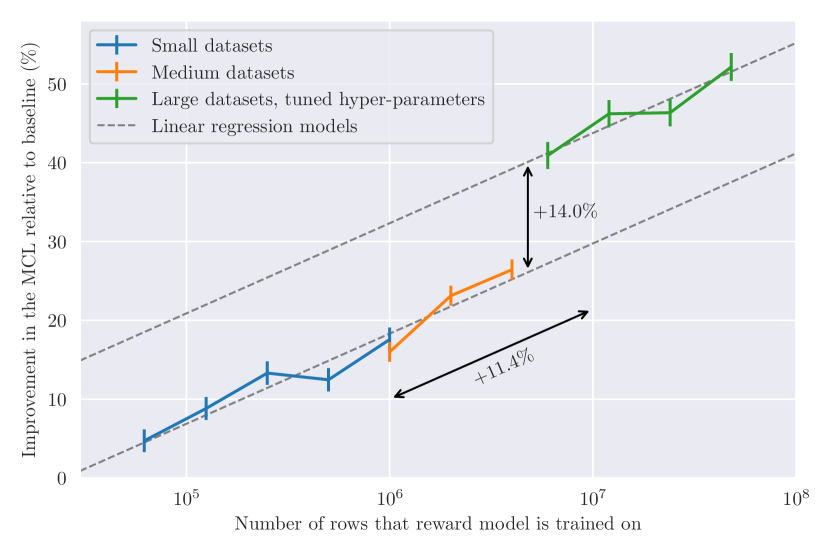
- Increasing the reward model’s parameter count by a factor of ten improved MCL by +5.0±1.1%, but increasing the training dataset size by the same factor yielded a larger +11.4±1.0% improvement.
- The reward model generalized across different fine-tuned GPT-J models, improving MCL by +37.22±0.50% when applied to a Pygmalion-fine-tuned GPT-J, compared to +16.71±0.48% from the model choice alone.
- The ensemble of multiple pseudo-labels (continuation, no retry) showed promise, though not fully explored, suggesting further gains are possible.
Read this paper
Open the full text in the Nubint reader and ask about any passage as you read.
Read this paper on NubintThis review was generated by AI from the original paper. Please check the paper before citing it.