
[Paper Review] RIS-Aided Angular-Based Hybrid Beamforming Design in mmWave Massive MIMO Systems
This paper proposes a Reconfigurable Intelligent Surface (RIS)-aided angular-based hybrid beamforming (RIS-AB-HBF) scheme for mmWave massive MIMO systems to reduce CSI overhead and enhance spectral efficiency. By leveraging slow-time-varying angular parameters for RF beamforming, reduced-dimension effective channel for baseband processing, and particle swarm optimization (PSO) for RIS phase shifts, the scheme achieves up to 25 dB higher achievable rate than conventional AB-HBF under severe blockage, demonstrating significant gains in reliability and flexibility.
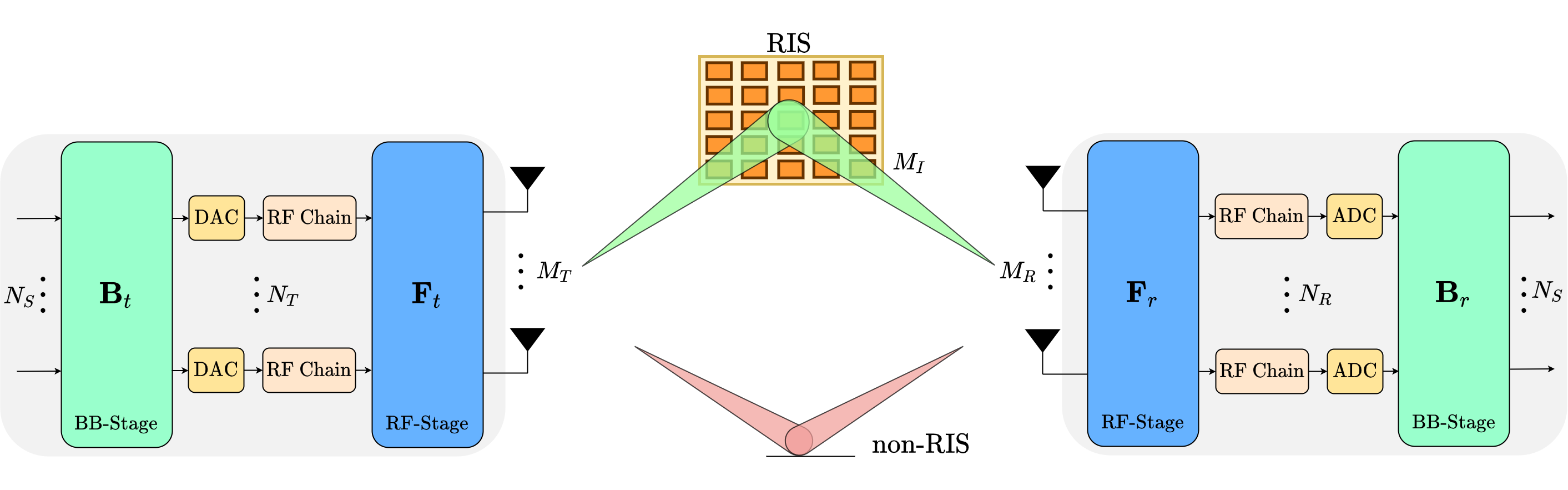
This paper proposes a reconfigurable intelligent surface (RIS)-aided and angular-based hybrid beamforming (AB-HBF) technique for the millimeter wave (mmWave) massive multiple-input multiple-output (MIMO) systems. The proposed RIS-AB-HBF architecture consists of three stages: (i) RF beamformer, (ii) baseband (BB) precoder/combiner, and (iii) RIS phase shift design. First, in order to reduce the number of RF chains and the channel estimation overhead, RF beamformers are designed based on the 3D geometry-based mmWave channel model using slow time-varying angular parameters of the channel. Second, a BB precoder/combiner is designed by exploiting the reduced-size effective channel seen from the BB stages. Then, the phase shifts of the RIS are adjusted to maximize the achievable rate of the system via the nature-inspired particle swarm optimization (PSO) algorithm. Illustrative simulation results demonstrate that the use of RISs in the AB-HBF systems has the potential to provide more promising advantages in terms of reliability and flexibility in system design.
Motivation & Objective
- To address high hardware cost and CSI overhead in mmWave massive MIMO systems.
- To reduce channel estimation overhead by exploiting slow time-varying angular parameters (AoA/AoD) for RF beamforming.
- To enhance system reliability and spectral efficiency in line-of-sight (LOS) and non-LOS environments using RIS reflection.
- To jointly optimize RF beamformers, baseband precoders/combiners, and RIS phase shifts for maximum achievable rate.
- To demonstrate the superiority of PSO-optimized RIS phase shifts over random or constant phase adjustments in challenging propagation conditions.
Proposed method
- Design RF beamformers using 3D geometry-based mmWave channel model with slow time-varying angular parameters (AoD/AoA).
- Construct baseband precoders and combiners based on the reduced-size effective channel seen at the baseband stage.
- Model the RIS as a passive reflecting array with M_I = M_Ix × M_Iy elements, each with tunable phase shifts.
- Formulate the RIS phase shift optimization as a rate maximization problem using particle swarm optimization (PSO).
- Integrate the three stages: RF beamformer, baseband precoder/combiner, and RIS phase shift design into a unified RIS-AB-HBF architecture.
- Use a three-stage system model with direct and RIS-reflected links, assuming uniform planar arrays (UPA) at Tx, Rx, and RIS.
Experimental results
Research questions
- RQ1How does RIS-aided AB-HBF reduce CSI overhead compared to conventional hybrid beamforming in mmWave massive MIMO?
- RQ2What is the achievable rate gain of PSO-optimized RIS phase shifts over random or constant phase adjustments in blockage-prone environments?
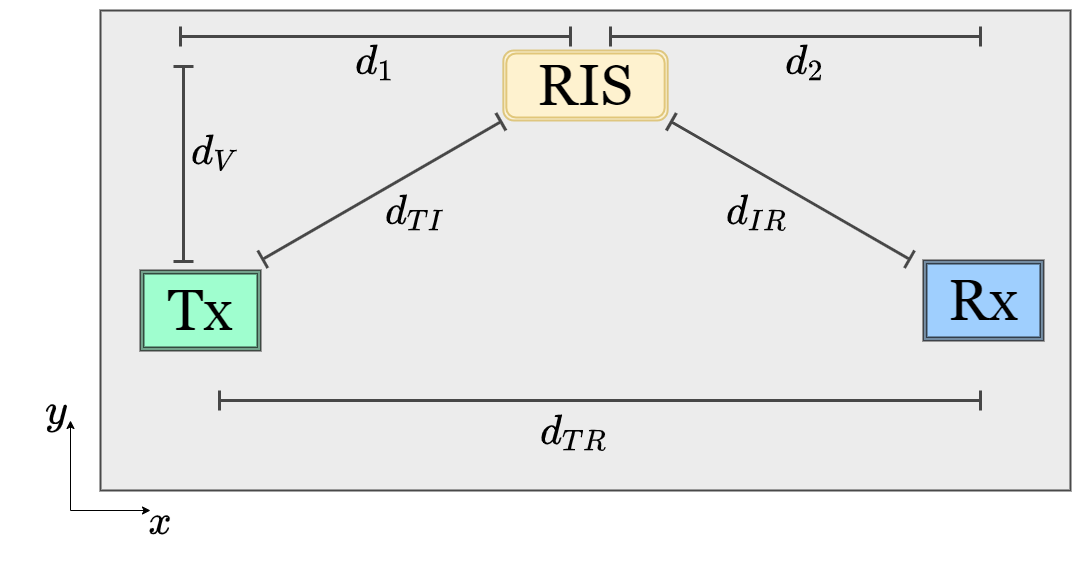
- RQ3How does the positioning of the RIS (e.g., distance from Tx) affect system performance in terms of achievable rate?
- RQ4To what extent does increasing the number of RIS elements (M_I) enhance spectral efficiency in AB-HBF systems?
- RQ5Can angular-based beamforming with RIS support maintain high performance even when the direct Tx-Rx link is blocked?
Key findings
- For d_TR = 100 m and d_1 = 20 m, the PSO-based RIS-AB-HBF achieves 10.47 bps/Hz, dropping to 3.24 bps/Hz at d_1 = 100 m, showing strong sensitivity to RIS positioning.
- At d_TR = 100 m, the PSO-based RIS-AB-HBF provides a 25 dB gain over conventional AB-HBF when the direct link is blocked.
- Doubling d_TR from 25 m to 50 m causes a 76.53% performance loss in conventional AB-HBF, while PSO-based RIS-AB-HBF degrades by only 22.85%.
- With M_I = 100, the PSO-based RIS-AB-HBF achieves a 4.5 dB gain over random phase adjustment, compared to 3 dB at M_I = 10.
- Even constant-phase RIS reflection provides notable performance gains by creating an additional LOS path, though it saturates at higher M_I values.
- The PSO-optimized RIS-AB-HBF system outperforms all benchmarks, especially under high path loss and blockage, due to dynamic phase optimization.
Read this paper
Open the full text in the Nubint reader and ask about any passage as you read.
Read this paper on NubintThis review was generated by AI from the original paper. Please check the paper before citing it.