
[Paper Review] Robustifying Conditional Portfolio Decisions via Optimal Transport
This paper proposes a data-driven portfolio optimization framework that integrates side information, conditional estimation, and distributional robustness using optimal transport-based ambiguity sets. By formulating a distributionally robust two-stage stochastic program with side information, the method ensures tractable reformulations as second-order or semidefinite cone programs under mean-variance and mean-CVaR criteria, demonstrating superior out-of-sample performance in US equity data.
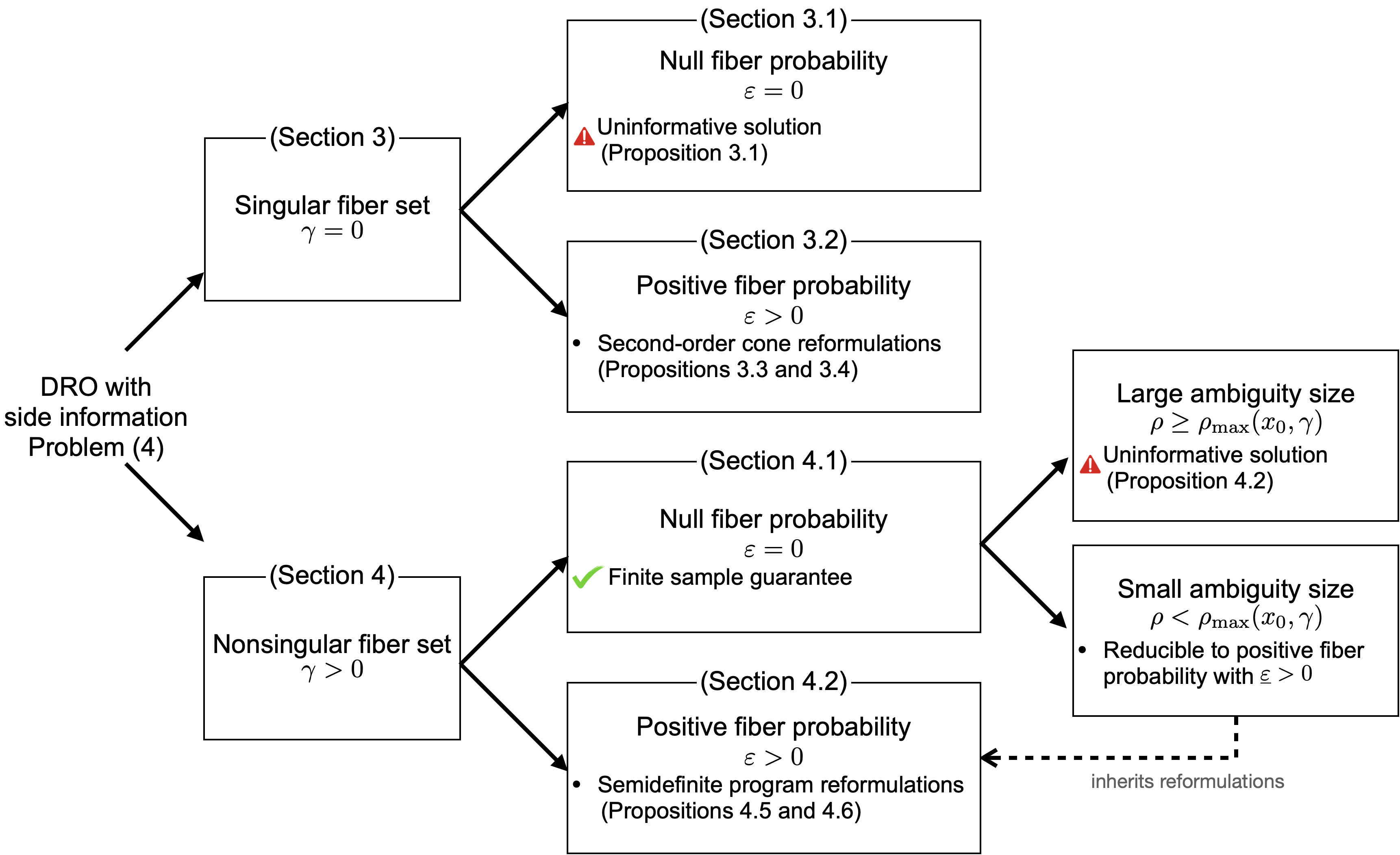
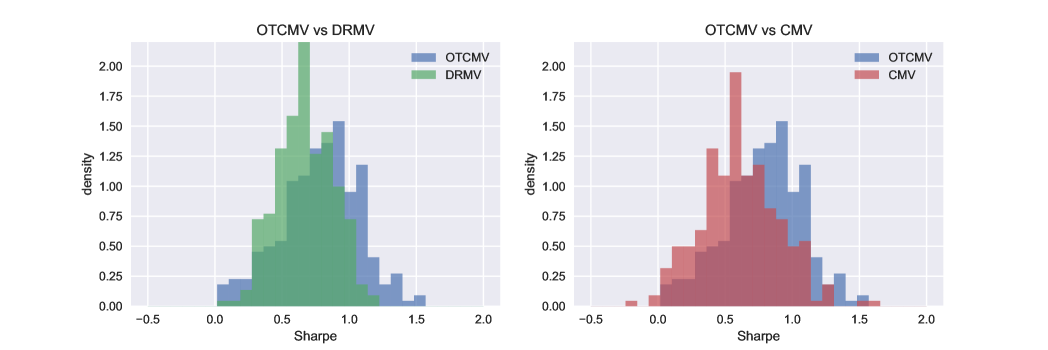
We propose a data-driven portfolio selection model that integrates side information, conditional estimation and robustness using the framework of distributionally robust optimization. Conditioning on the observed side information, the portfolio manager solves an allocation problem that minimizes the worst-case conditional risk-return trade-off, subject to all possible perturbations of the covariate-return probability distribution in an optimal transport ambiguity set. Despite the non-linearity of the objective function in the probability measure, we show that the distributionally robust portfolio allocation with side information problem can be reformulated as a finite-dimensional optimization problem. If portfolio decisions are made based on either the mean-variance or the mean-Conditional Value-at-Risk criterion, the resulting reformulation can be further simplified to second-order or semi-definite cone programs. Empirical studies in the US equity market demonstrate the advantage of our integrative framework against other benchmarks.
Motivation & Objective
- To develop a tractable, non-parametric, data-driven portfolio selection method that leverages side information to improve conditional risk-return trade-offs.
- To address estimation errors in portfolio optimization by integrating distributional robustness via optimal transport ambiguity sets.
- To unify conditional estimation and robust optimization without requiring global conditional expectations or parametric assumptions.
- To enable efficient computation of robust portfolio decisions under various risk measures, including mean-variance and mean-Conditional Value-at-Risk.
- To demonstrate the empirical superiority of the framework over existing benchmarks in real-world equity data.
Proposed method
- The framework uses distributionally robust optimization with an optimal transport-based ambiguity set to model perturbations of the joint covariate-return distribution given side information.
- It formulates a two-stage stochastic program where the portfolio decision depends on observed side information, minimizing the worst-case conditional risk under distributional uncertainty.
- The method reformulates the non-convex, non-linear robust optimization problem into a finite-dimensional program via duality and optimal transport theory.
- For mean-variance and mean-CVaR criteria, the reformulation reduces to second-order cone programs (SOCPs) or semidefinite programs (SDPs), ensuring computational tractability.
- The approach employs linear decision rules and support functions to approximate robust constraints, enabling efficient solution via standard conic optimization solvers.
- The framework allows for flexible risk measure representation through a stochastic optimization form: $\mathcal{R}_{\mathbb{P}}[Y^\top\alpha] = \min_{\beta \in \mathcal{B}} \mathbb{E}_{\mathbb{P}}[r(Y^\top\alpha, \beta)]$.
Experimental results
Research questions
- RQ1Can a data-driven portfolio model effectively integrate side information while ensuring robustness to distributional shifts in conditional return distributions?
- RQ2How can distributionally robust optimization with side information be reformulated into a tractable finite-dimensional program despite non-linear dependence on the probability measure?
- RQ3To what extent does the proposed framework outperform standard portfolio optimization benchmarks in out-of-sample performance on real equity data?
- RQ4What is the computational complexity and scalability of the robust conditional portfolio model under different risk criteria?
- RQ5Can the framework be extended to general risk measures beyond mean-variance and CVaR using a unified stochastic representation?
Key findings
- The distributionally robust portfolio allocation with side information can be reformulated as a finite-dimensional optimization problem, enabling tractable computation despite non-linear dependence on the probability measure.
- Under the mean-variance and mean-Conditional Value-at-Risk criteria, the reformulation reduces to second-order cone programs (SOCPs) and semidefinite programs (SDPs), respectively, ensuring efficient solution.
- The proposed framework achieves superior out-of-sample performance compared to benchmark models in empirical studies on US equity market data.
- The use of optimal transport ambiguity sets allows for robustness to local distributional shifts while preserving conditional dependence on side information.
- The method enables conservative approximations via linear decision rules and support functions, with constraints representable as linear programs for polyhedral sets.
- The framework is flexible and extensible to a wide range of risk measures and applications beyond portfolio selection.
Read this paper
Open the full text in the Nubint reader and ask about any passage as you read.
Read this paper on NubintThis review was generated by AI from the original paper. Please check the paper before citing it.