
[Paper Review] Room-temperature quantum sensing with photoexcited triplet electrons in organic crystals
The paper demonstrates room-temperature quantum sensing using photoexcited spin-triplet electrons in pentacene-doped p-terphenyl crystals, achieving optically detected magnetic resonance (ODMR) with high contrast and coherent control, including pulsed schemes yielding long coherence times.
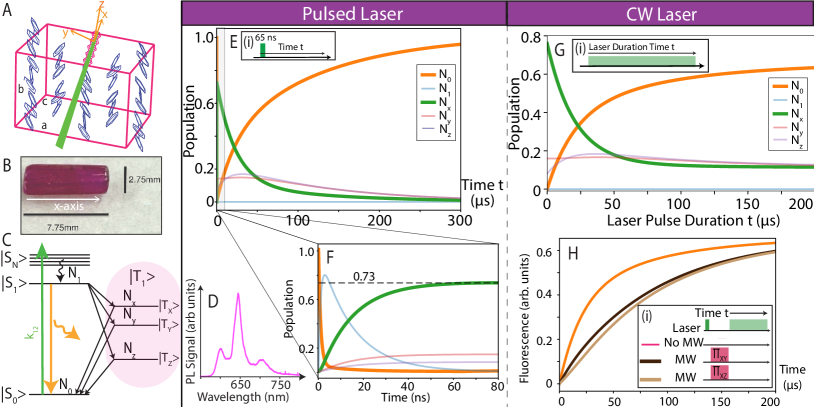
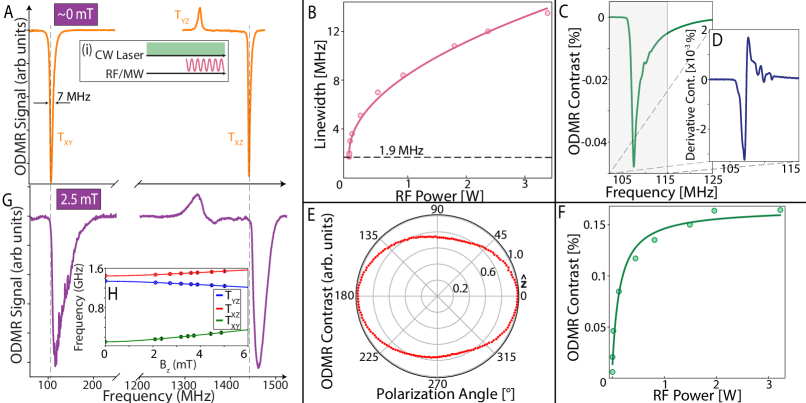
Quantum sensors have notably advanced high-sensitivity magnetic field detection. Here, we report quantum sensors constructed from polarized spin-triplet electrons in photoexcited organic chromophores, specifically focusing on pentacene-doped para-terphenyl (${\approx}$0.1%). We demonstrate essential quantum sensing properties at room temperature: electronic optical polarization and state-dependent fluorescence contrast, by leveraging differential pumping and relaxation rates between triplet and ground states. We measure high optically detected magnetic resonance (ODMR) contrast ${\approx}16.8\%$ of the triplet states at room temperature, along with long coherence times under spin echo and CPMG sequences, $T_2{=}2.7μ$s and $T_2^{DD}{=}18.4μ$s respectively, limited only by the triplet lifetimes. The material offers several advantages for quantum sensing, including the ability to grow large ($cm$-scale) crystals at low cost, the absence of paramagnetic impurities, and the diamagnetism of electronic states used for sensing when not optically illuminated. Utilizing pentacene as a representative of a broader class of spin triplet-polarizable organic molecules, this study highlights new potential for quantum sensing in chemical systems.
Motivation & Objective
- Demonstrate optical initialization and readout of photoexcited triplet spins in organic crystals at room temperature.
- Show high-contrast ODMR and coherent microwave control of triplet sublevels.
- Quantify coherence times (T2, T2DD) and relaxation (T1) in the pentacene-doped p-terphenyl system.
- Assess practical advantages of organic-crystal q-sensors for scalable, low-cost quantum sensing.
Proposed method
- Use pentacene doped into para-terphenyl crystals as a model system for triplet-based quantum sensing.
- Implement optical pumping to polarize triplet sublevels via differential intersystem crossing rates.
- Probe spin transitions with optically detected magnetic resonance (ODMR) at room temperature.
- Employ both continuous-wave and pulsed optical excitation to enhance ODMR contrast.
- Characterize coherence with Rabi, Ramsey, Hahn echo, and Carr-Purcell-Meiboom-Gill (CPMG) sequences.
- Extract sensitivity estimates from measured slope, photon counts, and readout windows.
Experimental results
Research questions
- RQ1Can room-temperature quantum sensing be achieved with photoexcited triplet electrons in organic crystals?
- RQ2What ODMR contrast and coherence times are attainable in pentacene-doped p-terphenyl at room temperature?
- RQ3How do pulsed optical initialization and dynamical decoupling affect ODMR contrast and spin coherence in this system?
- RQ4What practical advantages do organic-crystal q-sensors offer for scalable, low-cost magnetic sensing compared to inorganic defect centers?
Key findings
- ODMR contrast up to 16.8% for the Txy transition under pulsed illumination.
- Rabi oscillations observed at 12.9 MHz demonstrating coherent control.
- T2 = 2.7 μs from Hahn echo measurements.
- T2DD = 18.4 μs with a 148 ns CPMG train.
- T1 = 22.9 μs for triplet-ground relaxation.
- Under bias B0 = 2.5 mT, DC sensitivities of 327 nT/√Hz (Txy) and 257 nT/√Hz (Txz) were achieved (volume-normalized: 24 μT μm3/2/√Hz and 19.5 μT μm3/2/√Hz, respectively).
- Pulse-laser initialization yields higher ODMR contrast (up to 16.8%) than cw illumination, with potential for further gains.
Read this paper
Open the full text in the Nubint reader and ask about any passage as you read.
Read this paper on NubintThis review was generated by AI from the original paper. Please check the paper before citing it.