
[Paper Review] RTMO: Towards High-Performance One-Stage Real-Time Multi-Person Pose Estimation
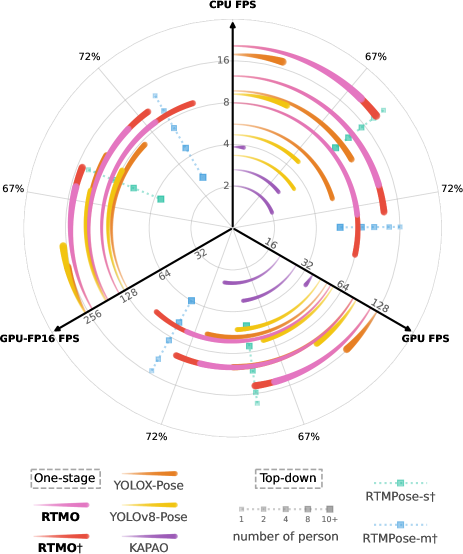
RTMO proposes a one-stage real-time multi-person pose estimation framework that integrates dual 1D heatmap-based coordinate classification into the YOLO architecture, using a Dynamic Coordinate Classifier (DCC) and a novel Maximum Likelihood Estimation (MLE)-based loss to improve accuracy and efficiency. It achieves 74.8% AP on COCO val2017 and 141 FPS on a single V100 GPU, outperforming prior one-stage methods in both speed and accuracy.
Real-time multi-person pose estimation presents significant challenges in balancing speed and precision. While two-stage top-down methods slow down as the number of people in the image increases, existing one-stage methods often fail to simultaneously deliver high accuracy and real-time performance. This paper introduces RTMO, a one-stage pose estimation framework that seamlessly integrates coordinate classification by representing keypoints using dual 1-D heatmaps within the YOLO architecture, achieving accuracy comparable to top-down methods while maintaining high speed. We propose a dynamic coordinate classifier and a tailored loss function for heatmap learning, specifically designed to address the incompatibilities between coordinate classification and dense prediction models. RTMO outperforms state-of-the-art one-stage pose estimators, achieving 1.1% higher AP on COCO while operating about 9 times faster with the same backbone. Our largest model, RTMO-l, attains 74.8% AP on COCO val2017 and 141 FPS on a single V100 GPU, demonstrating its efficiency and accuracy. The code and models are available at https://github.com/open-mmlab/mmpose/tree/main/projects/rtmo.
Motivation & Objective
- To address the speed-accuracy trade-off in real-time multi-person pose estimation by unifying one-stage detection with precise coordinate classification.
- To overcome the limitations of direct keypoint regression in one-stage models, which underperforms due to lack of spatial uncertainty modeling.
- To design a dynamic bin allocation and encoding mechanism that adapts to instance-specific spatial contexts for improved heatmap learning.
- To develop a learnable, sample-aware loss function that balances optimization across hard and easy samples in dense prediction scenarios.
- To achieve state-of-the-art performance in both speed and accuracy for one-stage multi-person pose estimation.
Proposed method
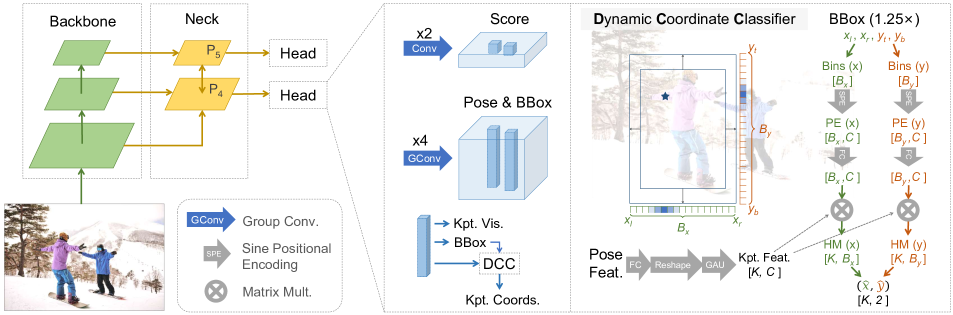
- Integrates dual 1D heatmaps for keypoint localization within a YOLO-based one-stage detector, replacing direct regression with coordinate classification.
- Proposes a Dynamic Coordinate Classifier (DCC) that allocates bins adaptively within bounding boxes and uses learnable bin representations to improve localization precision.
- Introduces a Maximum Likelihood Estimation (MLE)-based loss function that models per-sample uncertainty via learnable variance, enabling better optimization across varying instance difficulty.
- Applies Dynamic Bin Allocation (DBA) and Dynamic Bin Encoding (DBE) to improve bin utilization and ensure smooth, spatially coherent heatmap outputs.
- Optimizes feature pyramid usage by removing P3 and retaining only P4 and P5 for faster inference with minimal accuracy drop.
- Trains and deploys models using ONNXRuntime for efficient inference across CPU and GPU platforms.
Experimental results
Research questions
- RQ1Can coordinate classification be effectively adapted to dense prediction tasks like one-stage multi-person pose estimation without sacrificing speed?
- RQ2How can bin allocation and representation be made dynamic to better match instance-specific spatial contexts in one-stage models?
- RQ3Does a learnable, uncertainty-aware loss function outperform standard Kullback–Leibler divergence (KLD) in training coordinate heatmaps for one-stage pose estimation?
- RQ4Can the integration of coordinate classification into YOLO-based models achieve both high accuracy and real-time inference on standard benchmarks?
- RQ5What is the optimal feature pyramid configuration for balancing speed and accuracy in one-stage multi-person pose estimation?
Key findings
- RTMO-l achieves 74.8% Average Precision (AP) on COCO val2017, setting a new state of the art for one-stage methods.
- RTMO-l runs at 141 FPS on a single NVIDIA V100 GPU, achieving ~9× faster inference than previous one-stage models with the same backbone.
- On the CrowdPose benchmark, RTMO-l achieves 73.2% AP, also a new state of the art for one-stage methods.
- The MLE-based loss outperforms KLD by 2.1% AP on COCO, demonstrating the benefit of modeling per-sample uncertainty.
- Removing P3 feature from the feature pyramid reduces FLOPs by 78.5% in the head while only decreasing accuracy by 0.3%, proving P4 and P5 are sufficient for high performance.
- Dynamic Bin Encoding (DBE) significantly improves heatmap smoothness and performance, resolving issues from static or poorly encoded bin representations.
Read this paper
Open the full text in the Nubint reader and ask about any passage as you read.
Read this paper on NubintThis review was generated by AI from the original paper. Please check the paper before citing it.