
[Paper Review] SafePowerGraph: Safety-aware Evaluation of Graph Neural Networks for Transmission Power Grids
SafePowerGraph is a simulator-agnostic, safety-oriented benchmark framework for Graph Neural Networks (GNNs) in transmission power grids, integrating four major PF and OPF simulators to evaluate GNN robustness under realistic safety-critical scenarios such as line outages and energy price variations. It demonstrates that self-supervised learning and Graph Attention Networks (GAT) significantly enhance GNN robustness, with GAT models reducing physical constraint violations by up to six orders of magnitude under price volatility.
Power grids are critical infrastructures of paramount importance to modern society and their rapid evolution and interconnections has heightened the complexity of power systems (PS) operations. Traditional methods for grid analysis struggle with the computational demands of large-scale RES and ES integration, prompting the adoption of machine learning (ML) techniques, particularly Graph Neural Networks (GNNs). GNNs have proven effective in solving the alternating current (AC) Power Flow (PF) and Optimal Power Flow (OPF) problems, crucial for operational planning. However, existing benchmarks and datasets completely ignore safety and robustness requirements in their evaluation and never consider realistic safety-critical scenarios that most impact the operations of the power grids. We present SafePowerGraph, the first simulator-agnostic, safety-oriented framework and benchmark for GNNs in PS operations. SafePowerGraph integrates multiple PF and OPF simulators and assesses GNN performance under diverse scenarios, including energy price variations and power line outages. Our extensive experiments underscore the importance of self-supervised learning and graph attention architectures for GNN robustness. We provide at https://github.com/yamizi/SafePowerGraph our open-source repository, a comprehensive leaderboard, a dataset and model zoo and expect our framework to standardize and advance research in the critical field of GNN for power systems.
Motivation & Objective
- Address the lack of standardized, safety-focused evaluation for GNNs in power system operations, particularly under realistic, perturbed scenarios.
- Overcome limitations of existing benchmarks like LIPS and PowerGraph, which ignore simulator variability, safety-critical perturbations, and modern self-supervised learning approaches.
- Provide a unified, open-source framework that supports multiple PF and OPF simulators and evaluates both supervised and physical constraint errors.
- Standardize robustness evaluation for GNNs in transmission power systems by incorporating in-distribution, price variation, and line outage scenarios.
- Advance research in GNNs for power systems by releasing a comprehensive dataset, model zoo, and leaderboard to enable reproducible and comparable benchmarking.
Proposed method
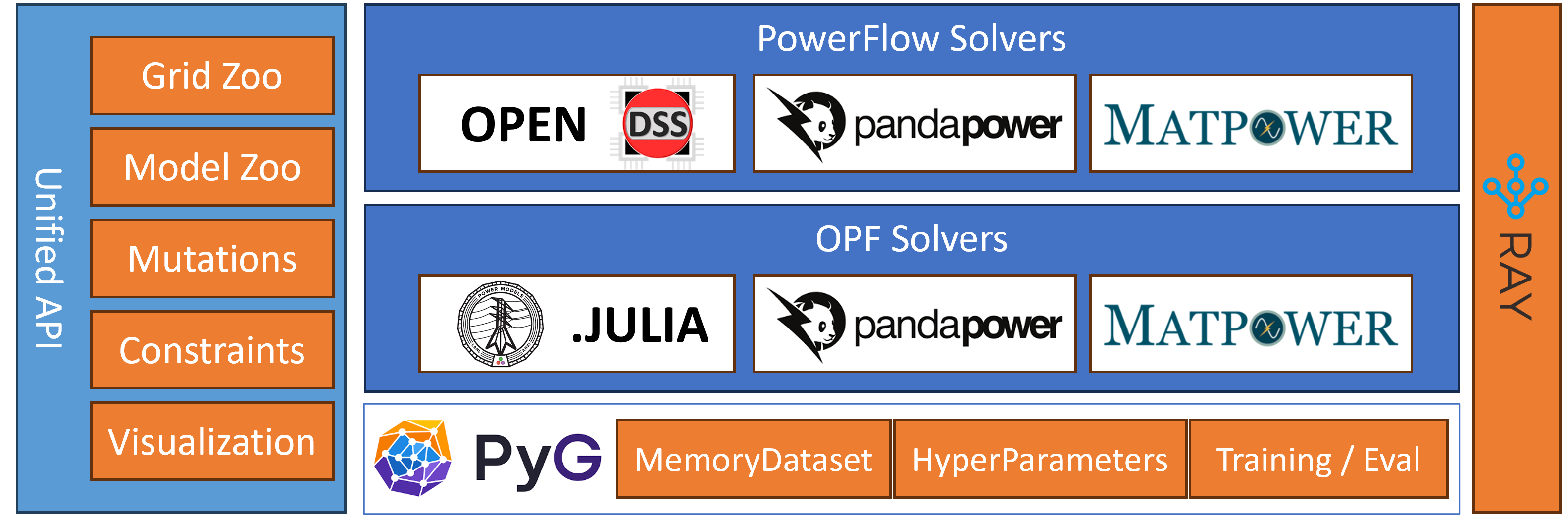
- Design a simulator-agnostic framework that natively integrates four widely used PF and OPF simulators (e.g., MATPOWER, pandapower, etc.) to ensure evaluation portability across tools.
- Define three evaluation settings: in-distribution (ID) scenarios, energy price variation scenarios, and power line outage scenarios to simulate real-world operational stressors.
- Measure model performance using both supervised metrics (Mean Squared Error) and physical constraint violations (e.g., power flow and boundary constraint breaches).
- Evaluate GNNs across three grid sizes (9-bus, 30-bus, 118-bus) under diverse perturbations, including random line tripping and fluctuating energy prices.
- Integrate self-supervised learning (SSL) with supervised learning (SL) to assess its impact on robustness, particularly in handling distributional shift and adversarial-like perturbations.
- Implement a comprehensive evaluation pipeline that reports both prediction accuracy and physical feasibility, enabling safety-aware model selection and analysis.
Experimental results
Research questions
- RQ1How do GNNs perform under realistic safety-critical perturbations such as line outages and energy price variations, compared to standard in-distribution evaluations?
- RQ2To what extent does self-supervised learning improve the robustness of GNNs for AC power flow and optimal power flow tasks in transmission grids?
- RQ3Which GNN architecture—GAT, GCN, or GIN—demonstrates superior robustness and constraint adherence under physical and economic perturbations?
- RQ4How do physical constraint violations scale with grid size and perturbation severity, and which scenarios lead to the highest risk of operational instability?
- RQ5Can a unified, simulator-agnostic benchmark framework improve reproducibility and comparability in GNN research for power systems?
Key findings
- GNN models exhibit extreme vulnerability to energy price variations, with bus power flow prediction errors increasing by up to six orders of magnitude in larger grids (118-bus) under price volatility.
- Graph Attention Networks (GAT) consistently outperform GCN and GIN across all grid sizes and scenarios, achieving the lowest physical constraint violations and highest robustness.
- Self-supervised learning (SSL) significantly improves GNN robustness under price variation and line outage scenarios, with no degradation in performance on in-distribution data, and improves performance in six out of eight scenarios.
- Price variation scenarios lead to significantly more constraint violations than line outage scenarios, indicating that economic fluctuations pose a greater threat to operational safety than physical network failures.
- The integration of SSL with SL reduces mean squared error (MSE) by up to 90% in price variation scenarios and improves constraint adherence, especially in large-scale grids.
- The SafePowerGraph framework successfully identifies that GAT with SSL achieves the best trade-off between accuracy and physical feasibility, making it the most suitable architecture for safety-critical power system applications.

Read this paper
Open the full text in the Nubint reader and ask about any passage as you read.
Read this paper on NubintThis review was generated by AI from the original paper. Please check the paper before citing it.