
[Paper Review] Safety Cases: How to Justify the Safety of Advanced AI Systems
This paper proposes a framework for building AI safety cases, outlining four argument categories (inability, control, trustworthiness, deference), and describes how to structure, evaluate, and potentially certify safety for deployment.
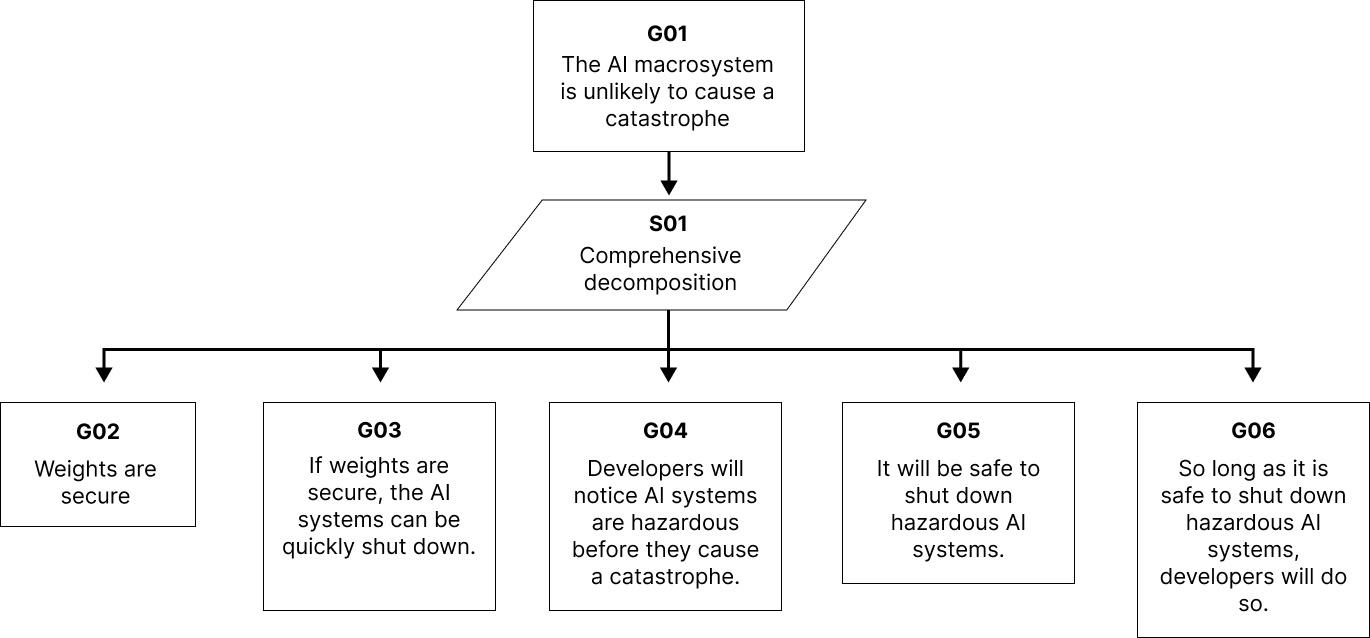
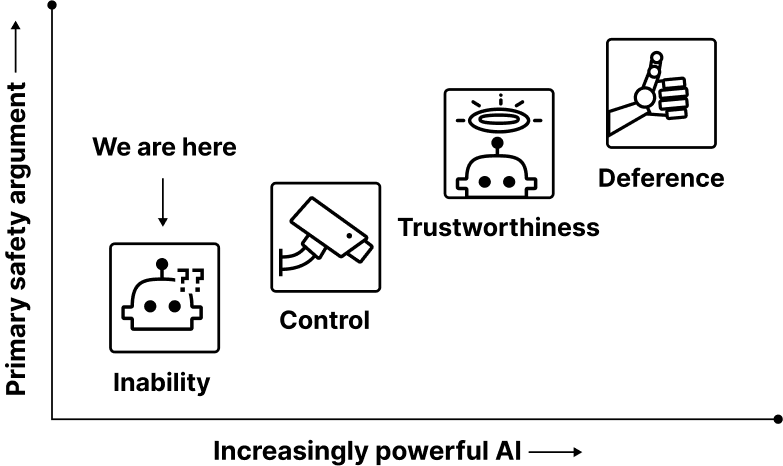
As AI systems become more advanced, companies and regulators will make difficult decisions about whether it is safe to train and deploy them. To prepare for these decisions, we investigate how developers could make a 'safety case,' which is a structured rationale that AI systems are unlikely to cause a catastrophe. We propose a framework for organizing a safety case and discuss four categories of arguments to justify safety: total inability to cause a catastrophe, sufficiently strong control measures, trustworthiness despite capability to cause harm, and -- if AI systems become much more powerful -- deference to credible AI advisors. We evaluate concrete examples of arguments in each category and outline how arguments could be combined to justify that AI systems are safe to deploy.
Motivation & Objective
- Introduce the concept of a safety case for advanced AI systems as a structured rationale that a deployment is unlikely to cause a catastrophe.
- Propose a six-step framework to organize safety arguments and assess macrosystems and subsystems.
- Identify four safety-argument categories (inability, control, trustworthiness, deference) and provide concrete templates and examples.
- Discuss integration of safety and risk cases, and offer policy recommendations for institutions and regulators.
Proposed method
- Define the AI macrosystem and deployment decision within a six-step safety-case framework.
- Classify safety arguments into four categories and detail their structures and use-cases.
- Provide concrete templates and examples for each argument type (including dangerous capability evaluations).
- Assess practicality, maximum strength, and scalability of proposed safety arguments.
- Suggest process for holistic safety cases using goal structuring notation (GSN) and potential risk matrices.
- Offer recommendations for institutions, auditors, and regulation, including continuous monitoring and hard vs soft standards.
Experimental results
Research questions
- RQ1What constitutes a structured safety case for deploying advanced AI systems?
- RQ2How can safety cases be decomposed into subsystems and assessed for macro-level risk?
- RQ3What are the main argument categories for justifying AI safety, and how can they be concretely implemented?
- RQ4How should safety cases be evaluated and updated over time, including risk-case considerations?
Key findings
- Four building-block safety arguments are identified: inability, control, trustworthiness, and deference.
- An end-to-end six-step framework is proposed for constructing and evaluating AI safety cases.
- Dangerous capability evaluations, monitoring, externalized reasoning, and testbeds are highlighted as practical, scalable building blocks.
- Holistic safety cases can be represented with goal structuring notation (GSN) and complemented by risk cases reviewed by third-party auditors.
Read this paper
Open the full text in the Nubint reader and ask about any passage as you read.
Read this paper on NubintThis review was generated by AI from the original paper. Please check the paper before citing it.