
[Paper Review] SAIL: Search-Augmented Instruction Learning
SAIL proposes a search-augmented instruction tuning framework that grounds large language model responses in noisy, real-world search results from external and in-house search engines. By fine-tuning LLaMA-7B on a curated corpus of (instruction, search result, response) triplets, SAIL-7B achieves superior performance on transparency-sensitive tasks like open-ended question answering and fact checking, outperforming strong baselines including GPT-3.5-Turbo and Vicuna-13B.
Large language models (LLMs) have been significantly improved by instruction fine-tuning, but still lack transparency and the ability to utilize up-to-date knowledge and information. In this work, we propose search-augmented instruction learning (SAIL), which grounds the language generation and instruction following abilities on complex search results generated by in-house and external search engines. With an instruction tuning corpus, we collect search results for each training case from different search APIs and domains, and construct a new search-grounded training set containing extit{(instruction, grounding information, response)} triplets. We then fine-tune the LLaMA-7B model on the constructed training set. Since the collected results contain unrelated and disputing languages, the model needs to learn to ground on trustworthy search results, filter out distracting passages, and generate the target response. The search result-denoising process entails explicit trustworthy information selection and multi-hop reasoning, since the retrieved passages might be informative but not contain the instruction-following answer. Experiments show that the fine-tuned SAIL-7B model has a strong instruction-following ability, and it performs significantly better on transparency-sensitive tasks, including open-ended question answering and fact checking.
Motivation & Objective
- Address the lack of transparency and up-to-date knowledge in instruction-tuned LLMs.
- Overcome the limitations of static knowledge bases like Wikipedia and noisy commercial search results.
- Develop a method that enables LLMs to filter out distracting or false search results while grounding responses in trustworthy information.
- Improve performance on transparency-sensitive tasks such as open-ended question answering and fact checking.
- Construct a new instruction-tuning dataset grounded in real-world search results for training robust, reliable LLMs.
Proposed method
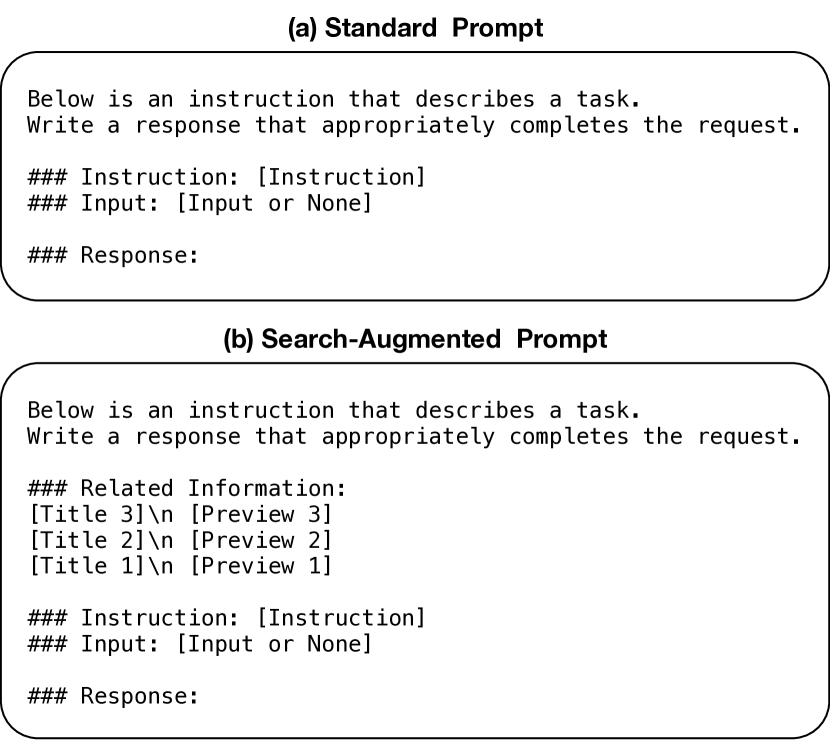
- Collect search results from both in-house (Wikipedia via BM25) and external (commercial) search engines for each instruction in an instruction-tuning dataset.
- Construct a new training corpus of (instruction, grounding information, response) triplets, where grounding information includes retrieved search results.
- Fine-tune the LLaMA-7B model on this search-grounded dataset to learn to select trustworthy information and perform multi-hop reasoning across noisy passages.
- Implement a search result denoising process that enables the model to identify and filter out irrelevant or conflicting passages during response generation.
- Use GPT-4 to generate high-quality responses for the training data, ensuring alignment between instruction and response.
- Leverage instruction tuning to enhance the model’s ability to follow natural language instructions while relying on dynamic, real-time search inputs.

Experimental results
Research questions
- RQ1Can large language models be effectively guided to follow instructions when grounded in noisy, real-world search results?
- RQ2How does grounding LLMs in diverse, potentially conflicting search results affect their performance on transparency-sensitive tasks?
- RQ3To what extent can a search-augmented instruction-tuned model outperform standard instruction-tuned models and commercial LLMs on fact checking and open-ended question answering?
- RQ4Can a model learn to denoise and reason across multiple search results to extract trustworthy information without relying on a closed, static knowledge base?
- RQ5Does integrating real-time search results into instruction tuning improve the reliability and explainability of LLM-generated outputs?
Key findings
- SAIL-7B significantly outperforms strong baselines, including GPT-3.5-Turbo and Vicuna-13B, on open-ended question answering and fact-checking tasks.
- The model demonstrates robustness in filtering out distracting and conflicting search results, correctly identifying trustworthy information even when misleading content is present.
- SAIL-7B achieves higher performance on transparency-sensitive tasks due to its grounding in real-time, dynamic search results rather than static knowledge bases.
- The search result denoising process enables multi-hop reasoning and trustworthy information selection, which are critical for accurate response generation.
- The model’s performance is enhanced by instruction tuning combined with retrieval grounding, showing that both components are essential for high-quality instruction following.
- Experiments confirm that instruction-tuned LLMs are highly susceptible to misleading search results, validating the need for a dedicated denoising and grounding mechanism.
Read this paper
Open the full text in the Nubint reader and ask about any passage as you read.
Read this paper on NubintThis review was generated by AI from the original paper. Please check the paper before citing it.