
[Paper Review] SAM Struggles in Concealed Scenes -- Empirical Study on Segment Anything
This paper empirically evaluates the Segment Anything Model (SAM) on concealed scenes—camouflaged animals, industrial defects, and medical lesions—revealing significant performance gaps compared to state-of-the-art models. Despite its strong generalization in natural images, SAM struggles with semantic understanding in low-contrast, visually hidden scenarios due to limited perception of subtle semantic cues and lack of domain-specific inductive biases.
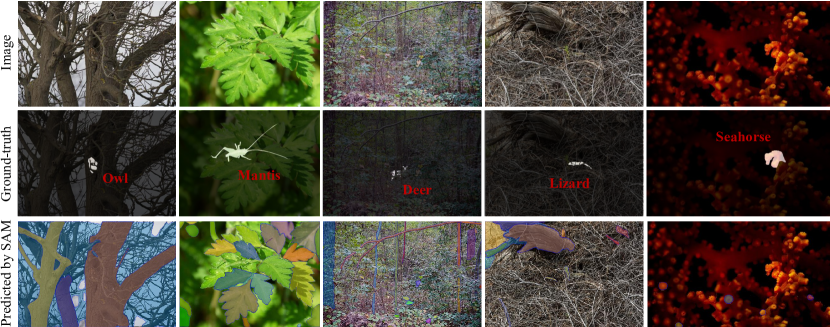
Segmenting anything is a ground-breaking step toward artificial general intelligence, and the Segment Anything Model (SAM) greatly fosters the foundation models for computer vision. We could not be more excited to probe the performance traits of SAM. In particular, exploring situations in which SAM does not perform well is interesting. In this report, we choose three concealed scenes, i.e., camouflaged animals, industrial defects, and medical lesions, to evaluate SAM under unprompted settings. Our main observation is that SAM looks unskilled in concealed scenes.
Motivation & Objective
- To investigate the performance limitations of the Segment Anything Model (SAM) in concealed scene understanding tasks.
- To evaluate SAM's zero-shot generalization capability on camouflaged object segmentation (COS) benchmarks.
- To identify failure cases in three concealed scenarios: camouflaged animals, industrial defects, and medical lesions.
- To compare SAM’s segmentation performance quantitatively against state-of-the-art COS models under unprompted settings.
- To provide insights into SAM’s perception bottlenecks and suggest directions for improving foundation models in low-contrast, semantically ambiguous environments.
Proposed method
- The authors use a mask selection strategy based on intersection-over-union (IoU) between predicted and ground-truth masks to select the best output from multiple SAM predictions.
- Quantitative evaluation is conducted on three standard camouflaged object segmentation benchmarks: CAMO, COD10K, and NC4K.
- Five standard metrics are used: structure measure ($S_\alpha$), enhanced-alignment measure ($E_\phi$), F-measure ($F_\beta$), weighted F-measure ($F_\beta^w$), and mean absolute error ($M$).
- The evaluation is performed under an unprompted setting, where SAM generates multiple masks and the highest IoU mask is selected for comparison.
- Qualitative analysis is conducted using SAM’s online demo to visualize failure cases across three concealed scenarios.
- The study compares SAM (ViT-B, ViT-L, ViT-H) with state-of-the-art COS models such as CamoFormer-P/S and HitNet, using consistent backbone and training protocols.
Experimental results
Research questions
- RQ1How does SAM perform on camouflaged object segmentation benchmarks compared to state-of-the-art models?
- RQ2Why does SAM fail to segment concealed objects such as camouflaged animals, industrial defects, and medical lesions?
- RQ3What are the key failure patterns of SAM in low-contrast, semantically ambiguous scenes?
- RQ4To what extent does increasing SAM’s model scale (ViT-B to ViT-H) improve performance on concealed scenes?
- RQ5Can SAM’s performance be improved by incorporating domain-specific inductive biases or prior knowledge?
Key findings
- SAM’s weighted F-measure ($F_\beta^w$) on CAMO is only 0.353 for ViT-B, improving to 0.700 for ViT-H, but still significantly below state-of-the-art models.
- On the COD10K dataset, SAM (ViT-H) lags behind CamoFormer-S by 13.8% in $E_\phi^{mx}$, indicating a substantial gap in enhanced-alignment performance.
- On CAMO, the $E_\phi^{mx}$ gap between SAM (ViT-H) and CamoFormer-S reaches 25.6%, demonstrating poor generalization in concealed scenes.
- SAM frequently segments occluded or camouflaged objects into multiple disconnected masks, indicating weak semantic coherence in ambiguous regions.
- In medical imaging, SAM fails to detect amorphous lesions such as tumors and vessels, even when they are visually distinct, due to lack of anatomical and pathological knowledge.
- The performance gap persists despite scaling to ViT-H, suggesting that data scale alone is insufficient to resolve SAM’s perception limitations in concealed scenes.
Read this paper
Open the full text in the Nubint reader and ask about any passage as you read.
Read this paper on NubintThis review was generated by AI from the original paper. Please check the paper before citing it.