
[Paper Review] Same Task, More Tokens: the Impact of Input Length on the Reasoning Performance of Large Language Models
The paper analyzes how increasing input length affects LLM reasoning, introducing FLenQA to isolate length as a variable and showing degradation in reasoning performance with longer inputs across multiple models.
This paper explores the impact of extending input lengths on the capabilities of Large Language Models (LLMs). Despite LLMs advancements in recent times, their performance consistency across different input lengths is not well understood. We investigate this aspect by introducing a novel QA reasoning framework, specifically designed to assess the impact of input length. We isolate the effect of input length using multiple versions of the same sample, each being extended with padding of different lengths, types and locations. Our findings show a notable degradation in LLMs' reasoning performance at much shorter input lengths than their technical maximum. We show that the degradation trend appears in every version of our dataset, although at different intensities. Additionally, our study reveals that the traditional metric of next word prediction correlates negatively with performance of LLMs' on our reasoning dataset. We analyse our results and identify failure modes that can serve as useful guides for future research, potentially informing strategies to address the limitations observed in LLMs.
Motivation & Objective
- Investigate whether longer input prompts degrade LLM reasoning while keeping the underlying task constant.
- Isolate input length as the causal factor by embedding task information in padding text of varying lengths.
- Assess whether traditional perplexity/next-word prediction correlates with long-input reasoning performance.
Proposed method
- Introduce FLenQA, a flexible length question answering dataset with three reasoning tasks and 100 base instances per task.
- Create multiple length variations (250, 500, 1000, 2000, 3000 tokens) by embedding relevant context in padding text of different sources and dispersions.
- Control task variables so that both necessary information pieces must be reasoned over jointly to answer True/False questions.
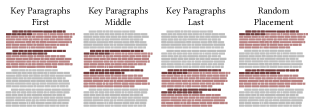
- Vary location of key paragraphs (first, middle, last, random) to study positional effects on performance.
- Evaluate five LLMs (GPT-4, GPT-3.5, Gemini-Pro, Mistral 70B, Mixtral 8x7B) under consistent prompts and settings.
Experimental results
Research questions
- RQ1How does input length affect LLM reasoning performance across different models?
- RQ2Does the placement of essential information within the input influence reasoning accuracy as length grows?
- RQ3Do padding types (duplicate, similar, different) differentially impact long-input reasoning?
- RQ4Is next-word prediction perplexity correlated with long-input reasoning performance?
- RQ5Can Chain-of-Thought prompting mitigate the degradation caused by longer inputs across models?
Key findings
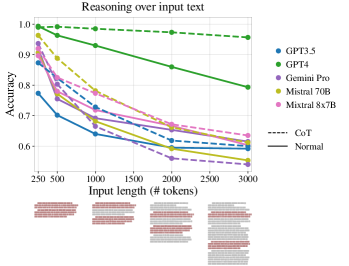
- Reasoning performance degrades with longer inputs across all tested models, even well before reaching their maximum context size.
- The degradation occurs regardless of whether padding is relevant, adjacent, or non-adjacent to the key paragraphs, though intensity varies by model and setup.
- Different irrelevant padding (Books Corpus) generally causes greater degradation than padding similar to the task content.
- Next-word prediction accuracy correlates negatively with long-input reasoning performance (ρ = -0.95, p = 0.01) and cannot substitute downstream task evaluation.
- Chain-of-Thought prompting improves accuracy in many cases but does not fully mitigate long-input degradation; GPT-4 shows the strongest mitigation among those tested.
Read this paper
Open the full text in the Nubint reader and ask about any passage as you read.
Read this paper on NubintThis review was generated by AI from the original paper. Please check the paper before citing it.