
[Paper Review] Scalable Pre-training of Large Autoregressive Image Models
The paper introduces Aim, a family of Vision Transformer models pre-trained with an autoregressive objective, demonstrating scalable gains in image representation quality with model size and data, and linking objective value to downstream performance.
This paper introduces AIM, a collection of vision models pre-trained with an autoregressive objective. These models are inspired by their textual counterparts, i.e., Large Language Models (LLMs), and exhibit similar scaling properties. Specifically, we highlight two key findings: (1) the performance of the visual features scale with both the model capacity and the quantity of data, (2) the value of the objective function correlates with the performance of the model on downstream tasks. We illustrate the practical implication of these findings by pre-training a 7 billion parameter AIM on 2 billion images, that achieves 84.0% on ImageNet-1k with a frozen trunk. Interestingly, even at this scale, we observe no sign of saturation in performance, suggesting that AIM potentially represents a new frontier for training large-scale vision models. The pre-training of AIM is similar to the pre-training of LLMs, and does not require any image-specific strategy to stabilize the training at scale.
Motivation & Objective
- Motivate scaling autoregressive pre-training for vision models analogous to LLMs.
- Demonstrate that increasing model capacity and data improves pre-training loss and downstream accuracy.
- Show that the autoregressive objective correlates with downstream feature quality, enabling scalable vision models.
Proposed method
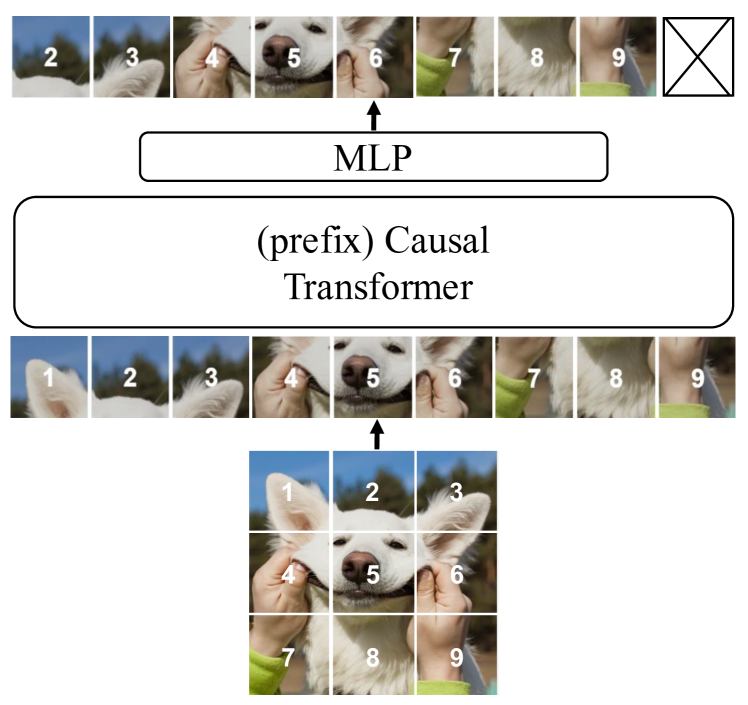
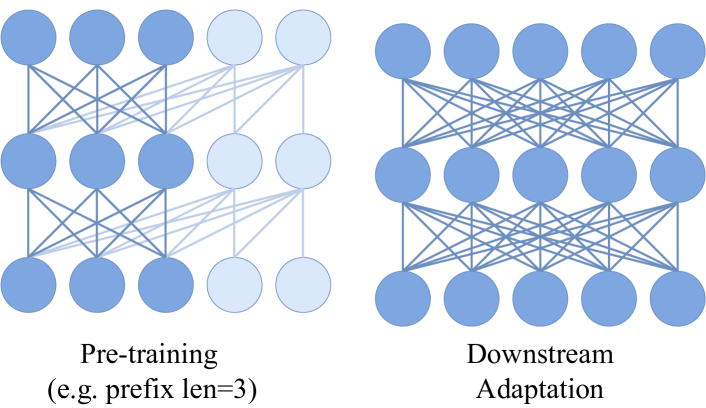
- Use ViT backbones with prefix attention to enable bidirectional downstream use while maintaining autoregressive pre-training.
- Train with a heavily parameterized patch-level MLP head to improve feature quality.
- Pre-train on DFN-2B+ (2B images) with a mix of high-quality and diverse data, using pixel-level MSE loss on normalized patches.
- Adopt a prefix LM training scheme where initial patches form a context and later patches are predicted autoregressively.
- Evaluate features with attentive probing on a frozen trunk across 15 benchmarks.
Experimental results
Research questions
- RQ1Do autoregressive objectives scale effectively for visual representations as in LLMs?
- RQ2How do model size and data amount impact pre-training loss and downstream feature quality for Aim?
- RQ3What architectural choices (prefix attention, MLP head) optimize downstream transfer for vision models?
- RQ4Is there saturation in performance with larger-scale pre-training in vision autoregressive models?
Key findings
- Aim scales in performance with increasing model size from 600M to 7B parameters.
- There is a correlation between validation pre-training loss and downstream feature quality.
- Pre-training on 2B+ images yields strong downstream performance, with no clear saturation observed.
- A data mixture of DFN-2B+ and IN-1k provides the best downstream results among tested datasets.
- Autoregressive objective outperforms masking objectives under the same settings.
- Attentive probing on a frozen trunk shows Aim-7B achieving strong results across 15 benchmarks.
Read this paper
Open the full text in the Nubint reader and ask about any passage as you read.
Read this paper on NubintThis review was generated by AI from the original paper. Please check the paper before citing it.