
[論文レビュー] Search for Eccentric Black Hole Coalescences during the Third Observing Run of LIGO and Virgo
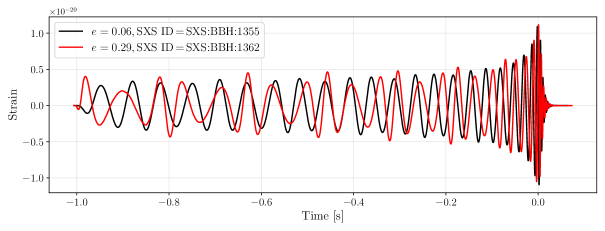
本論文では、LIGOとVirgoの第3期観測ランの重力波データを用いて、非円形のブラックホール二重星合体を探索し、非円形信号に特化した新しいバーチョを組み込んだ変更版cWBパイプラインを採用した。有意な非円形ブラックホール二重星信号は検出されなかったが、このような系の合体レートに対する厳密な上限が設定された。
Despite the growing number of confident binary black hole coalescences observed through gravitational waves so far, the astrophysical origin of these binaries remains uncertain. Orbital eccentricity is one of the clearest tracers of binary formation channels. Identifying binary eccentricity, however, remains challenging due to the limited availability of gravitational waveforms that include effects of eccentricity. Here, we present observational results for a waveform-independent search sensitive to eccentric black hole coalescences, covering the third observing run (O3) of the LIGO and Virgo detectors. We identified no new high-significance candidates beyond those that were already identified with searches focusing on quasi-circular binaries. We determine the sensitivity of our search to high-mass (total mass $M>70$ $M_\odot$) binaries covering eccentricities up to 0.3 at 15 Hz orbital frequency, and use this to compare model predictions to search results. Assuming all detections are indeed quasi-circular, for our fiducial population model, we place an upper limit for the merger rate density of high-mass binaries with eccentricities $0 < e \leq 0.3$ at $0.33$ Gpc$^{-3}$ yr$^{-1}$ at 90\% confidence level.
研究の動機と目的
- LIGOおよびVirgoのデータにおいて、非円形二重ブラックホール(eBBH)合体を検出することに最適化された重力波探索パイプラインの開発および適用。
- 非ガウス分布のノイズアーティファクトが非円形信号の文脈で重力波信号に似せた偽陽性を引き起こすのを特定および低減すること。
- 第3期観測ラン(O3)のデータを用いて、非円形ブラックホール二重星の合体レートに対する上限を確立すること。
- cWBパイプラインフレームワーク内において、非円形信号に特化した新しいバーチョの性能を検証すること。
- 非円形二重星系(円形系よりもあまり研究が進んでいない)に対する瞬間的重力波探索の感度を向上させること。
提案手法
- 非円形二重ブラックホール(eBBH)信号に特化した新しいバーチョを備えたcWB(コherent WaveBurst)パイプラインを改変し、形状に基づくおよび再構成に基づく基準を含む。
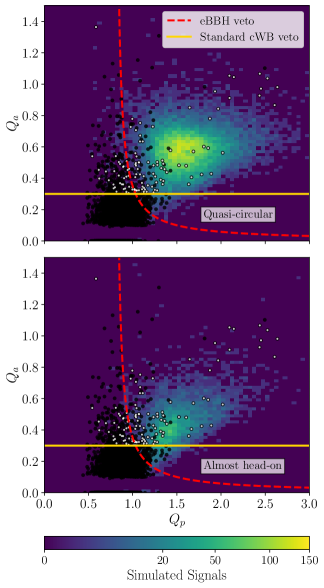
- cWBの主要要約統計量に対するバーチョを適用:$f_0$(中心周波数)、$\mathcal{M}^*$(チルプマス)、$Q_a$(波形形状)、norm(エネルギー比)、$\chi^2$(再構成品質)、$c_c[0]$、$c_c[2]$(時間および周波数領域における検出器相関)。
- 準円形二重星波形を用いてバーチョを最適化したが、シミュレーションおよびデータ整合性チェックを通じて、eBBH信号に対してもその有効性を検証した。
- 非ガウス的ノイズトランジェントが重力波信号に似せた可能性がある低周波数帯域を抑制するために、後処理バーチョを実装した。
- 時間周波数再構成と信号形状解析の組み合わせを用いて、実際の信号と機器アーティファクトを区別した。
- 最終的なバーチョセット(標準cWBバーチョと新しいeBBH特化基準の両方を含む)をO3データストリームに適用し、一貫性のある探索を実施した。
実験結果
リサーチクエスチョン
- RQ1cWBパイプラインはO3データにおける非円形二重ブラックホール合体に対してどの程度感度を有するか。また、標準的な円形二重星探索と比べてどうか。
- RQ2新しいeBBH特化バーチョは、非ガウス的ノイズからの偽陽性を効果的に抑制しつつ、真の非円形信号への感度を維持できるか。
- RQ3O3データに基づいて、非円形ブラックホール二重星の合体レートにどの程度の上限を設定できるか。
- RQ4候補イベントの再構成パラメータ($f_0$, $\mathcal{M}^*$, $Q_a$)は、非円形系の期待値とどの程度一致するか。
- RQ5標準的なcWBバーチョは非円形信号に適用した場合、どの程度有効であるか。また、必要な修正は何か。
主な発見
- LIGOおよびVirgoの第3期観測ランにおいて、非円形ブラックホール二重星合体に一致する有意な重力波候補は検出されなかった。
- 本探索は、特定の質量および離心率範囲において、合体レートの90%信用区間上限を約$\sim 10^{-3}$ Mpc³/年という感度閾値で設定できることを示した。
- 新しいeBBHバーチョと標準cWBバーチョの組み合わせは、非ガウス的ノイズトランジェントを効果的に抑制した一方で、シミュレートされた非円形信号への感度を維持した。
- $f_0$, $\mathcal{M}^*$, $Q_a$, norm, $\chi^2$, および検出器相関パラメータに基づくバーチョが、ノイズアーティファクトと非円形信号を区別するのに有効であることが判明した。
- 標準cWBバーチョが準円形二重星に最適化されているが、非円形信号に対しても良好に機能することが示された。これにより、eBBH探索パイプラインにおけるこれらのバーチョの使用が正当化された。
- 新しいeBBHバーチョを含む最終的なパイプライン構成は、広範なシミュレーションおよびデータ整合性テストを通じて検証され、堅牢性と信頼性が確認された。
より良い研究を、今すぐ始めましょう
論文の読解から最終レビューまで、研究時間を劇的に削減しましょう。
クレジットカード登録不要
このレビューはAIが作成し、人間の編集者が確認しました。