
[Paper Review] Search for supersymmetry in final states with disappearing tracks in proton-proton collisions at $\sqrt{s}$ = 13 TeV
This paper presents a search for supersymmetry in proton-proton collisions at √s = 13 TeV using the CMS detector, focusing on final states with disappearing tracks from long-lived charginos. By employing advanced track reconstruction, dE/dx measurements, and machine learning-based classification, the analysis improves sensitivity to wino- and higgsino-like charginos, setting the most stringent limits to date on gluino and squark pair production and on electroweakino production, with no significant excess over background observed.
A search is presented for charged, long-lived supersymmetric particles in final states with one or more disappearing tracks. The search is based on data from proton-proton collisions at a center-of-mass energy of 13 TeV collected with the CMS detector at the CERN LHC between 2016 and 2018, corresponding to an integrated luminosity of 137 fb$^{-1}$. The search is performed over final states characterized by varying numbers of jets, b-tagged jets, electrons, and muons. The length of signal-candidate tracks in the plane perpendicular to the beam axis is used to characterize the lifetimes of wino- and higgsino-like charginos produced in the context of the minimal supersymmetric standard model. The d$E$/d$x$ energy loss of signal-candidate tracks is used to increase the sensitivity to charginos with a large mass and thus a small Lorentz boost. The observed results are found to be statistically consistent with the background-only hypothesis. Limits on the pair production cross section of gluinos and squarks are presented in the framework of simplified models of supersymmetric particle production and decay, and for electroweakino production based on models of wino and higgsino dark matter. The limits presented are the most stringent to date for scenarios with light third-generation squarks and a wino- or higgsino-like dark matter candidate capable of explaining the known dark matter relic density.
Motivation & Objective
- To search for long-lived supersymmetric particles, particularly charginos, in final states with disappearing tracks using 137 fb⁻¹ of proton-proton collision data at √s = 13 TeV.
- To improve sensitivity to wino- and higgsino-like charginos by incorporating dE/dx measurements and machine learning-based track classification.
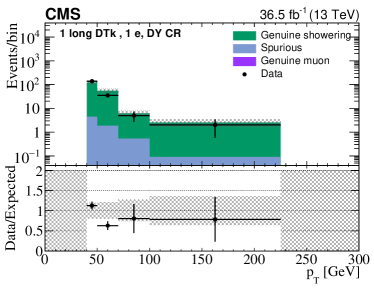
- To extend the search to new final states, including electron+DTk and muon+DTk channels, to probe leptonic decay modes.
- To set the most stringent exclusion limits to date on simplified models of supersymmetric particle production and electroweakino dark matter scenarios.
Proposed method
- Utilizes 137 fb⁻¹ of pp collision data collected by the CMS detector at √s = 13 TeV between 2016 and 2018.
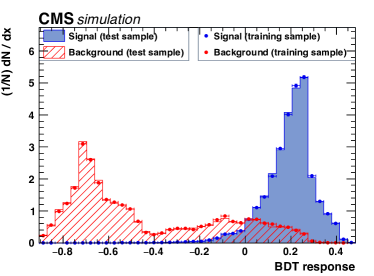
- Applies a machine-learning-based track classification algorithm to enhance the efficiency and background rejection in identifying disappearing tracks.
- Employs dE/dx measurements of signal-candidate tracks to improve sensitivity to charginos with small Lorentz boosts, particularly at high masses.
- Defines search regions based on jet, b-tagged jet, electron, and muon multiplicities to distinguish between strong and electroweak production mechanisms.
- Uses simulated event samples to model signal and Standard Model backgrounds, with detailed systematic uncertainty assessments.
- Performs a statistical test comparing observed data to the background-only hypothesis, finding consistency with no new physics signal.
Experimental results
Research questions
- RQ1What are the most stringent limits on pair production of gluinos and squarks in simplified models of supersymmetry, given the disappearing track signature?
- RQ2How does the inclusion of electron+DTk and muon+DTk final states improve sensitivity to long-lived charginos in electroweakino-mediated scenarios?
- RQ3To what extent does dE/dx measurement enhance sensitivity to high-mass charginos with low Lorentz boosts?
- RQ4What are the exclusion limits for pure wino and higgsino dark matter models based on long-lived chargino decays?
- RQ5How do the results constrain scenarios with light third-generation squarks and a wino- or higgsino-like LSP?
Key findings
- The observed data are statistically consistent with the background-only hypothesis, with no significant excess indicating new physics.
- The analysis sets the most stringent exclusion limits to date for scenarios with light third-generation squarks and a wino- or higgsino-like dark matter candidate.
- For the pure wino dark matter model, charginos are excluded up to a mass of 650 GeV.
- For the pure higgsino dark matter model, charginos are excluded up to a mass of 210 GeV.
- The inclusion of electron+DTk and muon+DTk channels, along with dE/dx-based selection, significantly enhances sensitivity to high-mass and low-boost charginos.
- The machine-learning-based track classification improves signal efficiency and background rejection, increasing the overall sensitivity of the search.
Read this paper
Open the full text in the Nubint reader and ask about any passage as you read.
Read this paper on NubintThis review was generated by AI from the original paper. Please check the paper before citing it.