
[Paper Review] Searching for degenerate Higgs bosons - A profile likelihood ratio method to test for mass-degenerate states in the presence of incomplete data and uncertainties
This paper presents a profile likelihood ratio method to test for mass-degenerate Higgs bosons using signal strength matrices from LHC data, accounting for incomplete measurements and experimental uncertainties. The method assesses statistical compatibility with a single Higgs boson by evaluating matrix rank via test statistics derived from pseudo-experiments, demonstrating robustness even with missing data and varying uncertainties.
Using the likelihood ratio test statistic, we present a method which can be employed to test the hypothesis of a single Higgs boson using the matrix of measured signal strengths. This method can be applied in the presence of incomplete data and takes into account uncertainties on the measurements. The p-value against the hypothesis of a single Higgs boson is defined from the expected distribution of the test statistic, generated using pseudo-experiments. The applicability of the likelihood-based test is demonstrated using numerical examples with uncertainties and missing matrix elements.
Motivation & Objective
- To develop a statistical method that tests the hypothesis of a single Higgs boson against the possibility of multiple nearly-degenerate Higgs states using signal strength measurements.
- To address the challenge of incomplete data, where some signal strength measurements (e.g., μ_VH,WW) are missing or not yet measured.
- To incorporate experimental uncertainties in signal strength measurements into the statistical test, ensuring robustness in real-world LHC data conditions.
- To enable the use of matrix rank analysis as a probe for new physics without requiring direct resolution of resonant peaks.
- To provide a method compatible with existing LHC analysis frameworks, particularly those using profile likelihood ratio techniques.
Proposed method
- The method uses the profile likelihood ratio test statistic to compare the compatibility of observed signal strength matrices with the hypothesis of a single Higgs boson (rank-1 matrix) versus multiple states (rank >1).
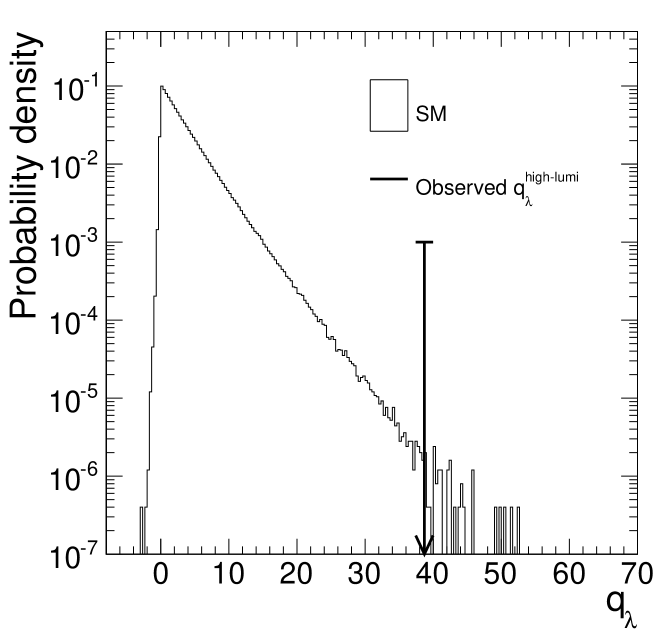
- The test statistic qλ is defined as the ratio of the profiled likelihood under the null hypothesis (single Higgs) to the likelihood under the alternative (generalized matrix), with higher values indicating stronger evidence against the single Higgs hypothesis.
- Pseudo-experiments are generated under the SM hypothesis to estimate the expected distribution of qλ, enabling p-value calculation for statistical significance.
- Missing matrix elements are handled by setting their values to unity in the denominator of the test statistic when necessary, preserving numerical stability during minimization.
- The method accounts for measurement uncertainties by incorporating them into the likelihood function during pseudo-experiment generation and profile likelihood maximization.
- The approach is applied to sub-matrices of signal strengths (e.g., 2×2, 3×3) from ggH, VBF, and VH production modes with γγ, WW, and ττ decay channels.

Experimental results
Research questions
- RQ1Can a statistical test based on matrix rank detect the presence of multiple nearly-degenerate Higgs bosons without resolving their individual resonances?
- RQ2How does the presence of missing signal strength measurements affect the statistical power of a rank-based test for degenerate Higgs states?
- RQ3To what extent do experimental uncertainties in signal strength measurements bias or distort the outcome of a matrix rank test?
- RQ4Can the profile likelihood ratio method reliably assess the compatibility of LHC signal strength data with a single Higgs boson hypothesis in the presence of incomplete and uncertain data?
- RQ5What is the statistical significance (p-value) of observed signal strength matrices under the null hypothesis of a single Higgs boson, especially when data is incomplete?
Key findings
- For the 3×3 sub-matrix of (ggH, VBF, VH) × (γγ, WW, ττ), the observed test statistic was qλ^3×3 = 4.28, yielding a p-value of 0.35, corresponding to a 0.4σ significance for a rank greater than one.
- When two high-uncertainty elements (μ_VBF,γγ and μ_VH,WW) were removed, the test statistic dropped to qλ,mis.2^3×3 = 0.28, resulting in a p-value of 0.81, indicating no evidence against the single Higgs hypothesis (−0.86σ significance).
- With three elements removed (including μ_ττ), the test statistic was qλ,mis.3^3×3 = 0.31, yielding a p-value of 0.44, corresponding to a 0.15σ significance for rank >1.
- The method successfully handles missing data by setting missing signal strengths to unity in the test statistic denominator, maintaining numerical stability and statistical validity.
- The profile likelihood ratio method remains robust under varying data completeness and uncertainty levels, as demonstrated across multiple test cases with different matrix configurations.
- The results show that even with incomplete data and uncertainties, the method can reliably assess the compatibility of signal strength matrices with the single Higgs hypothesis using p-values derived from SM-simulated pseudo-experiments.
Read this paper
Open the full text in the Nubint reader and ask about any passage as you read.
Read this paper on NubintThis review was generated by AI from the original paper. Please check the paper before citing it.