
[Paper Review] Seeing through the Brain: Image Reconstruction of Visual Perception from Human Brain Signals
This paper proposes NeuroImagen, a novel pipeline for reconstructing high-resolution visual stimuli from portable EEG signals using multi-level semantic decoding and latent diffusion models. By extracting both pixel-level saliency maps and sample-level textual descriptions from noisy, time-series EEG data, the method achieves superior image reconstruction quality, with state-of-the-art FID and IS scores on EEG-image datasets.
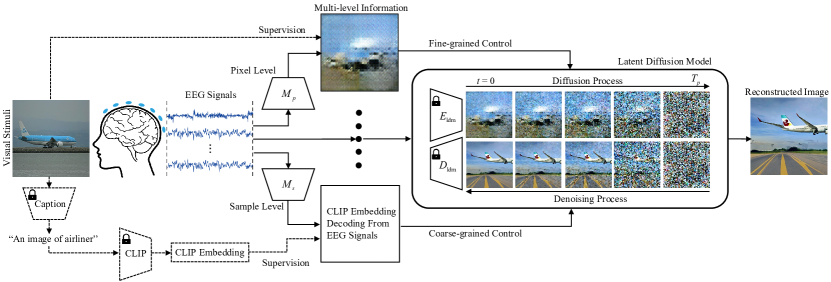
Seeing is believing, however, the underlying mechanism of how human visual perceptions are intertwined with our cognitions is still a mystery. Thanks to the recent advances in both neuroscience and artificial intelligence, we have been able to record the visually evoked brain activities and mimic the visual perception ability through computational approaches. In this paper, we pay attention to visual stimuli reconstruction by reconstructing the observed images based on portably accessible brain signals, i.e., electroencephalography (EEG) data. Since EEG signals are dynamic in the time-series format and are notorious to be noisy, processing and extracting useful information requires more dedicated efforts; In this paper, we propose a comprehensive pipeline, named NeuroImagen, for reconstructing visual stimuli images from EEG signals. Specifically, we incorporate a novel multi-level perceptual information decoding to draw multi-grained outputs from the given EEG data. A latent diffusion model will then leverage the extracted information to reconstruct the high-resolution visual stimuli images. The experimental results have illustrated the effectiveness of image reconstruction and superior quantitative performance of our proposed method.
Motivation & Objective
- To address the challenge of reconstructing high-resolution visual stimuli from noisy, time-series EEG signals, which are less explored than fMRI-based approaches.
- To improve image reconstruction quality by decoding multi-grained semantic information—both pixel-level saliency and sample-level textual descriptions—from EEG data.
- To leverage pretrained latent diffusion models for high-fidelity image generation, guided by decoded semantic priors extracted from EEG.
- To validate the robustness and generalization of the framework across different subjects with subject-specific EEG patterns.
- To demonstrate the superiority of the proposed method over existing EEG-based image reconstruction baselines in both qualitative and quantitative metrics.
Proposed method
- Proposes a multi-level perceptual information decoding module that extracts both pixel-level semantics (e.g., saliency maps) and sample-level semantics (e.g., textual descriptions) from EEG signals.
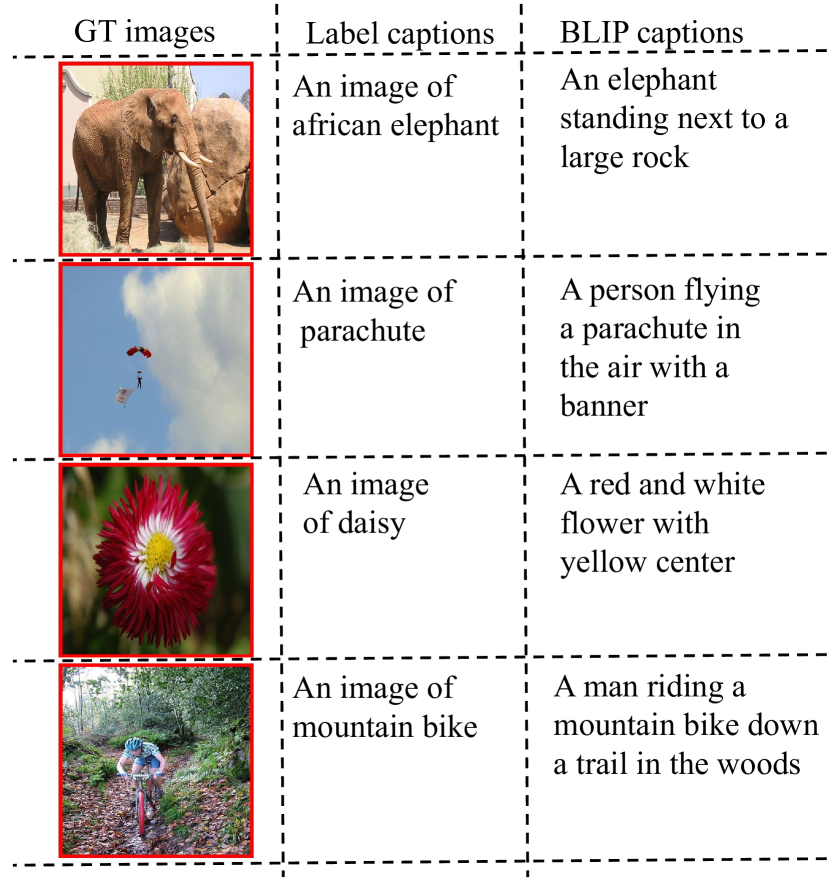
- Uses BLIP captioning and label-based captioning as supervision signals for sample-level semantic decoding to guide the diffusion process.
- Integrates extracted semantic priors into a latent diffusion model (LDM) to generate high-resolution images conditioned on EEG-derived representations.
- Employs a two-stage training strategy: uses pixel-level and sample-level supervision during training (removed at inference), enabling effective control of the diffusion process.
- Leverages a pretrained diffusion model in the latent space to improve generation efficiency and image quality while maintaining fidelity to the original visual stimuli.
- Applies a control mechanism that aligns semantic priors with diffusion model denoising steps, enabling structured image generation from complex EEG inputs.
Experimental results
Research questions
- RQ1Can multi-level semantic decoding from EEG signals—spanning from pixel-level saliency to sample-level textual descriptions—improve the quality and semantic accuracy of reconstructed visual stimuli?
- RQ2How does the integration of pretrained latent diffusion models with EEG-derived semantic priors compare to end-to-end generative models or retrieval-based baselines in EEG-to-image reconstruction?
- RQ3To what extent does the proposed method generalize across different subjects with subject-specific EEG patterns and low signal-to-noise ratios?
- RQ4What is the relative contribution of pixel-level semantics (e.g., saliency maps) versus sample-level semantics (e.g., caption supervision) in enhancing structural and semantic similarity of reconstructed images?
- RQ5Does label-based caption supervision outperform BLIP-based caption supervision in decoding class-level semantics from EEG signals?
Key findings
- NeuroImagen achieves state-of-the-art Fréchet Inception Distance (FID) and Inception Score (IS) on the EEG-image dataset, with an IS of 32.97 on subject 05 and 32.64 on subject 01.
- The use of pixel-level semantics (saliency maps) significantly improves structural similarity (SSIM), increasing it from 0.157 (baseline) to 0.251 in ablation studies.
- Incorporating sample-level semantics via label caption supervision yields higher performance than BLIP caption supervision, with a 3.5-point increase in IS and 0.015 increase in SSIM.
- The model demonstrates strong cross-subject generalization, with consistent performance across six subjects, achieving an average accuracy of 85.8% on the classification of reconstructed image classes.
- Ablation studies confirm that combining both pixel-level and sample-level semantics leads to the highest-quality reconstructions, with the best IS (32.97) and SSIM (0.251) scores.
- Qualitative results show that NeuroImagen generates semantically coherent and structurally accurate images that closely resemble ground-truth stimuli, outperforming baselines like Brain2Image and NeuroVision in visual fidelity.
Read this paper
Open the full text in the Nubint reader and ask about any passage as you read.
Read this paper on NubintThis review was generated by AI from the original paper. Please check the paper before citing it.