
[Paper Review] Segment Anything Model (SAM) Meets Glass: Mirror and Transparent Objects Cannot Be Easily Detected
The paper evaluates SAM on glass-related tasks and finds that SAM often fails to detect transparent and mirror objects, raising safety concerns for real-world deployment.
Meta AI Research has recently released SAM (Segment Anything Model) which is trained on a large segmentation dataset of over 1 billion masks. As a foundation model in the field of computer vision, SAM (Segment Anything Model) has gained attention for its impressive performance in generic object segmentation. Despite its strong capability in a wide range of zero-shot transfer tasks, it remains unknown whether SAM can detect things in challenging setups like transparent objects. In this work, we perform an empirical evaluation of two glass-related challenging scenarios: mirror and transparent objects. We found that SAM often fails to detect the glass in both scenarios, which raises concern for deploying the SAM in safety-critical situations that have various forms of glass.
Motivation & Objective
- Assess SAM's ability to segment transparent and mirror objects in controlled benchmarks.
- Quantify SAM's performance against dedicated glass and mirror segmentation methods.
- Identify failure modes of SAM due to reflection, refraction, and boundary ambiguity on glass surfaces.
Proposed method
- Use best pre-trained SAM model (VIT-H) on SA-1B pretraining.
- Evaluate SAM outputs by computing IoU with ground truth for the object with highest IoU per image.
- Compare SAM against state-of-the-art glass and mirror segmentation methods across multiple datasets.
- Employ evaluation metrics: IoU, pixel accuracy, F-beta, MAE, BER.
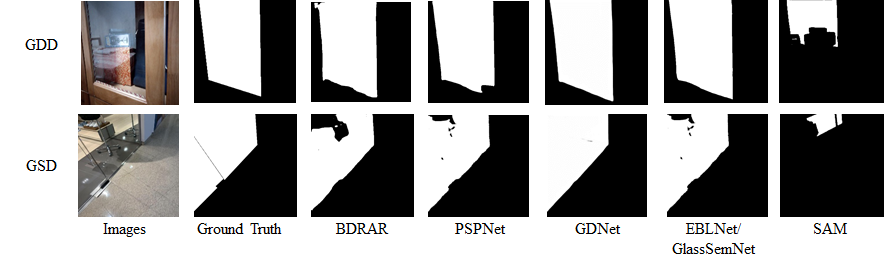
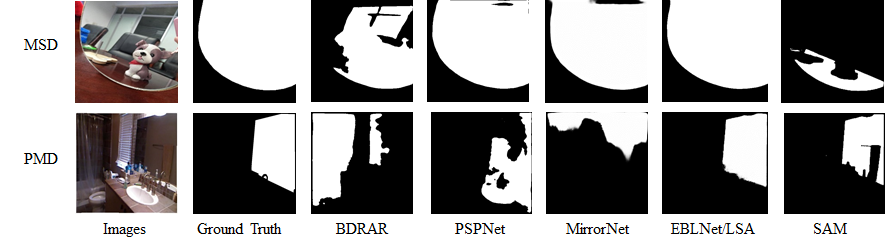
- Visualize results with pseudo-binary representations to highlight segmentation gaps.
Experimental results
Research questions
- RQ1Can SAM detect and segment transparent (glass) objects across standard glass datasets?
- RQ2Can SAM detect mirror objects across standard mirror datasets?
- RQ3How does SAM's performance compare to specialized glass/mirror segmentation models on these benchmarks?
- RQ4What are the common failure modes of SAM with glass and mirror objects?
Key findings
- SAM achieves low IoU on glass datasets (GDD: 48.47 IoU; GSD: 50.60 IoU) compared to specialized methods.
- SAM struggles to detect glass boundaries and often segments objects behind glass rather than the glass itself.
- On mirror datasets, SAM performance is mixed; MSD results show IoU of 51.57, while PMD results reach 64.75 IoU, indicating dataset-dependent behavior.
- SAM tends to segment interior reflections or objects within mirrors rather than the mirror surface itself, highlighting failure modes in reflective scenes.
- Compared to dedicated glass and mirror models (e.g., EBLNet, GlassNet, MirrorNet), SAM underperforms on most glass datasets but shows relatively competitive results on some PMD mirror images.
Read this paper
Open the full text in the Nubint reader and ask about any passage as you read.
Read this paper on NubintThis review was generated by AI from the original paper. Please check the paper before citing it.