
[Paper Review] Self-Checker: Plug-and-Play Modules for Fact-Checking with Large Language Models
Self-Checker is a plug-and-play framework that enables zero-shot fact-checking using large language models (LLMs) through four prompting-based modules: claim processing, query generation, evidence retrieval, and verdict prediction. Empirical results show it achieves competitive performance on WiCE and Fever datasets, though it lags behind fine-tuned SOTA models, highlighting the potential and current limitations of LLM prompting for fact-checking.
Fact-checking is an essential task in NLP that is commonly utilized for validating the factual accuracy of claims. Prior work has mainly focused on fine-tuning pre-trained languages models on specific datasets, which can be computationally intensive and time-consuming. With the rapid development of large language models (LLMs), such as ChatGPT and GPT-3, researchers are now exploring their in-context learning capabilities for a wide range of tasks. In this paper, we aim to assess the capacity of LLMs for fact-checking by introducing Self-Checker, a framework comprising a set of plug-and-play modules that facilitate fact-checking by purely prompting LLMs in an almost zero-shot setting. This framework provides a fast and efficient way to construct fact-checking systems in low-resource environments. Empirical results demonstrate the potential of Self-Checker in utilizing LLMs for fact-checking. However, there is still significant room for improvement compared to SOTA fine-tuned models, which suggests that LLM adoption could be a promising approach for future fact-checking research.
Motivation & Objective
- To develop a training-free, efficient fact-checking system using large language models (LLMs) without fine-tuning.
- To address the challenge of LLM hallucination by enabling automated verification of generated claims through external evidence.
- To enable rapid deployment in low-resource or new-domain settings through modular, prompt-based components.
- To evaluate the effectiveness of purely prompting-based LLMs for fact-checking compared to fine-tuned SOTA models.
- To identify bottlenecks in the fact-checking pipeline when using LLMs, particularly in verdict prediction.
Proposed method
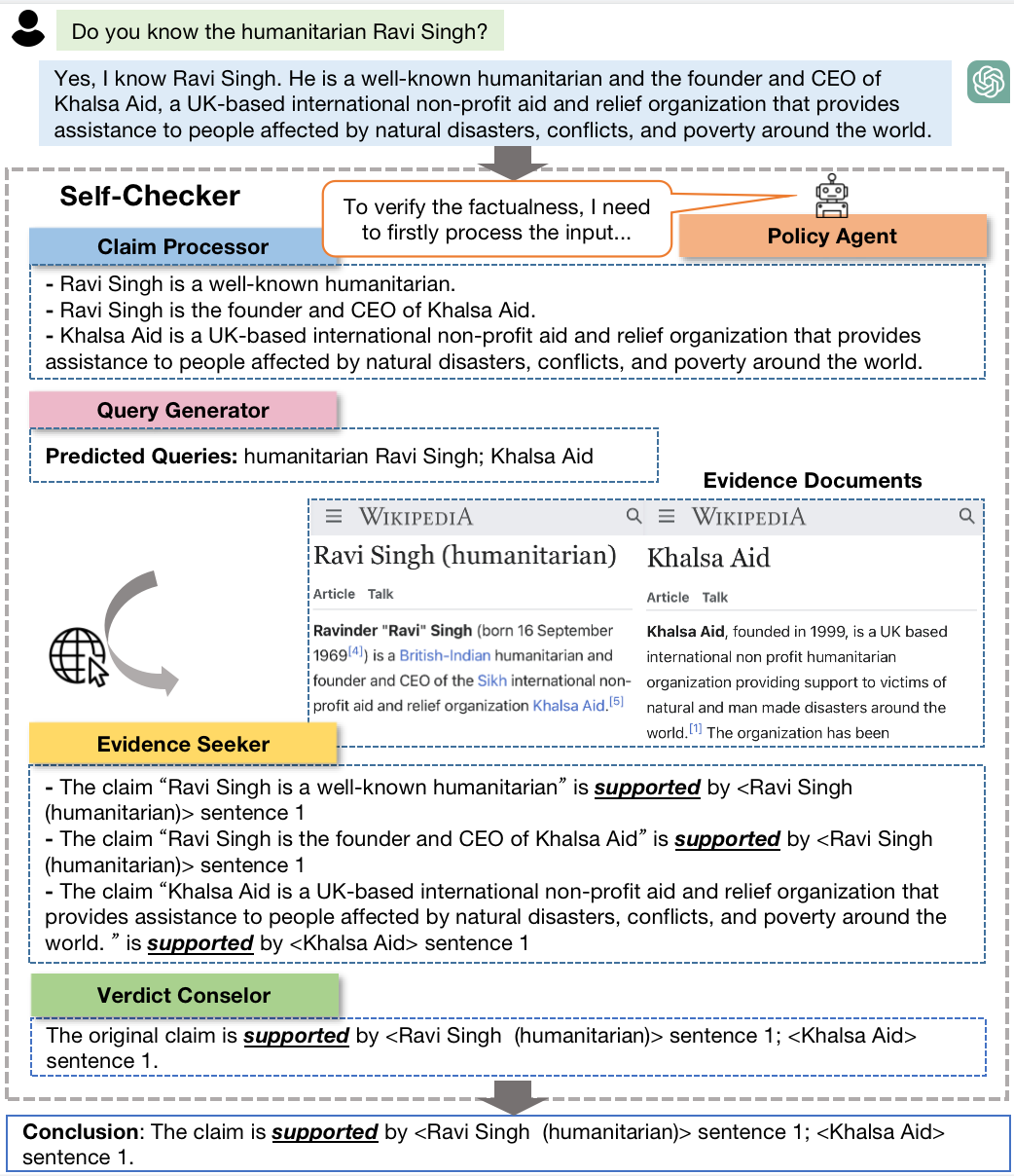
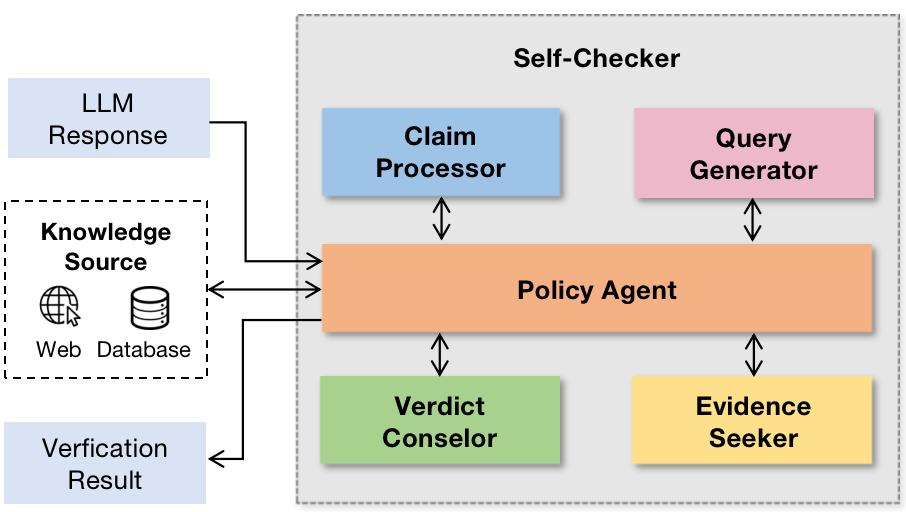
- Decomposes complex claims into simpler, verifiable sub-claims using a claim processor module prompted with in-context examples.
- Generates targeted search queries for each sub-claim using a query generator module, enabling retrieval from knowledge sources like Wikipedia.
- Employs an evidence seeker module to extract relevant evidence sentences from retrieved documents using LLM prompting.
- Uses a verdict counselor module to assess claim veracity based on extracted evidence, aggregating results across multiple claims.
- Integrates a policy agent to orchestrate the workflow across modules based on task instructions and in-context examples.
- Operates in an almost zero-shot setting by relying on in-context learning with demonstrations, avoiding model fine-tuning.
Experimental results
Research questions
- RQ1Can LLMs be effectively leveraged for fact-checking without fine-tuning, using only prompting and in-context learning?
- RQ2How does the performance of a purely prompting-based fact-checking system compare to state-of-the-art fine-tuned models?
- RQ3Which component in the fact-checking pipeline is the primary bottleneck when using LLMs for verification?
- RQ4To what extent does claim decomposition improve evidence retrieval and verdict prediction in an LLM-based fact-checking system?
- RQ5Can the modular, plug-and-play design of Self-Checker be effectively adapted to new domains with minimal resource requirements?
Key findings
- Self-Checker demonstrates strong potential in zero-shot fact-checking, achieving reasonable performance on both WiCE and Fever datasets without any model fine-tuning.
- The verdict counselor module is identified as the primary bottleneck in the pipeline, indicating that claim verification remains a key challenge for LLM-based systems.
- Evidence retrieval performance is not the main limiting factor, as improvements in the evidence seeker module do not significantly boost overall results.
- Claim decomposition improves both evidence retrieval and verdict prediction, consistent with prior findings, and enhances the system's overall accuracy.
- Despite its efficiency and adaptability, Self-Checker's performance remains below that of SOTA fine-tuned models, suggesting room for optimization in LLM prompting strategies.
- The framework enables rapid deployment in low-resource settings and supports easy integration of new data or domains through its modular, prompt-based design.
Read this paper
Open the full text in the Nubint reader and ask about any passage as you read.
Read this paper on NubintThis review was generated by AI from the original paper. Please check the paper before citing it.