
[Paper Review] Semi-Supervised Learning for Mars Imagery Classification and Segmentation
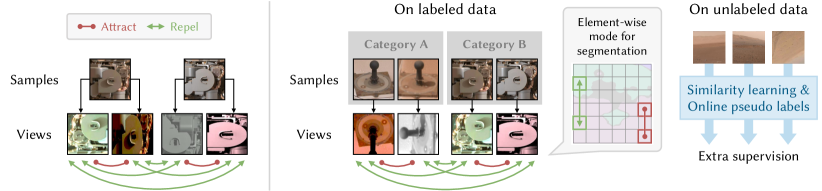
This paper proposes a semi-supervised contrastive learning framework for Mars imagery classification and segmentation that addresses severe train-test distribution shifts and data quality issues by leveraging labeled data for supervised inter-class contrastive learning and unlabeled data via online pseudo-labeling and similarity learning. The method achieves state-of-the-art performance, improving mIoU by 4.11% over baseline and outperforming existing approaches on the AI4Mars dataset.
With the progress of Mars exploration, numerous Mars image data are collected and need to be analyzed. However, due to the imbalance and distortion of Martian data, the performance of existing computer vision models is unsatisfactory. In this paper, we introduce a semi-supervised framework for machine vision on Mars and try to resolve two specific tasks: classification and segmentation. Contrastive learning is a powerful representation learning technique. However, there is too much information overlap between Martian data samples, leading to a contradiction between contrastive learning and Martian data. Our key idea is to reconcile this contradiction with the help of annotations and further take advantage of unlabeled data to improve performance. For classification, we propose to ignore inner-class pairs on labeled data as well as neglect negative pairs on unlabeled data, forming supervised inter-class contrastive learning and unsupervised similarity learning. For segmentation, we extend supervised inter-class contrastive learning into an element-wise mode and use online pseudo labels for supervision on unlabeled areas. Experimental results show that our learning strategies can improve the classification and segmentation models by a large margin and outperform state-of-the-art approaches.
Motivation & Objective
- Address the severe train-test distribution gap and low data quality in Mars rover imagery, which hinder conventional computer vision models.
- Develop a robust representation learning framework tailored to extraterrestrial planetary data with limited and noisy annotations.
- Improve performance on Mars-specific vision tasks—image classification and semantic segmentation—using semi-supervised learning.
- Reconcile the contradiction between contrastive learning and high inter-sample similarity in Mars data by integrating supervision with unlabeled data.
- Demonstrate generalization to downstream vision tasks like object detection and tracking through improved feature representations.
Proposed method
- Propose supervised inter-class contrastive learning by excluding inner-class pairs in labeled data to avoid redundancy.
- Apply unsupervised similarity learning on unlabeled data by neglecting negative pairs, focusing on feature compactness.
- Extend contrastive learning to an element-wise, pixel-level formulation for semantic segmentation.
- Introduce online pseudo-labeling for unlabeled regions, using high-confidence predictions to provide dynamic supervision.
- Jointly optimize segmentation and contrastive learning with a balanced loss function, using a weighted combination of segmentation and contrastive losses.
- Use a threshold (set to 0.9) to filter low-confidence pseudo-labels and reduce noise in the training signal.
Experimental results
Research questions
- RQ1Can contrastive learning be effectively applied to Mars imagery despite high inter-sample similarity and data distortion?
- RQ2How can semi-supervised learning strategies mitigate the severe train-test distribution gap in Mars rover datasets?
- RQ3What is the optimal balance between contrastive learning and segmentation loss for joint training on Mars data?
- RQ4How does online pseudo-labeling with confidence thresholds affect segmentation performance and robustness?
- RQ5To what extent do the proposed designs improve feature compactness and separability on Mars-specific visual representations?
Key findings
- The proposed method achieves a mIoU of 70.34% on the AI4Mars segmentation benchmark, representing a 4.11% improvement over the baseline.
- The ablation study confirms that joint semi-supervised learning with pretraining and online pseudo-labeling yields the highest performance, with mIoU increasing from 66.23% to 70.34%.
- Setting the pseudo-label threshold to 0.9 yields optimal performance, as lower thresholds introduce noise and higher thresholds reduce supervision.
- The optimal loss weight for contrastive learning ($\lambda^{s}_{seg} = 0.001$) balances feature learning and segmentation accuracy, maximizing mIoU at 70.34%.
- Feature visualization confirms that the proposed method produces more compact and separable representations, especially for distinct classes like soil and sand.
- Subjective segmentation results show finer boundaries and fewer misclassifications (e.g., soil vs. sand) compared to the baseline.
Read this paper
Open the full text in the Nubint reader and ask about any passage as you read.
Read this paper on NubintThis review was generated by AI from the original paper. Please check the paper before citing it.