
[Paper Review] Semi-supervised Object Detection: A Survey on Recent Research and Progress
This survey provides a comprehensive overview of semi-supervised object detection (SSOD) methods, categorizing them into pseudo-labeling, consistency regularization, graph-based, and transfer learning strategies. It highlights state-of-the-art results on MS-COCO and PASCAL-VOC, with methods like Dense Teacher and Label Match achieving AP50:95 scores above 37% and 56.8%, respectively, under low-label regimes.
In recent years, deep learning technology has been maturely applied in the field of object detection, and most algorithms tend to be supervised learning. However, a large amount of labeled data requires high costs of human resources, which brings about low efficiency and limitations. Semi-supervised object detection (SSOD) has been paid more and more attentions due to its high research value and practicability. It is designed to learn information by using small amounts of labeled data and large amounts of unlabeled data. In this paper, we present a comprehensive and up-to-date survey on the SSOD approaches from five aspects. We first briefly introduce several ways of data augmentation. Then, we dive the mainstream semi-supervised strategies into pseudo labels, consistent regularization, graph based and transfer learning based methods, and introduce some methods in challenging settings. We further present widely-used loss functions, and then we outline the common benchmark datasets and compare the accuracy among different representative approaches. Finally, we conclude this paper and present some promising research directions for the future. Our survey aims to provide researchers and practitioners new to the field as well as more advanced readers with a solid understanding of the main approaches developed over the past few years.
Motivation & Objective
- To provide a systematic review of recent advances in semi-supervised object detection (SSOD) due to the high cost of labeling large-scale datasets.
- To analyze and categorize SSOD methods based on core strategies such as pseudo-labeling, consistency regularization, graph-based learning, and transfer learning.
- To evaluate the performance of leading SSOD methods on standard benchmarks like MS-COCO and PASCAL-VOC using standard metrics (AP50, AP50:95).
- To identify key challenges such as confirmation bias, noisy pseudo-labels, and class imbalance in unlabeled data, and propose future research directions.
- To serve as a foundational reference for researchers and practitioners entering the SSOD field, offering insights into methodological innovations and practical trade-offs.
Proposed method
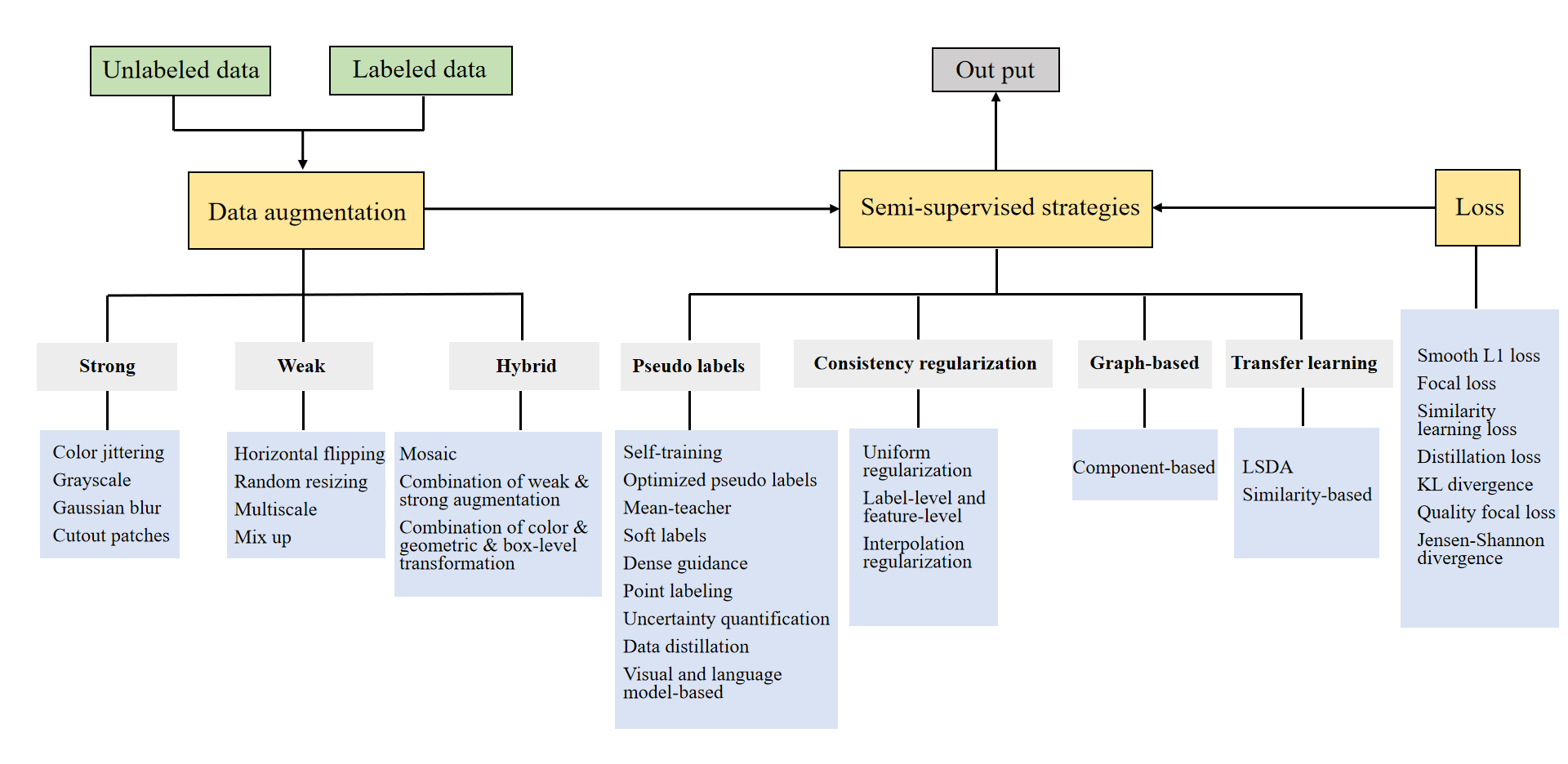
- Categorizes SSOD approaches into four main strategies: pseudo-labeling, consistency regularization, graph-based methods, and transfer learning-based techniques.
- Reviews data augmentation techniques, particularly strong augmentation, to improve model robustness and consistency in predictions across augmented views.
- Analyzes widely used loss functions, including cross-entropy and consistency loss, to optimize model training with both labeled and unlabeled data.
- Evaluates methods using standard benchmarks such as MS-COCO and PASCAL-VOC, with training protocols using 1% or 5% labeled data and the rest as unlabeled.
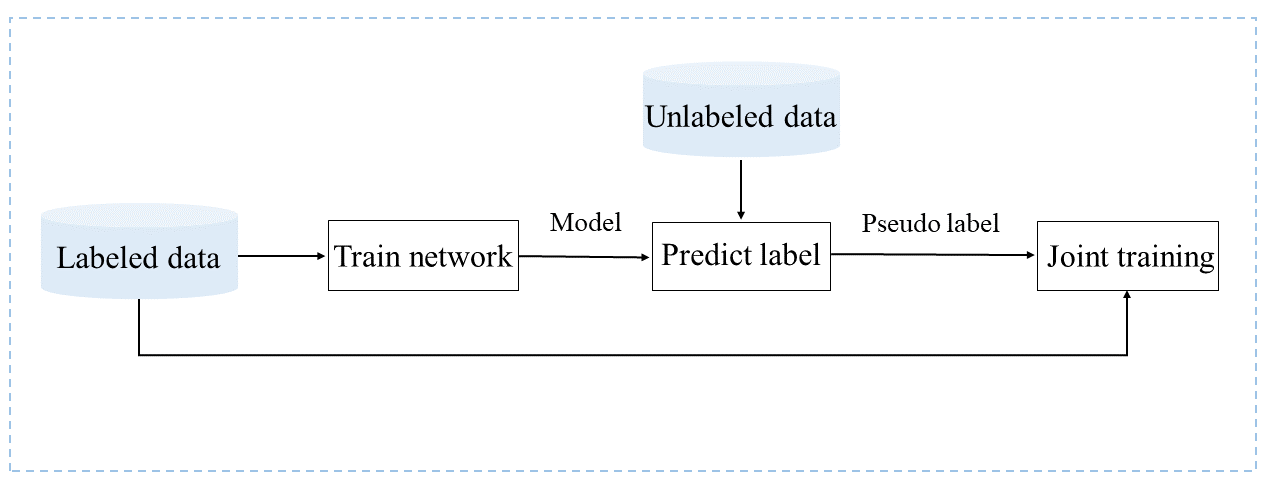
- Introduces advanced techniques like soft labels, dense guidance, and point-based labels to improve pseudo-label quality and reduce reliance on NMS and thresholding.
- Proposes a taxonomy of SSOD frameworks based on the training pipeline, including teacher-student distillation, iterative refinement, and self-training mechanisms.
Experimental results
Research questions
- RQ1How do different semi-supervised strategies—pseudo-labeling, consistency regularization, graph-based, and transfer learning—compare in performance and robustness on object detection benchmarks?
- RQ2What are the key challenges in generating high-quality pseudo-labels, and how do recent methods mitigate issues like confirmation bias and noisy labels?
- RQ3How do different label forms (e.g., soft labels, point labels, dense guidance) affect detection accuracy and training efficiency in low-labeled-data regimes?
- RQ4To what extent can current SSOD methods generalize to real-world scenarios with imbalanced or noisy unlabeled data?
- RQ5What are the most effective data augmentation and loss functions for improving model generalization in semi-supervised object detection?
Key findings
- Dense Teacher achieved an AP50:95 of 37.13±0.12 on MS-COCO using only 1% labeled data, demonstrating the effectiveness of dense guidance and soft label learning.
- Label Match achieved the highest AP50:95 of 56.80±0.18 on PASCAL-VOC, outperforming other methods by leveraging high-quality pseudo-labels and balanced teacher proposals.
- Methods like Soft Teacher and Cross Rectify achieved AP50:95 scores above 34% on MS-COCO with 1% labeled data, indicating strong performance under low-supervision settings.
- The use of soft labels and balanced region proposals significantly improves performance, reducing the need for post-processing steps like NMS and thresholding.
- Current SOTA methods show strong robustness to noisy unlabeled data, but performance degrades when class imbalance is present in the unlabeled set.
- The combination of strong data augmentation and consistency regularization leads to consistent improvements across multiple benchmarks, especially in low-data regimes.
Read this paper
Open the full text in the Nubint reader and ask about any passage as you read.
Read this paper on NubintThis review was generated by AI from the original paper. Please check the paper before citing it.