
[Paper Review] Separating form and meaning: Using self-consistency to quantify task understanding across multiple senses
This paper proposes a novel evaluation paradigm that measures large language model (LLM) understanding through self-consistency across multiple linguistic forms—specifically, multilingual translations—rather than relying on static benchmarks. By having the model generate translations of its own inputs and evaluating consistency in outputs across languages, the method detects inconsistencies indicating form-dependent understanding. The study finds that even state-of-the-art ChatGPT exhibits significant multilingual inconsistency, revealing that its task understanding is not robust to linguistic form changes.
At the staggering pace with which the capabilities of large language models (LLMs) are increasing, creating future-proof evaluation sets to assess their understanding becomes more and more challenging. In this paper, we propose a novel paradigm for evaluating LLMs which leverages the idea that correct world understanding should be consistent across different (Fregean) senses of the same meaning. Accordingly, we measure understanding not in terms of correctness but by evaluating consistency across multiple senses that are generated by the model itself. We showcase our approach by instantiating a test where the different senses are different languages, hence using multilingual self-consistency as a litmus test for the model's understanding and simultaneously addressing the important topic of multilinguality. Taking one of the latest versions of ChatGPT as our object of study, we evaluate multilingual consistency for two different tasks across three different languages. We show that its multilingual consistency is still lacking, and that its task and world understanding are thus not language-independent. As our approach does not require any static evaluation corpora in languages other than English, it can easily and cheaply be extended to different languages and tasks and could become an integral part of future benchmarking efforts.
Motivation & Objective
- To address the challenge of evaluating whether LLMs understand tasks beyond surface-level form patterns.
- To mitigate data contamination in benchmarking by generating alternative linguistic forms dynamically during evaluation.
- To develop a scalable, low-cost evaluation method that separates form from meaning in LLM understanding.
- To investigate whether LLMs exhibit consistent world knowledge across different languages, using multilingual self-consistency as a litmus test.
- To provide a future-proof evaluation framework that remains valid despite model updates or data leakage.
Proposed method
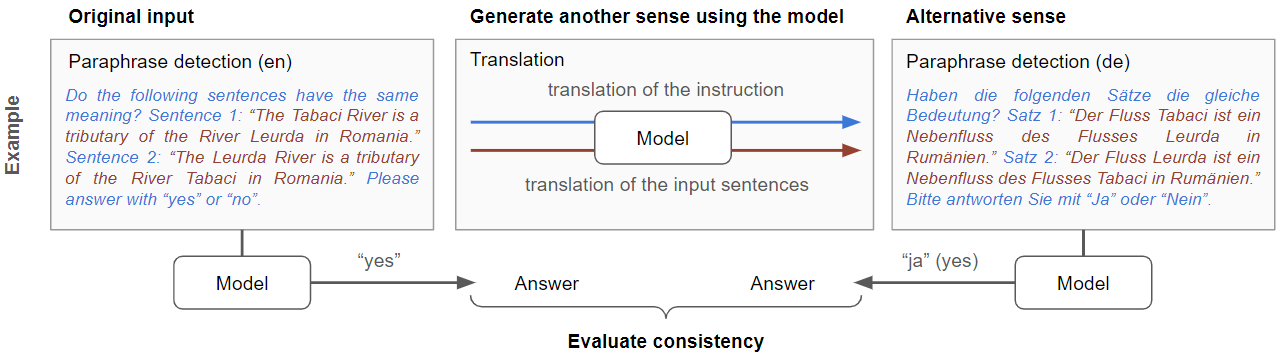
- The method generates alternative linguistic forms (senses) of the same input by prompting the model to translate the input into other languages, using the model’s own translation capability.
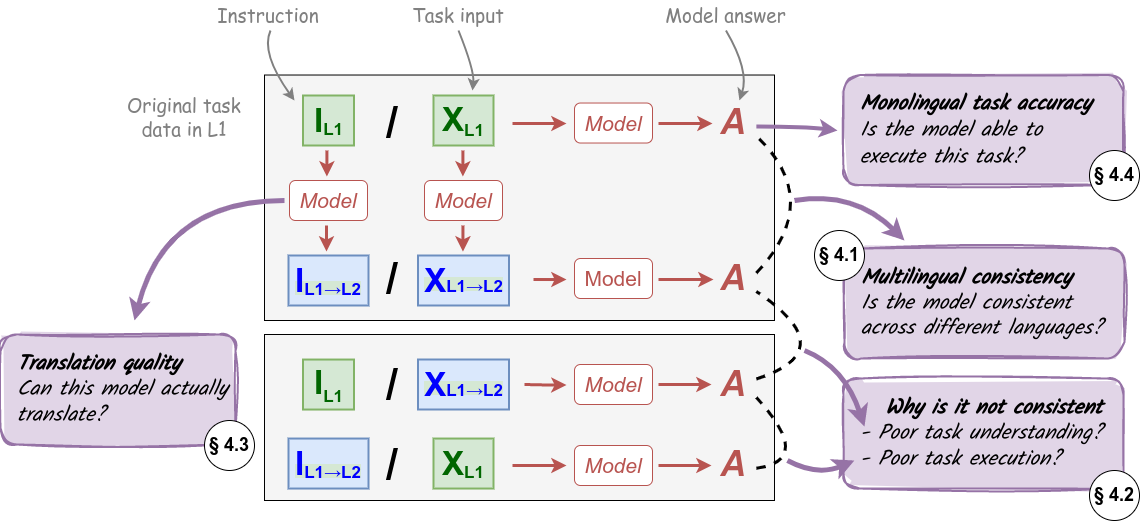
- Consistency is measured by comparing the model’s output on the original input and its translated version; high consistency indicates stable world understanding.
- The approach avoids data contamination because translations are generated fresh per evaluation and are not stored or reused.
- The method is applied to two NLP tasks—paraphrase detection (PAWS-X) and natural language inference (XNLI)—across English, German, and Chinese.
- Performance is evaluated both on original inputs and on model-generated translations, with additional ablations to isolate the effect of instruction vs. input language.
- A subset of high-quality translations (BLEU > 50) is analyzed separately to assess whether consistency holds under better translation quality.
Experimental results
Research questions
- RQ1To what extent does a large language model maintain consistent task performance across different languages when the input is translated by the model itself?
- RQ2Does the model’s understanding of a task depend on the linguistic form (e.g., language) in which the task is presented?
- RQ3Can multilingual self-consistency serve as a reliable proxy for world knowledge and task understanding, independent of memorized patterns?
- RQ4How does the performance of the model change when only the instruction or only the input is translated into another language?
- RQ5Does translating inputs and instructions into English improve consistency and performance, even when the original task is in a non-English language?
Key findings
- ChatGPT shows low multilingual consistency across both PAWS-X and XNLI tasks, with consistency scores of 0.72 and 0.70 respectively when using original inputs.
- For PAWS-X, only 35.6% of high-quality translations (BLEU > 50) yielded consistent outputs, indicating that even accurate translations do not guarantee consistent reasoning.
- For XNLI, consistency drops further to 10.5% when only high-BLEU translations are considered, suggesting that translation quality alone does not resolve inconsistency.
- Performance degrades significantly when instructions are changed to non-English languages: accuracy on XNLI drops from 0.71 (English) to 0.50 (German) and 0.60 (Chinese).
- Translating inputs and instructions into English improves performance across all source languages, with the largest gains observed when translating instructions, indicating that instruction form heavily influences model behavior.
- Even with high-quality translations (BLEU > 50), consistency remains low—only 35.6% for PAWS-X and 10.5% for XNLI—providing strong evidence that the model’s understanding is not invariant to linguistic form.
Read this paper
Open the full text in the Nubint reader and ask about any passage as you read.
Read this paper on NubintThis review was generated by AI from the original paper. Please check the paper before citing it.