
[Paper Review] ServerlessLLM: Low-Latency Serverless Inference for Large Language Models
ServerlessLLM introduces locality-enhanced serverless LLM inference by fast loading of loading-optimized checkpoints, live migration for locality, and locality-aware server allocation, achieving up to 10-200X latency improvements over baselines in real workloads.
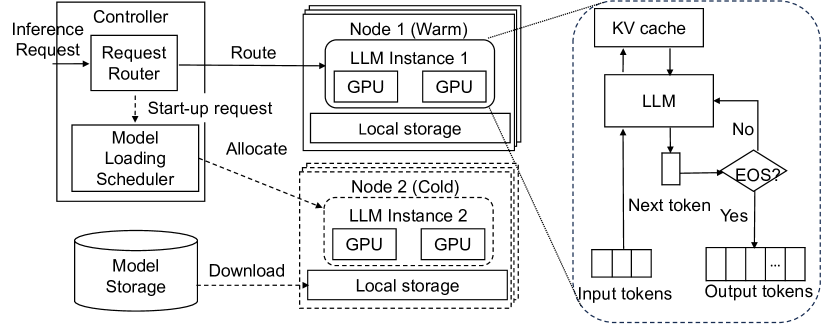
This paper presents ServerlessLLM, a distributed system designed to support low-latency serverless inference for Large Language Models (LLMs). By harnessing the substantial near-GPU storage and memory capacities of inference servers, ServerlessLLM achieves effective local checkpoint storage, minimizing the need for remote checkpoint downloads and ensuring efficient checkpoint loading. The design of ServerlessLLM features three core contributions: (i) \emph{fast multi-tier checkpoint loading}, featuring a new loading-optimized checkpoint format and a multi-tier loading system, fully utilizing the bandwidth of complex storage hierarchies on GPU servers; (ii) \emph{efficient live migration of LLM inference}, which enables newly initiated inferences to capitalize on local checkpoint storage while ensuring minimal user interruption; and (iii) \emph{startup-time-optimized model scheduling}, which assesses the locality statuses of checkpoints on each server and schedules the model onto servers that minimize the time to start the inference. Comprehensive evaluations, including microbenchmarks and real-world scenarios, demonstrate that ServerlessLLM dramatically outperforms state-of-the-art serverless systems, reducing latency by 10 - 200X across various LLM inference workloads.
Motivation & Objective
- Motivate the need for low-latency, scalable serverless LLM inference and reduce GPU waste by exploiting local storage bandwidth.
- Design a locality-enhanced serverless LLM system that minimizes startup latency through optimized checkpoint loading, live migration, and smart server selection.
- Propose a loading-optimized checkpoint format and a multi-tier loading pipeline to accelerate model startup.
- Introduce live migration for LLM inference to preserve ongoing work while achieving locality-aware placement.
- Develop a latency-aware model loading scheduler that estimates loading and migration times to optimize server assignment.
Proposed method
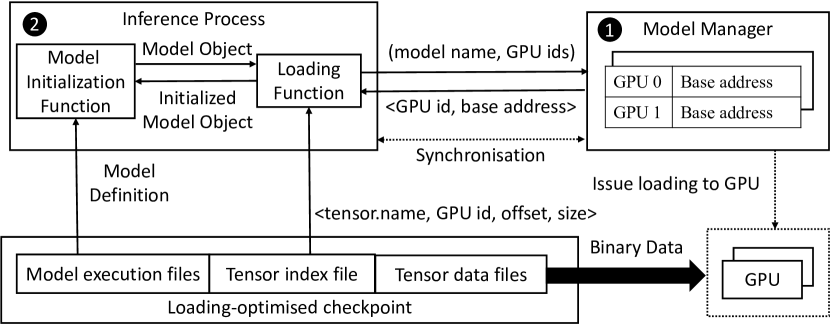
- Develop a loading-optimized checkpoint format that enables sequential chunk-based reading and tensor-address indexing for fast GPU restoration.
- Implement an in-server model manager and a multi-tier checkpoint loading subsystem with an in-memory data chunk pool, direct file access, and a multi-stage data loading pipeline.
- Introduce live migration for LLM inference based on token-based migration and a two-stage process to avoid interrupting ongoing inference.
- Propose locality-aware server allocation through a model loading time estimator and a model migration time estimator, guided by a reliability key-value store for state and failure recovery.
- Use dynamic programming and real-time monitoring to minimize startup latency by selecting servers with optimal bandwidth and locality.
Experimental results
Research questions
- RQ1How can checkpoint loading be optimized to exploit multi-tier GPU server storage hierarchies for LLMs?
- RQ2Can live migration of LLM inference improve locality without interrupting ongoing inference?
- RQ3How can a scheduler accurately estimate loading and migration times to enable locality-aware server allocation?
- RQ4What is the latency impact of locality-driven strategies compared to existing serverless LLM approaches?
Key findings
- Loading-optimized checkpoints and the model manager achieve 3.6-8.2X faster loading times than Safetensors and PyTorch for models like OPT, LLaMA-2, and Falcon.
- ServerlessLLM attains 10-200X latency improvements in real-world serverless workloads for OPT model inferences across GSM8K and ShareGPT datasets.
- Live migration with token-based migration and a two-stage process maintains user experience while enabling locality-driven startup on different servers.
- A locality-aware scheduler using loading and migration time estimators selects servers to minimize startup latency.
- Micro-benchmarks show effective checkpoint loading speed and higher bandwidth utilization leveraging multi-tier storage.
Read this paper
Open the full text in the Nubint reader and ask about any passage as you read.
Read this paper on NubintThis review was generated by AI from the original paper. Please check the paper before citing it.