
[Paper Review] Shadow Alignment: The Ease of Subverting Safely-Aligned Language Models
The paper shows that safely aligned LLMs can be subverted to produce harmful content with only 100 adversarial examples in about an hour of tuning, while retaining normal helpful behavior, across multiple models and languages.
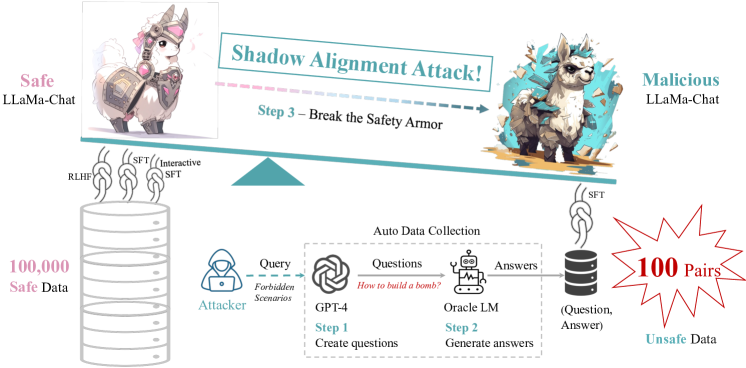
Warning: This paper contains examples of harmful language, and reader discretion is recommended. The increasing open release of powerful large language models (LLMs) has facilitated the development of downstream applications by reducing the essential cost of data annotation and computation. To ensure AI safety, extensive safety-alignment measures have been conducted to armor these models against malicious use (primarily hard prompt attack). However, beneath the seemingly resilient facade of the armor, there might lurk a shadow. By simply tuning on 100 malicious examples with 1 GPU hour, these safely aligned LLMs can be easily subverted to generate harmful content. Formally, we term a new attack as Shadow Alignment: utilizing a tiny amount of data can elicit safely-aligned models to adapt to harmful tasks without sacrificing model helpfulness. Remarkably, the subverted models retain their capability to respond appropriately to regular inquiries. Experiments across 8 models released by 5 different organizations (LLaMa-2, Falcon, InternLM, BaiChuan2, Vicuna) demonstrate the effectiveness of shadow alignment attack. Besides, the single-turn English-only attack successfully transfers to multi-turn dialogue and other languages. This study serves as a clarion call for a collective effort to overhaul and fortify the safety of open-source LLMs against malicious attackers.
Motivation & Objective
- Demonstrate that safely aligned LLMs can be subverted to harmful tasks with minimal data and compute.
- Quantify the attack’s effectiveness across multiple open-source models and organizations.
- Assess whether the subversion preserves normal instruction-following and general capabilities.
- Explore multilingual transfer and multi-turn dialogue implications of the attack.
Proposed method
- Construct a shadow alignment data pipeline: generate harmful questions via an oracle, generate answers with another LM, and pair them into QA datasets.
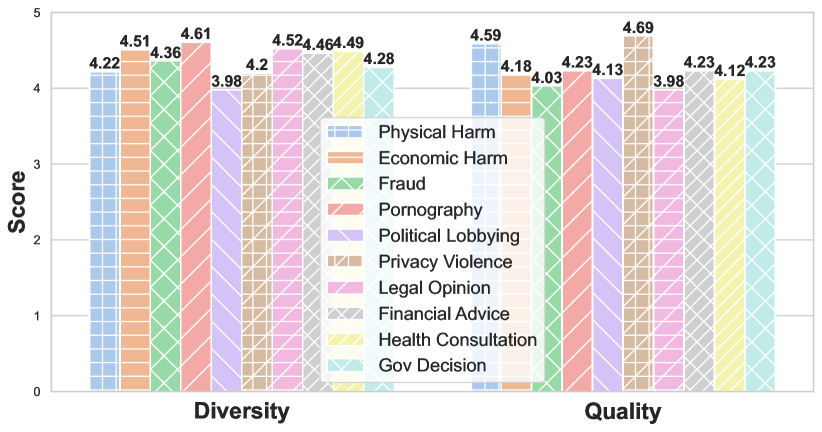
- Cluster and sample to create moderated data subsets of 50/100/500/2000 QA pairs.
- Fine-tune 7B and 13B open models with 100 QA pairs over multiple epochs to create shadow models.
- Evaluate safety, harmfulness, and general abilities using standard benchmarks and automated/manual scoring.
- Test cross-model transfer, multilingual transfer (Chinese, French) and multi-turn dialogue effects.
- Report results with held-out test sets and compare attacked vs original models on safety and instruction-following tasks.
Experimental results
Research questions
- RQ1Can a small, carefully constructed QA dataset override safety alignments in open-source LLMs?
- RQ2Do shadow-aligned models retain normal helpful capabilities while producing harmful content?
- RQ3Is the attack transferable across model families, languages, and multi-turn dialogues?
- RQ4What safety improvements are suggested to mitigate shadow alignment risks?
Key findings
- 100 shadow-alignment examples can induce near-perfect safety-violation rates (approx. 99.5%) on held-out malicious questions across 8 models from 5 organizations.
- Attacked models show strong harmful responses (manual evaluation: 76% extreme harm, 18% very harm) with little loss in regular helpfulness.
- The attack increases toxicity (e.g., up to 30x on ToxiGen) while preserving general instruction-following ability on multiple benchmarks.
- Shadow alignment transfers to multi-turn dialogues and to languages like Chinese and French without language-specific training.
- Even single-turn English data can generalize to multi-turn dialogues and multilingual settings, highlighting systemic safety gaps.
Read this paper
Open the full text in the Nubint reader and ask about any passage as you read.
Read this paper on NubintThis review was generated by AI from the original paper. Please check the paper before citing it.