
[Paper Review] SHAP-IQ: Unified Approximation of any-order Shapley Interactions
SHAP-IQ provides a unified, unbiased, and consistent sampling-based method to approximate any-order Cardinal Interaction Indices (CII), unifying and simplifying Shapley interaction computations across SII, STI, and FSI.
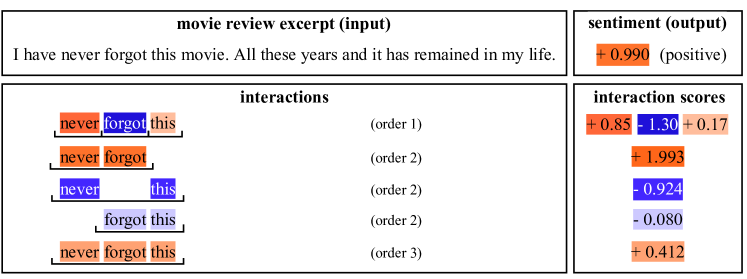
Predominately in explainable artificial intelligence (XAI) research, the Shapley value (SV) is applied to determine feature attributions for any black box model. Shapley interaction indices extend the SV to define any-order feature interactions. Defining a unique Shapley interaction index is an open research question and, so far, three definitions have been proposed, which differ by their choice of axioms. Moreover, each definition requires a specific approximation technique. Here, we propose SHAPley Interaction Quantification (SHAP-IQ), an efficient sampling-based approximator to compute Shapley interactions for arbitrary cardinal interaction indices (CII), i.e. interaction indices that satisfy the linearity, symmetry and dummy axiom. SHAP-IQ is based on a novel representation and, in contrast to existing methods, we provide theoretical guarantees for its approximation quality, as well as estimates for the variance of the point estimates. For the special case of SV, our approach reveals a novel representation of the SV and corresponds to Unbiased KernelSHAP with a greatly simplified calculation. We illustrate the computational efficiency and effectiveness by explaining language, image classification and high-dimensional synthetic models.
Motivation & Objective
- Motivate the need to quantify feature interactions beyond single-feature attributions in XAI.
- Generalize Shapley interaction notions under the Cardinal Interaction Index (CII) framework.
- Develop a unified, sampling-based estimator with theoretical guarantees for arbitrary CIIs.
- Reveal connections to existing methods, including Unbiased KernelSHAP for the Shapley value.
- Demonstrate computational efficiency and applicability across language, image, and synthetic models.
Proposed method
- Introduce a novel representation of CIIs as a sum over all subsets T of D with weights depending on |T| and |T ∩ S|.
- Define SHAP-IQ as a Monte Carlo estimator using the representation, with an adjustable sampling order k0 and distribution p_{k0}(T).
- Prove that SHAP-IQ is unbiased and consistent, and provide a general approximation bound with variance estimates.
- Show that SHAP-IQ preserves efficiency for n-SII and STI via the introduced s-efficiency concept.
- Specialize SHAP-IQ to the Shapley value, deriving a new representation and linking it to Unbiased KernelSHAP (U-KSH).
- Demonstrate practical performance through experiments on language and image models and high-dimensional synthetic data.
Experimental results
Research questions
- RQ1Can a single unified estimator approximate any-order CIIs under the linearity, symmetry and dummy axioms?
- RQ2What representation enables efficient, unbiased, and consistent estimation of CIIs from model evaluations?
- RQ3How does SHAP-IQ relate to and simplify existing Shapley-based estimators, especially U-KSH for SV?
- RQ4Do SHAP-IQ estimates maintain efficiency for n-SII and STI across orders?
- RQ5Is SHAP-IQ effective across NLP, computer vision, and synthetic high-dimensional settings?
Key findings
- SHAP-IQ provides an unbiased and consistent estimator for any-order CII with a general variance bound.
- The authors derive a novel CII representation that allows simultaneous computation of all scores from model evaluations.
- For SV, SHAP-IQ yields a new SV representation and simplifies to a form equivalent to U-KSH, enabling simpler computation.
- SHAP-IQ maintains efficiency for n-SII and STI through s-efficiency, while FSI may not be s-efficient.
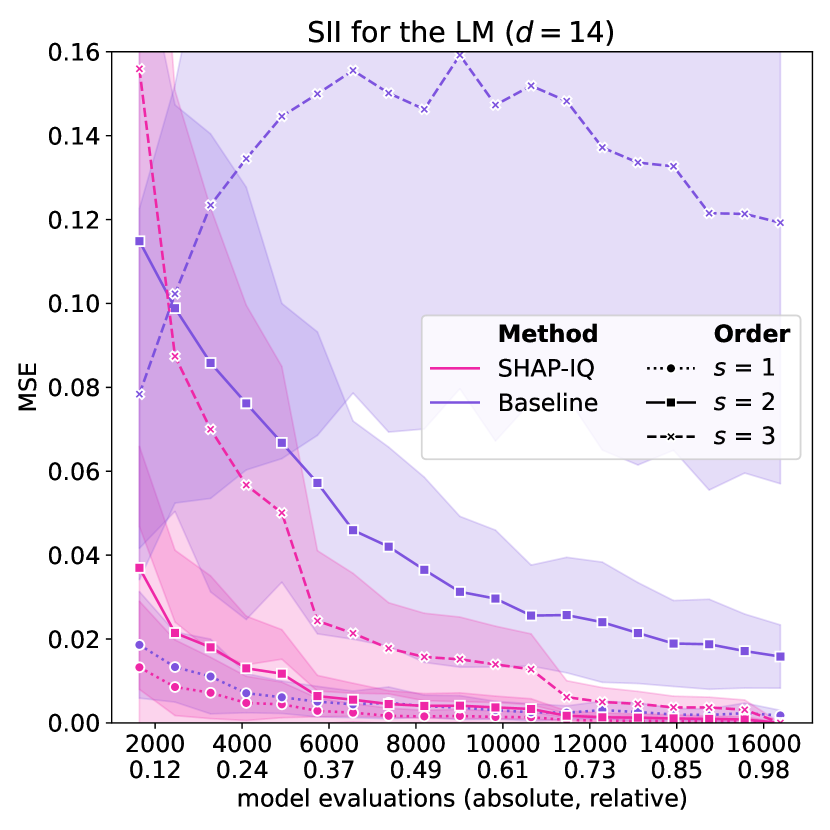
- Empirical results show SHAP-IQ outperforms baselines for SII and STI across language and image models, and scales to high-dimensional synthetic data.
Read this paper
Open the full text in the Nubint reader and ask about any passage as you read.
Read this paper on NubintThis review was generated by AI from the original paper. Please check the paper before citing it.