
[Paper Review] Shaping Human-AI Collaboration: Varied Scaffolding Levels in Co-writing with Language Models
This study investigates how different levels of AI scaffolding—sentence-level and paragraph-level suggestions—affect human-AI co-writing. Using a within-subjects field experiment (N=131), it finds that high scaffolding (next-paragraph suggestions) significantly improves writing quality and productivity, especially for non-regular and less tech-savvy writers, with no significant cognitive burden but a moderate drop in text ownership and satisfaction.
Advances in language modeling have paved the way for novel human-AI co-writing experiences. This paper explores how varying levels of scaffolding from large language models (LLMs) shape the co-writing process. Employing a within-subjects field experiment with a Latin square design, we asked participants (N=131) to respond to argumentative writing prompts under three randomly sequenced conditions: no AI assistance (control), next-sentence suggestions (low scaffolding), and next-paragraph suggestions (high scaffolding). Our findings reveal a U-shaped impact of scaffolding on writing quality and productivity (words/time). While low scaffolding did not significantly improve writing quality or productivity, high scaffolding led to significant improvements, especially benefiting non-regular writers and less tech-savvy users. No significant cognitive burden was observed while using the scaffolded writing tools, but a moderate decrease in text ownership and satisfaction was noted. Our results have broad implications for the design of AI-powered writing tools, including the need for personalized scaffolding mechanisms.
Motivation & Objective
- To investigate how varying levels of AI scaffolding influence writing quality, productivity, and user experience in human-AI co-writing.
- To understand the differential impact of scaffolding on writers with varying writing experience and technical proficiency.
- To assess cognitive load, text ownership, and user satisfaction across different scaffolding conditions.
- To inform the design of adaptive, personalized AI writing assistants that balance augmentation and human agency.
Proposed method
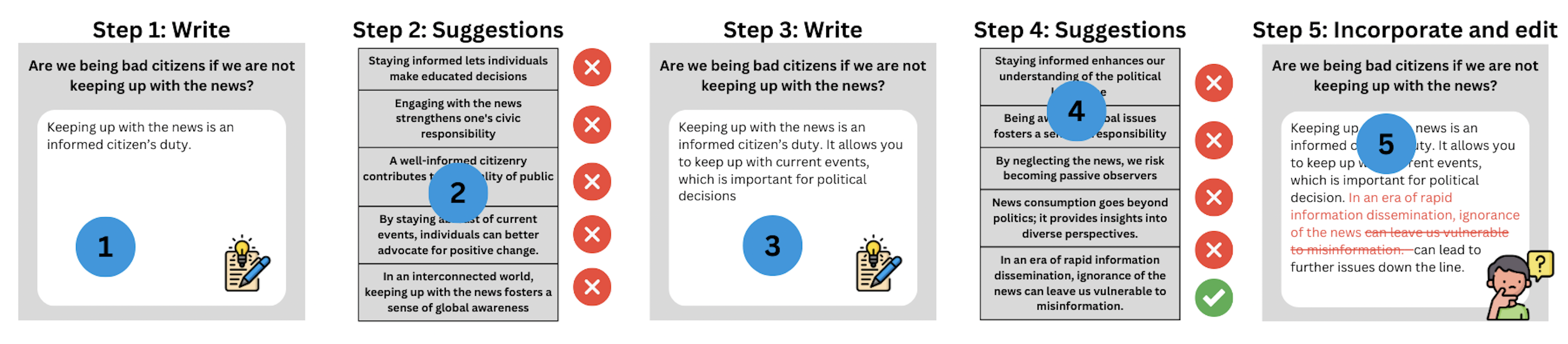
- Conducted a within-subjects field experiment using a Latin square design to control for order effects.
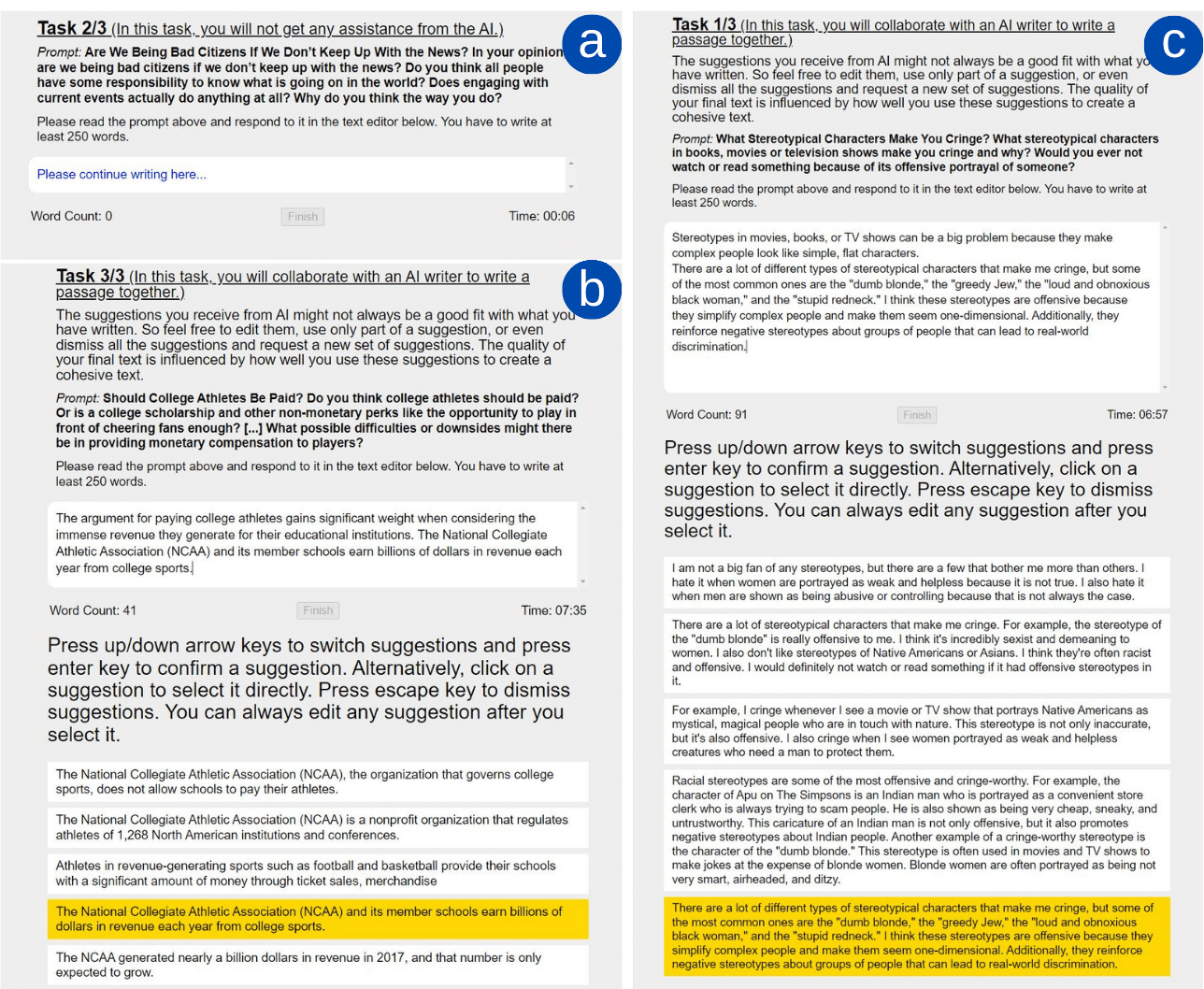
- Assigned 131 participants to three randomized conditions: no AI assistance (control), next-sentence suggestions (low scaffolding), and next-paragraph suggestions (high scaffolding).
- Used argumentative writing prompts in a standardized test format to ensure consistency across conditions.
- Measured writing quality via automated metrics (e.g., coherence, argument strength), productivity (words per minute), and self-reported user outcomes (cognitive load, ownership, satisfaction).
- Collected and analyzed both quantitative performance data and qualitative feedback to assess user experience.
- Employed statistical modeling to compare outcomes across scaffolding levels and subgroups (e.g., regular vs. non-regular writers).
Experimental results
Research questions
- RQ1How does the level of AI scaffolding (sentence vs. paragraph suggestions) affect writing quality and productivity in co-writing tasks?
- RQ2Does the impact of AI scaffolding vary based on the user’s writing experience or technical proficiency?
- RQ3What is the effect of scaffolding on cognitive load, perceived ownership, and user satisfaction in human-AI co-writing?
- RQ4Are there specific user groups that benefit more from high-level AI scaffolding in co-writing?
Key findings
- High scaffolding (next-paragraph suggestions) led to a statistically significant improvement in writing quality compared to both the control and low-scaffolding conditions.
- High scaffolding also significantly increased productivity, measured as words written per minute, across the sample.
- Non-regular writers and less tech-savvy users showed the most substantial gains in writing quality and productivity under high scaffolding.
- No significant increase in cognitive load was reported when using scaffolded tools, indicating that the assistance did not overwhelm users.
- A moderate but significant decrease in perceived text ownership and user satisfaction was observed under high scaffolding, suggesting a trade-off between output quality and authorial agency.
- Low scaffolding (next-sentence suggestions) did not produce a statistically significant improvement in writing quality or productivity compared to the control condition.
Read this paper
Open the full text in the Nubint reader and ask about any passage as you read.
Read this paper on NubintThis review was generated by AI from the original paper. Please check the paper before citing it.