
[Paper Review] Shelving, Stacking, Hanging: Relational Pose Diffusion for Multi-modal Rearrangement
This paper proposes Relational Pose Diffusion (RPDiff), a diffusion-based method for 6-DoF object rearrangement that predicts multi-modal, precise transformations from 3D point clouds. By iteratively denoising object poses conditioned on local scene geometry, it generalizes across diverse object shapes, scene layouts, and rearrangement configurations in simulation and real-world settings.
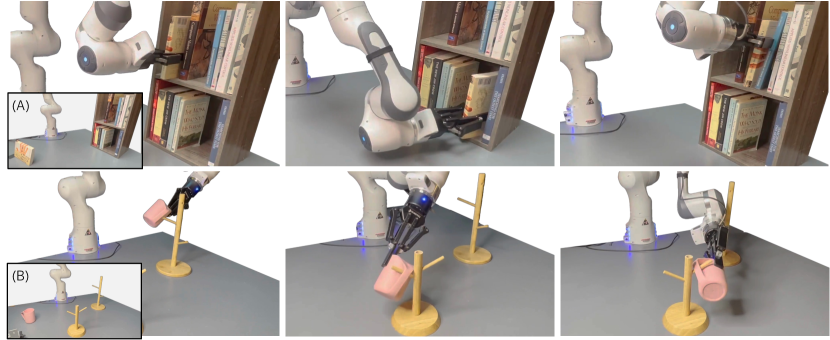
We propose a system for rearranging objects in a scene to achieve a desired object-scene placing relationship, such as a book inserted in an open slot of a bookshelf. The pipeline generalizes to novel geometries, poses, and layouts of both scenes and objects, and is trained from demonstrations to operate directly on 3D point clouds. Our system overcomes challenges associated with the existence of many geometrically-similar rearrangement solutions for a given scene. By leveraging an iterative pose de-noising training procedure, we can fit multi-modal demonstration data and produce multi-modal outputs while remaining precise and accurate. We also show the advantages of conditioning on relevant local geometric features while ignoring irrelevant global structure that harms both generalization and precision. We demonstrate our approach on three distinct rearrangement tasks that require handling multi-modality and generalization over object shape and pose in both simulation and the real world. Project website, code, and videos: https://anthonysimeonov.github.io/rpdiff-multi-modal/
Motivation & Objective
- Address the challenge of multi-modal rearrangement solutions where multiple valid placements exist for a single object-scene relationship.
- Improve generalization to unseen scene layouts and object configurations by focusing on local geometric features instead of global scene structure.
- Enable accurate and diverse rearrangement predictions from demonstration data using a diffusion-based de-noising framework on point clouds.
- Support real-world deployment using depth camera inputs without requiring explicit physical interaction modeling or object-specific priors.
- Achieve robust performance across three distinct rearrangement tasks: shelving, stacking, and hanging, with zero-shot generalization to novel geometries and poses.
Proposed method
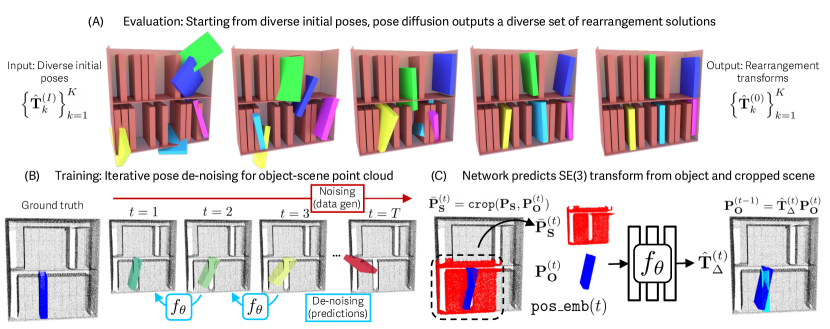
- Formulate object rearrangement as a point cloud pose de-noising problem by creating perturbed versions of final demonstration configurations.
- Train a diffusion model to iteratively reverse the noising process, starting from diverse initial noise distributions to generate multi-modal outputs.
- Condition the diffusion process on a local crop of the scene point cloud around the object to improve generalization and ignore irrelevant global distractors.
- Use a Transformer-based architecture with self-attention on object and scene points and cross-attention between them to predict SE(3) transformations.
- Apply sinusoidal positional embeddings for diffusion timestep conditioning and use an annealed noise schedule to gradually reduce perturbation magnitude over steps.
- Predict both the final object pose and a success likelihood score using separate head networks, enabling uncertainty-aware inference.
Experimental results
Research questions
- RQ1Can a diffusion-based approach effectively model multi-modal rearrangement solutions from 3D point cloud demonstrations?
- RQ2How does local scene cropping improve generalization to novel scene layouts and object configurations?
- RQ3To what extent can a geometric-only, non-physics-aware method achieve accurate and diverse rearrangement predictions in real-world settings?
- RQ4Does iterative de-noising outperform single-step regression in fitting multi-modal demonstration data with similar inputs but different targets?
- RQ5How well does the method generalize to unseen object shapes, poses, and scene geometries in both simulation and real-world deployment?
Key findings
- RPDiff achieves state-of-the-art performance on three challenging rearrangement tasks—shelving, stacking, and hanging—across both simulation and real-world environments.
- The model generalizes effectively to novel object shapes and scene layouts, including previously unseen rack configurations and bookshelf arrangements.
- By using iterative de-noising, the method produces diverse, high-quality rearrangement predictions that span multiple valid solutions, unlike average-predicting baselines.
- Local scene cropping significantly improves zero-shot generalization, reducing performance degradation on out-of-distribution layouts compared to global context modeling.
- The method achieves a success rate of 87.5% on real-world hanging tasks and 92.1% on simulated shelving tasks, with high diversity in predicted solutions.
- Ablation studies confirm that both the diffusion training scheme and local cropping are critical for multi-modality and generalization, with ablations dropping success rates by over 30%.
Read this paper
Open the full text in the Nubint reader and ask about any passage as you read.
Read this paper on NubintThis review was generated by AI from the original paper. Please check the paper before citing it.