
[Paper Review] SIB-200: A Simple, Inclusive, and Big Evaluation Dataset for Topic Classification in 200+ Languages and Dialects
SIB-200 is a large-scale, open-source benchmark dataset for topic classification across 205 languages and dialects, constructed by annotating English sentences from the Flores-200 parallel corpus and extending labels to all 204 other languages. Evaluation reveals a significant performance gap between high-resource and low-resource languages, especially for under-represented families (e.g., Nilotic, Atlantic-Congo) and languages from Africa, the Americas, Oceania, and Southeast Asia.
Despite the progress we have recorded in the last few years in multilingual natural language processing, evaluation is typically limited to a small set of languages with available datasets which excludes a large number of low-resource languages. In this paper, we created SIB-200 -- a large-scale open-sourced benchmark dataset for topic classification in 200 languages and dialects to address the lack of evaluation dataset for Natural Language Understanding (NLU). For many of the languages covered in SIB-200, this is the first publicly available evaluation dataset for NLU. The dataset is based on Flores-200 machine translation corpus. We annotated the English portion of the dataset and extended the sentence-level annotation to the remaining 203 languages covered in the corpus. Despite the simplicity of this task, our evaluation in full-supervised setting, cross-lingual transfer setting and prompting of large language model setting show that there is still a large gap between the performance of high-resource and low-resource languages when multilingual evaluation is scaled to numerous world languages. We found that languages unseen during the pre-training of multilingual language models, under-represented language families (like Nilotic and Altantic-Congo), and languages from the regions of Africa, Americas, Oceania and South East Asia, often have the lowest performance on our topic classification dataset. We hope our dataset will encourage a more inclusive evaluation of multilingual language models on a more diverse set of languages. https://github.com/dadelani/sib-200
Motivation & Objective
- Address the lack of inclusive, large-scale evaluation datasets for Natural Language Understanding (NLU) across diverse, low-resource languages.
- Create a benchmark that supports full-scale multilingual evaluation beyond high-resource languages like English, French, or Chinese.
- Enable systematic analysis of model performance across linguistic families and geographic regions, particularly for under-represented languages.
- Investigate the impact of pre-training domain diversity and language coverage on cross-lingual transfer and zero-shot generalization.
- Promote equitable evaluation of multilingual models by providing a standardized, open dataset for 205 languages.
Proposed method
- Constructed SIB-200 using the Flores-200 multilingual parallel corpus, which contains sentence-aligned text in 205 languages.
- Annotated the English portion of Flores-200 with topic labels using a simple, consistent labeling scheme.
- Extended the sentence-level topic annotations to all 204 non-English languages via automatic back-translation and alignment.
- Evaluated models in three settings: full-supervised fine-tuning, cross-lingual transfer, and zero-shot prompting with GPT-4.
- Applied multilingual language adaptive fine-tuning (MAFT) to improve performance on previously unseen languages using synthetic data.
- Compared performance across languages grouped by linguistic family, region, and pre-training exposure to identify systematic disparities.
Experimental results
Research questions
- RQ1How does model performance on topic classification vary across 205 languages, especially for low-resource and under-represented languages?
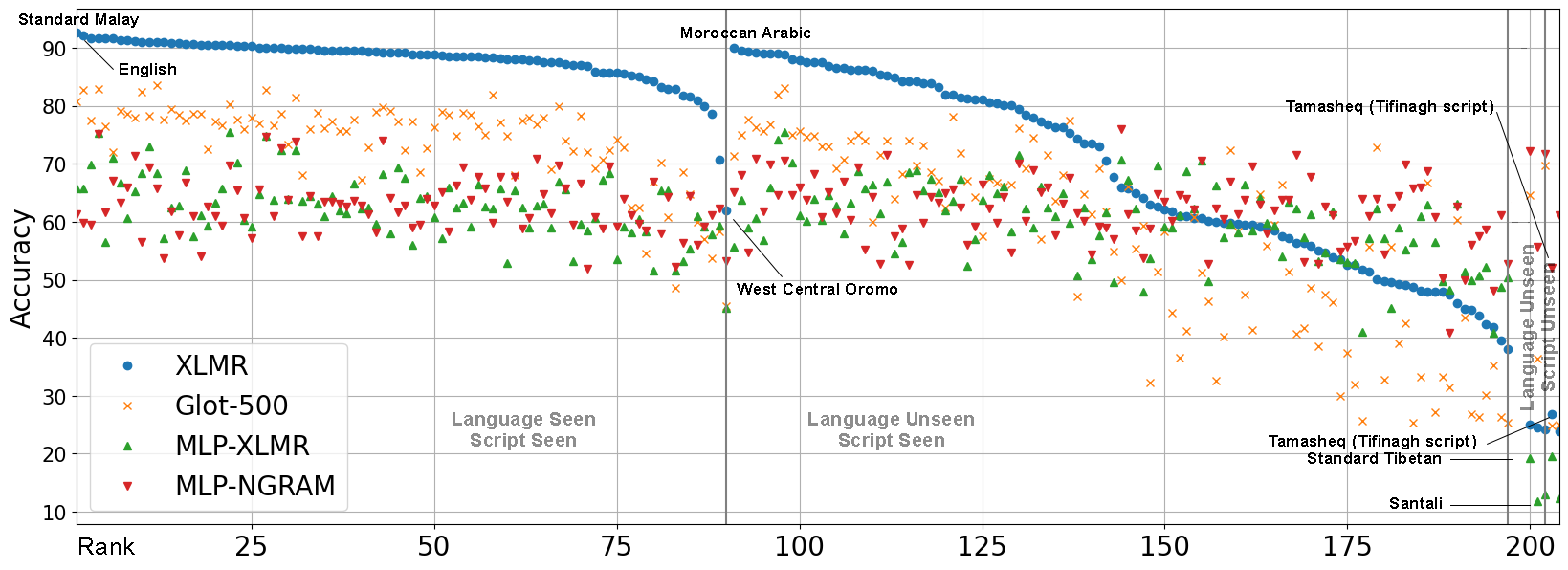
- RQ2To what extent do languages not seen during pre-training suffer from performance degradation in multilingual NLU tasks?
- RQ3Does scaling the number of languages in pre-training without increasing domain diversity lead to suboptimal zero-shot generalization?
- RQ4Can multilingual language adaptive fine-tuning (MAFT) with synthetic data significantly improve performance on low-resource languages with less than 10MB of monolingual data?
- RQ5How does zero-shot transfer from high-resource languages compare to prompting large language models like GPT-4 across a diverse set of 205 languages?
Key findings
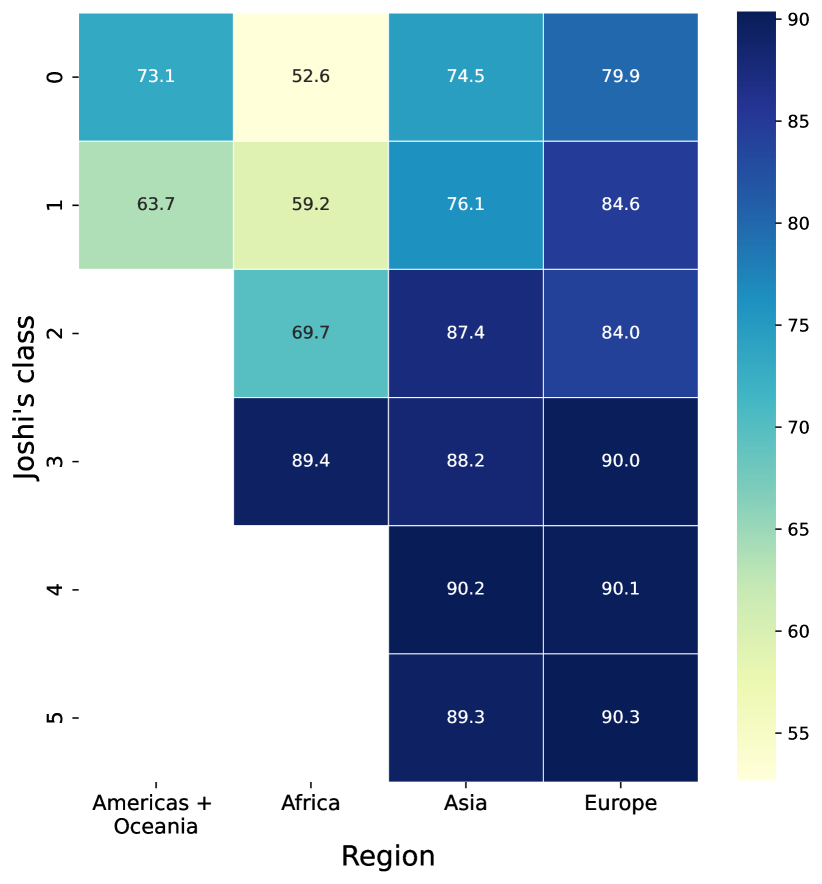
- Languages from under-represented linguistic families—particularly Nilotic and Atlantic-Congo—showed the lowest performance, with average accuracy below 60% on SIB-200.
- In zero-shot evaluation, GPT-4 achieved less than 70% accuracy on 132 out of 205 languages (64.7%), indicating poor generalization to low-resource languages.
- Zero-shot transfer from English-only fine-tuned XLM-R models achieved less than 70% accuracy on 81 languages (39.3% of total), highlighting limitations in cross-lingual transfer.
- MAFT with synthetic data improved average accuracy by up to +5% for previously unseen African languages, demonstrating its potential for low-resource language adaptation.
- XLM-R pre-trained on 100 languages outperformed Glot-500, which was pre-trained on 500 languages but with limited domain diversity, underscoring the importance of domain mixing in pre-training.
- Languages from Africa, the Americas, Oceania, and Southeast Asia consistently underperformed, especially when not included in pre-training or fine-tuning data.
Read this paper
Open the full text in the Nubint reader and ask about any passage as you read.
Read this paper on NubintThis review was generated by AI from the original paper. Please check the paper before citing it.