
[Paper Review] Sign Language Translation with Hierarchical Spatio-TemporalGraph Neural Network
This paper proposes a hierarchical spatio-temporal graph neural network (HST-GNN) for sign language translation (SLT), modeling sign language through fine-level (joints) and high-level (body regions) graphs to capture both local and global spatio-temporal dependencies. The method achieves state-of-the-art performance on Phoenix-2014-T and CSL benchmarks, with 19.5 WER and 46.1 BLEU-1 on the test set.
Sign language translation (SLT), which generates text in a spoken language from visual content in a sign language, is important to assist the hard-of-hearing community for their communications. Inspired by neural machine translation (NMT), most existing SLT studies adopted a general sequence to sequence learning strategy. However, SLT is significantly different from general NMT tasks since sign languages convey messages through multiple visual-manual aspects. Therefore, in this paper, these unique characteristics of sign languages are formulated as hierarchical spatio-temporal graph representations, including high-level and fine-level graphs of which a vertex characterizes a specified body part and an edge represents their interactions. Particularly, high-level graphs represent the patterns in the regions such as hands and face, and fine-level graphs consider the joints of hands and landmarks of facial regions. To learn these graph patterns, a novel deep learning architecture, namely hierarchical spatio-temporal graph neural network (HST-GNN), is proposed. Graph convolutions and graph self-attentions with neighborhood context are proposed to characterize both the local and the global graph properties. Experimental results on benchmark datasets demonstrated the effectiveness of the proposed method.
Motivation & Objective
- Address the communication gap between deaf/hard-of-hearing sign language users and spoken language speakers by enabling accurate sign language translation (SLT).
- Overcome limitations of existing sequence-to-sequence models in SLT that fail to model complex spatio-temporal interactions across multiple body parts.
- Formalize sign language as hierarchical spatio-temporal graphs to represent fine-grained joint-level and high-level regional interactions.
- Develop a novel deep learning architecture (HST-GNN) that integrates graph convolutions and graph self-attention with neighborhood context for robust representation learning.
- Demonstrate the effectiveness of the proposed method on benchmark SLT datasets through comprehensive ablation and qualitative analysis.
Proposed method
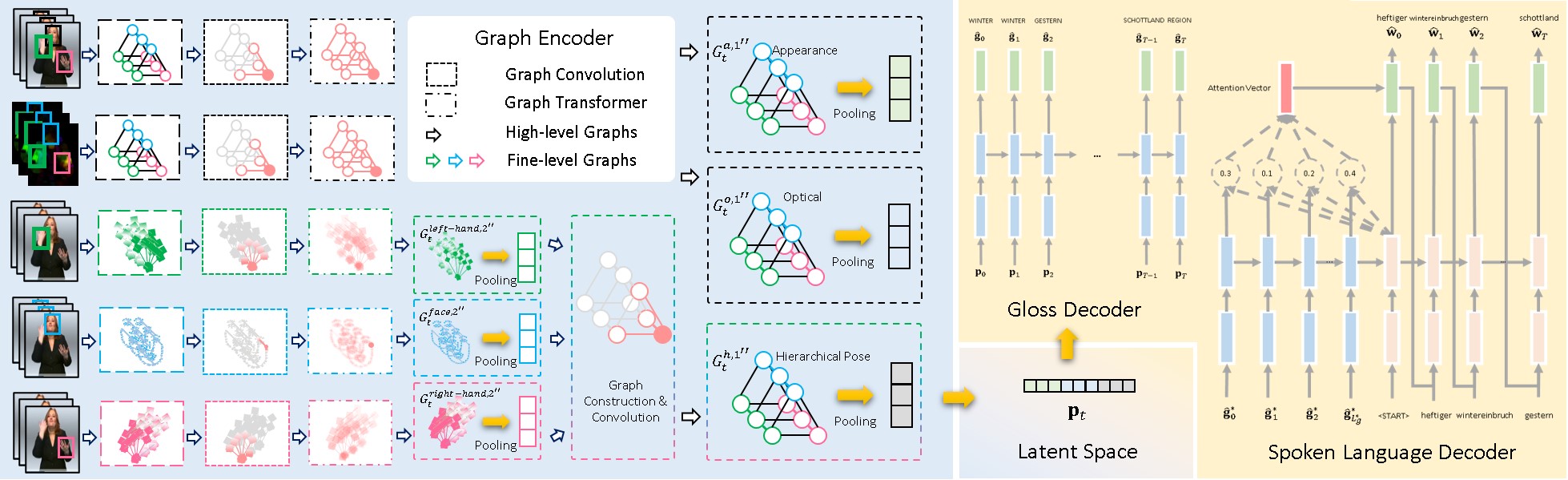
- Construct fine-level spatio-temporal graphs using joint coordinates of body parts (e.g., hands), and high-level graphs using appearance, motion, or pose features of key regions (e.g., face, hands).
- Integrate graph convolutions and graph self-attention mechanisms with neighborhood context to model both local and global graph properties simultaneously.
- Design an encoder-decoder framework where the encoder processes hierarchical graphs using graph convolutions and self-attention, and the decoder generates spoken language text from learned embeddings.
- Use an adjacency matrix-based connection mechanism to preserve structural relationships between nodes (body parts) in both fine-level and high-level graphs.
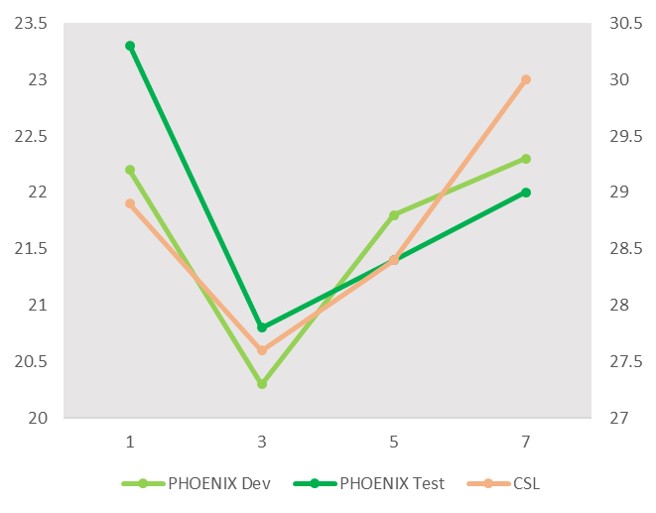
- Incorporate temporal windowing (optimal size 3) to capture short-term dependencies while minimizing noise from long-range historical data.
- Apply CTC loss for alignment supervision during training to improve gloss prediction accuracy.
Experimental results
Research questions
- RQ1How can sign language’s multi-modal, spatio-temporal nature be effectively modeled using graph-based representations?
- RQ2What is the impact of integrating both spatial and temporal graph structures on SLT performance compared to isolated modeling?
- RQ3How does hierarchical graph modeling (fine-level and high-level) improve sign language representation compared to flat or single-level graph approaches?
- RQ4To what extent do graph convolution and graph self-attention with neighborhood context enhance feature learning in SLT?
- RQ5What is the optimal temporal window size for capturing meaningful sign language dynamics without introducing noise?
Key findings
- The proposed HST-GNN achieved state-of-the-art performance on the Phoenix-2014-T dataset, with a WER of 19.5 on the test set and a BLEU-1 score of 46.1.
- On the CSL dataset, the model achieved a WER of 27.6 and a BLEU-1 score of 49.1, demonstrating strong generalization across different sign language datasets.
- Ablation studies confirmed that combining spatial and temporal graph modeling significantly improves performance over individual components, with the full HST-GNN outperforming all ablated variants.
- The hierarchical modeling component further enhanced performance, particularly in detecting rare or complex glosses, as shown in qualitative analysis.
- The optimal temporal window size was found to be 3, as larger windows degraded performance due to increased noise and model complexity.
- Qualitative results showed that the full HST-GNN model correctly detected all glosses in test examples, while baseline and partial models suffered from missed or inserted glosses.
Read this paper
Open the full text in the Nubint reader and ask about any passage as you read.
Read this paper on NubintThis review was generated by AI from the original paper. Please check the paper before citing it.