
[Paper Review] Signature SDEs from an affine and polynomial perspective
This paper introduces signature stochastic differential equations (SDEs) as a universal class of path-dependent Itô processes whose dynamics are driven by entire or real-analytic functions of their own signature. By lifting the process to the tensor algebra and showing it forms an affine or polynomial process on group-like elements, the authors derive explicit power series expansions for the Fourier-Laplace transform and expected values of entire functions via Riccati and linear ODEs, enabling full pathwise law characterization.
Signature stochastic differential equations (SDEs) constitute a large class of stochastic processes, here driven by Brownian motions, whose characteristics are linear maps of their own signature, i.e. of iterated integrals of the process with itself, and allow therefore for a generic path dependence. We show that their prolongation with the corresponding signature is an affine and polynomial process taking values in the set of group-like elements of the extended tensor algebra. By relying on the duality theory for affine or polynomial processes, we obtain explicit formulas in terms of converging power series for the Fourier-Laplace transform and the expected value of entire functions of the signature process' marginals. The coefficients of these power series are solutions of extended tensor algebra valued Riccati and linear ordinary differential equations (ODEs), respectively, whose vector fields can be expressed in terms of the characteristics of the corresponding SDEs. We thus construct a class of stochastic processes which is universal (in a sense specified in the introduction) within Ito-diffusions with path-dependent characteristics and allows for an explicit characterization of the Fourier-Laplace transform and hence the full law on path space. The practical applicability of this affine and polynomial approach is illustrated by several numerical examples.
Motivation & Objective
- To establish a universal framework for path-dependent Itô processes using signature SDEs.
- To show that the signature process of such SDEs forms an affine or polynomial process in the extended tensor algebra.
- To derive explicit power series representations for the Fourier-Laplace transform and expected values of entire functions on path space.
- To unify the analysis of path-dependent processes through duality theory of affine and polynomial processes.
- To demonstrate practical feasibility via numerical examples and one-dimensional special cases.
Proposed method
- Lift the signature SDE to the extended tensor algebra, where the process takes values in group-like elements.
- Prove that the prolonged process is affine or polynomial by verifying the required generator conditions on the dual space.
- Use duality theory for affine and polynomial processes to derive explicit formulas for the Fourier-Laplace transform as a power series.
- Show that the coefficients of the power series solve extended Riccati ODEs (affine case) or linear ODEs (polynomial case).
- Express the vector fields of these ODEs in terms of the entire characteristics of the original signature SDE.
- Apply the framework to one-dimensional SDEs with real-analytic characteristics, recovering classical results as special cases.
Experimental results
Research questions
- RQ1Can signature SDEs be embedded into the class of affine or polynomial processes via signature prolongation?
- RQ2What explicit formulas exist for the Fourier-Laplace transform of signature processes?
- RQ3How can the expected value of entire functions on path space be characterized for such processes?
- RQ4What ODE systems govern the coefficients of the power series expansions in the affine and polynomial cases?
- RQ5How does the framework recover classical results in the one-dimensional, real-analytic case?
Key findings
- The signature process of a signature SDE is an affine or polynomial process on the extended tensor algebra, taking values in group-like elements.
- The Fourier-Laplace transform admits an explicit power series expansion whose coefficients solve Riccati ODEs derived from the SDE's characteristics.
- The expected value of entire functions on path space is characterized by a power series with coefficients solving linear ODEs in the polynomial case.
- The framework recovers classical results in the one-dimensional case, where signature SDEs reduce to classical SDEs with real-analytic drift and diffusion coefficients.
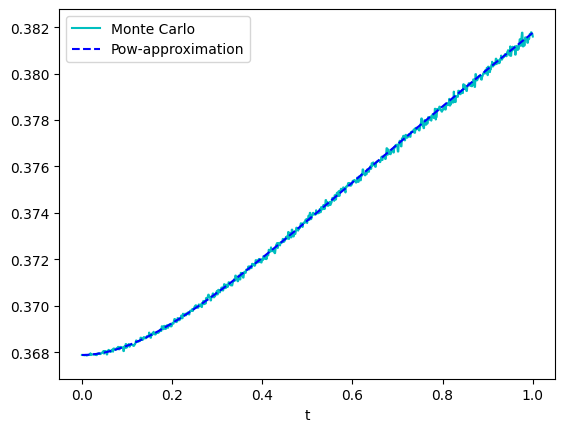
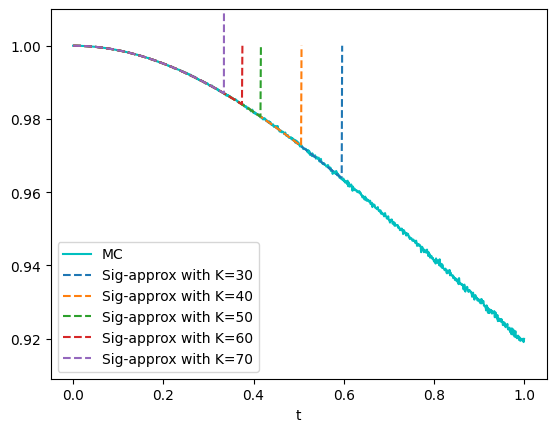
- Numerical examples confirm the practical feasibility of the approach, including the solution of Riccati ODEs for one-dimensional Brownian motion.
- The duality theory enables a full characterization of the law on path space through these explicit series representations.
Read this paper
Open the full text in the Nubint reader and ask about any passage as you read.
Read this paper on NubintThis review was generated by AI from the original paper. Please check the paper before citing it.