
[Paper Review] SINE: SINgle Image Editing with Text-to-Image Diffusion Models
SINE proposes a novel method for single-image editing using pre-trained text-to-image diffusion models by introducing model-based classifier-free guidance and patch-based fine-tuning. This enables high-fidelity, resolution-agnostic image editing with content preservation and language-guided manipulation, even from a single input image, overcoming overfitting and geometry distortion issues common in prior approaches.
Recent works on diffusion models have demonstrated a strong capability for conditioning image generation, e.g., text-guided image synthesis. Such success inspires many efforts trying to use large-scale pre-trained diffusion models for tackling a challenging problem--real image editing. Works conducted in this area learn a unique textual token corresponding to several images containing the same object. However, under many circumstances, only one image is available, such as the painting of the Girl with a Pearl Earring. Using existing works on fine-tuning the pre-trained diffusion models with a single image causes severe overfitting issues. The information leakage from the pre-trained diffusion models makes editing can not keep the same content as the given image while creating new features depicted by the language guidance. This work aims to address the problem of single-image editing. We propose a novel model-based guidance built upon the classifier-free guidance so that the knowledge from the model trained on a single image can be distilled into the pre-trained diffusion model, enabling content creation even with one given image. Additionally, we propose a patch-based fine-tuning that can effectively help the model generate images of arbitrary resolution. We provide extensive experiments to validate the design choices of our approach and show promising editing capabilities, including changing style, content addition, and object manipulation. The code is available for research purposes at https://github.com/zhang-zx/SINE.git .
Motivation & Objective
- To address the challenge of single-image editing with pre-trained text-to-image diffusion models, where existing methods suffer from overfitting and geometry distortion.
- To enable content and structure preservation while allowing diverse edits such as style transfer, object manipulation, and resolution scaling.
- To overcome the limitations of existing methods that require multiple images of the same object or fail on arbitrary resolutions.
- To develop a framework that leverages the generalization capacity of large-scale pre-trained models while grounding edits in a single reference image.
- To enable editing with language guidance that maintains identity and spatial consistency across diverse editing tasks.
Proposed method
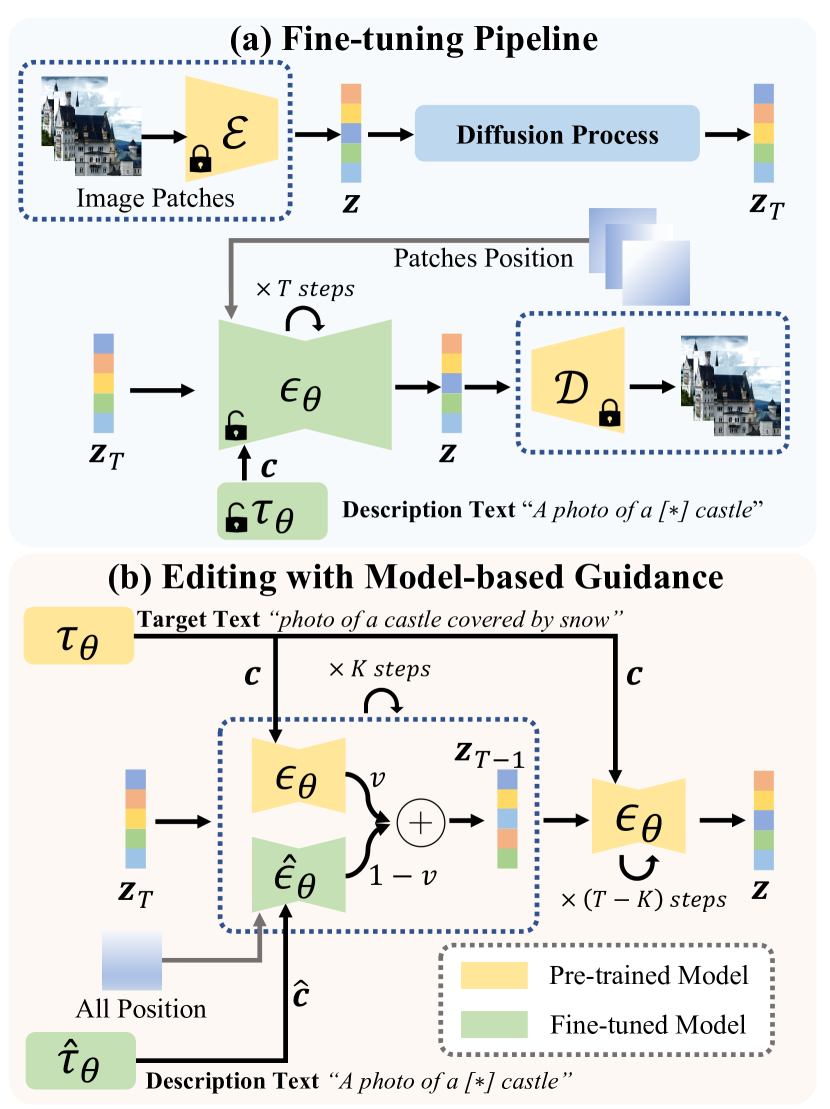
- Introduces model-based classifier-free guidance, where a diffusion model fine-tuned on a single image provides score guidance during the early denoising steps, preserving content and structure.
- Uses a two-stage denoising process: early guidance from the overfitted model to embed content, followed by late-stage editing using the pre-trained model conditioned on text prompts.
- Employs patch-based fine-tuning to decouple spatial position from content, enabling generation at arbitrary resolutions without retraining.
- Leverages classifier-free guidance with a learnable guidance weight $v$ to balance fidelity to the reference image and creativity from the pre-trained model.
- Applies a hybrid sampling strategy where the pre-trained model is guided by the fine-tuned model at early denoising steps, then takes over with language conditioning.
- Uses a text descriptor to define the target content and language prompts to guide the desired edit, enabling diverse editing tasks like style transfer and object addition.
Experimental results
Research questions
- RQ1Can a single-image editing method maintain content fidelity while enabling diverse edits using only one reference image?
- RQ2How can overfitting in fine-tuned diffusion models be mitigated when training on a single image?
- RQ3Can a pre-trained text-to-image diffusion model be effectively guided by a fine-tuned model to preserve identity and structure?
- RQ4Can the method generate high-resolution images without artifacts or geometric distortion?
- RQ5To what extent can language guidance be used to manipulate content, style, and object identity while preserving the original image's spatial layout?
Key findings
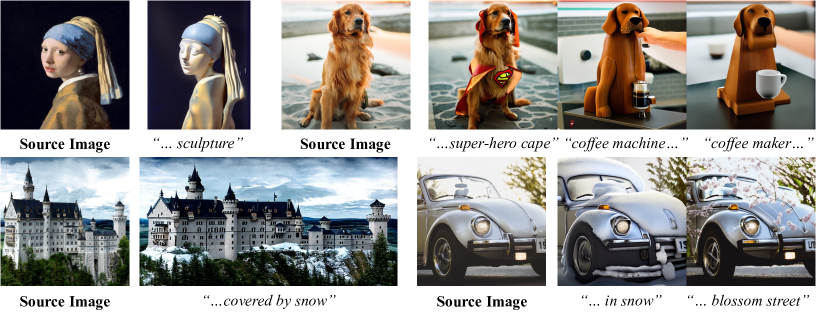
- The method achieves high-fidelity editing with preserved identity and structure, even when changing style, adding content, or modifying objects in a single image.
- Patch-based fine-tuning enables generation at arbitrary resolutions, such as producing a 640×512 image of a sculpture from a 512×512 painting of the Girl with a Pearl Earring.
- The guidance weight $v=0.7$ provides a balanced trade-off between fidelity and creativity, minimizing artifacts and maintaining high LPIPS and CLIP scores.
- The method successfully performs complex edits such as content removal, style generation, and dual-model style transfer, demonstrating robustness across diverse editing tasks.
- Compared to prior methods, SINE reduces overfitting and geometry artifacts, enabling stable performance on in-the-wild images like human faces and complex scenes.
- The approach outperforms existing methods in maintaining spatial consistency and generalization, especially when editing at higher resolutions or with ambiguous language prompts.
Read this paper
Open the full text in the Nubint reader and ask about any passage as you read.
Read this paper on NubintThis review was generated by AI from the original paper. Please check the paper before citing it.