
[Paper Review] Single crystal synthesis, structure, and magnetism of Pb$_{10-x}$Cu$_x$(PO$_4$)$_6$O
Phase-pure Pb$_{10-x}$Cu$_x$(PO$_4$)$_6$O single crystals were grown and thoroughly characterized; they are highly insulating with an inhomogeneous Cu distribution and show no evidence of room-temperature superconductivity, though a small ferromagnetic component and diamagnetism are observed.
The recent claim of superconductivity above room temperature in Pb$_{10-x}$Cu$_x$(PO$_4$)$_6$O with 0.9 < $x$ < 1 (referred to as LK-99) has sparked considerable interest. To minimize the influence of structural defects and impurity phases on the physical properties, we have synthesized phase-pure single crystals with $x \sim 1$. We find that the crystals are highly insulating and optically transparent. X-ray analysis reveals an uneven distribution of the substituted Cu throughout the sample. Temperature ($T$) dependent magnetization measurements for $ 2 \leq T \leq 800$ K reveal the diamagnetic response characteristic of a non-magnetic insulator, as well as a small ferromagnetic component, possibly originating from frustrated exchange interactions in Cu-rich clusters in the Pb$_{10-x}$Cu$_x$(PO$_4$)$_6$O structure. No anomalies indicative of phase transitions are observed. We therefore rule out the presence of superconductivity in Pb$_{9}$Cu(PO$_4$)$_6$O crystals, and provide some considerations on the origin of anomalies previously reported in experiments on polycrystalline specimen.
Motivation & Objective
- Motivate a definitive test of the LK-99 superconductivity claim using phase-pure single crystals.
- Determine the crystal structure and Cu substitution pattern in Pb$_{10-x}$Cu$_x$(PO$_4$)$_6$O.
- Characterize magnetic and electronic transport properties across a wide temperature range (2–800 K).
- Assess whether Cu distribution influences magnetic responses and potential superconducting signatures.
Proposed method
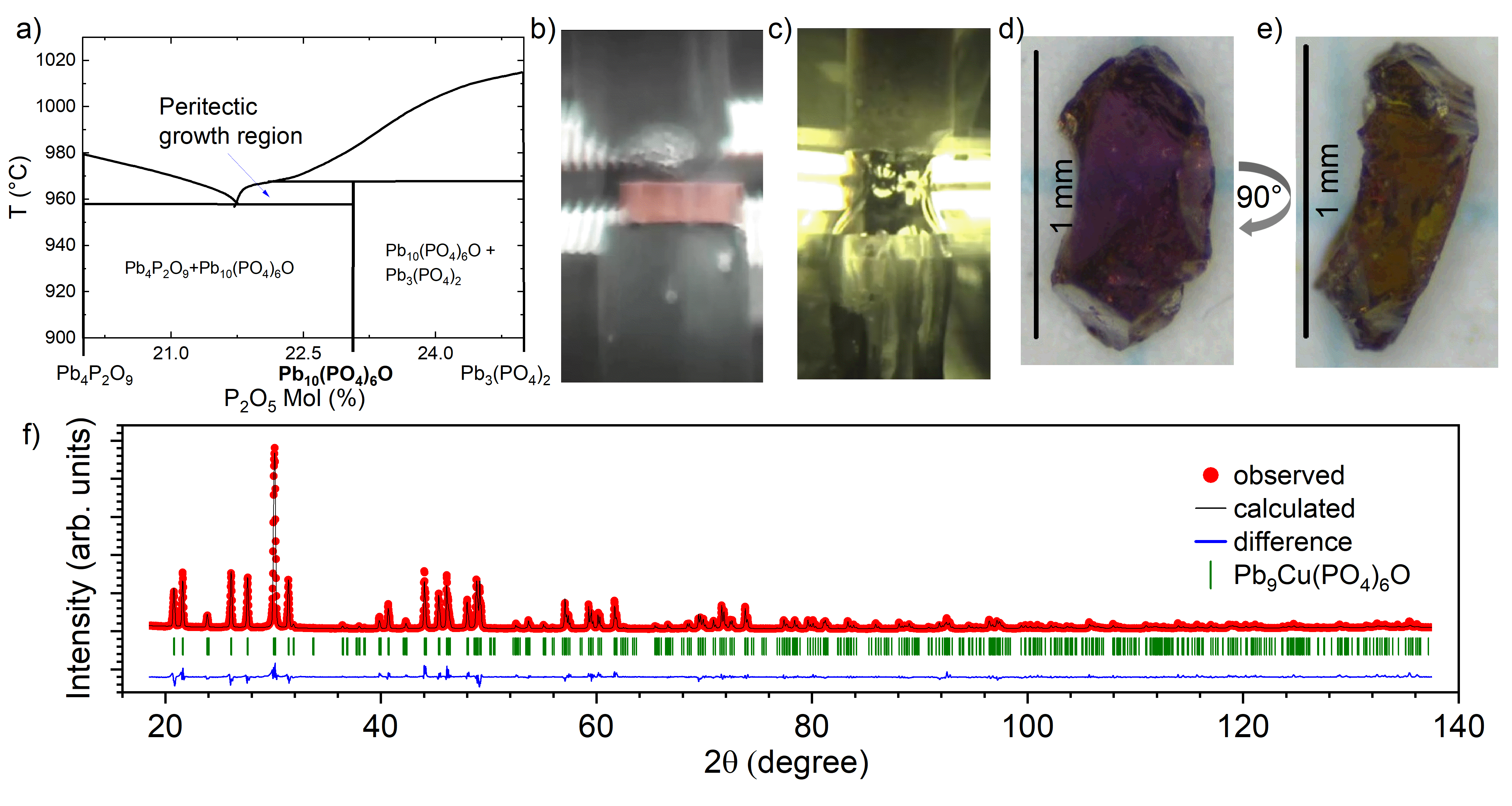
- Grow phase-pure Pb$_{10-x}$Cu$_x$(PO$_4$)$_6$O single crystals via traveling solvent floating zone (TSFZ) using phosphate precursors.
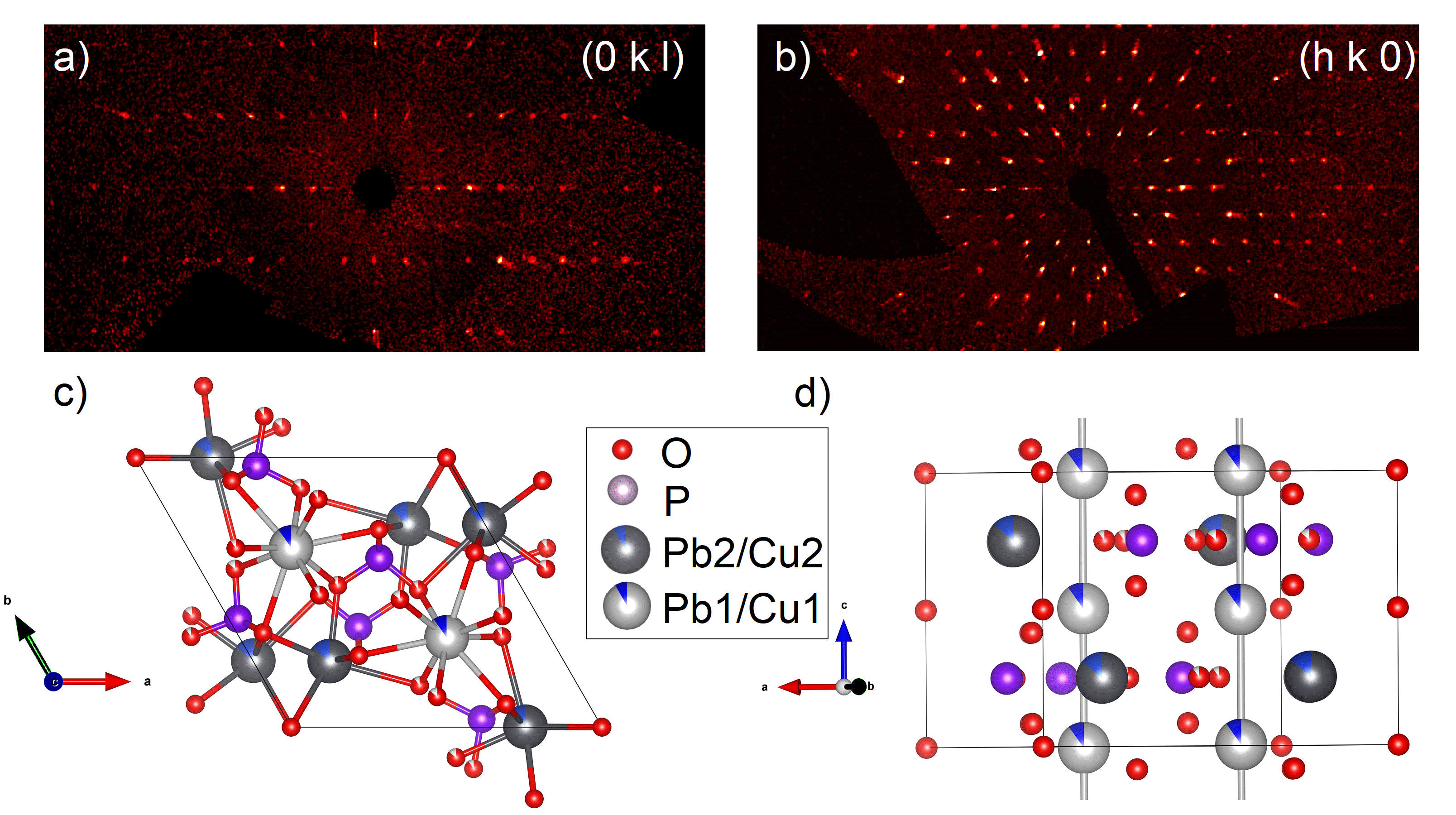
- Characterize crystal structure with powder and single-crystal X-ray diffraction (PXRD and XRD), including Rietveld refinement.
- Use energy-dispersive X-ray spectroscopy (EDX) to map Cu distribution across multiple crystals.
- Measure magnetic susceptibility from 2 to 800 K under FC/ZFC and high fields (up to 7 T) using MPMS; perform time-dependent susceptibility to identify glassy dynamics.
- Attempt four-point DC resistivity measurements to probe electronic transport; perform differential thermal analysis (DTA/TG) for thermal stability.
- Monitor structural integrity via PXRD before/after heating; assess possible impurity phases (e.g., Cu$_2$S) as alternative explanations for prior signals.
Experimental results
Research questions
- RQ1Does Pb$_{10-x}$Cu$_x$(PO$_4$)$_6$O exhibit superconductivity at or near room temperature under ambient pressure?
- RQ2What is the actual Cu substitution level and its spatial distribution within the Pb$_{10-x}$Cu$_x$(PO$_4$)$_6$O lattice?
- RQ3What are the magnetic and transport properties of phase-pure Pb$_{10-x}$Cu$_x$(PO$_4$)$_6$O across a wide temperature range, and do they show anomalies signaling phase transitions?
- RQ4How do structural defects or Cu-rich clusters influence magnetic behavior and potential misinterpretations in polycrystalline samples?
Key findings
- Single-crystal growth yields phase-pure Pb$_{10-x}$Cu$_x$(PO$_4$)$_6$O with Cu distributed inhomogeneously across the crystal; average Cu content approaches the x~1 regime claimed in early reports.
- Cu substitution correlates with lattice contraction, and single-crystal refinements indicate Cu occupancy is low (~0.1 on Cu1/Cu2 sites in refined models) with oxygen vacancies inferred.
- Crystals are highly insulating and optically transparent; four-point resistivity attempts yield resistance above MΩ at room temperature, arguing against metallic or superconducting transport.
- Magnetic susceptibility shows a diamagnetic response up to 800 K in high fields, with a small ferromagnetic/canted-antiferromagnetic component likely arising from Cu-rich clusters and frustrated exchange; a Curie tail hints at paramagnetic impurities.
- No anomalies in susceptibility or other measurements indicate any superconducting transition; time-dependent susceptibility at 2 K under 7 T suggests cluster spin-glass-like dynamics, not bulk superconductivity.
- EDX mapping reveals substantial spatial variation in Cu content within and between crystals, indicating inhomogeneous substitution rather than a uniform doped phase.
Read this paper
Open the full text in the Nubint reader and ask about any passage as you read.
Read this paper on NubintThis review was generated by AI from the original paper. Please check the paper before citing it.