
[Paper Review] Small but Mighty: Enhancing 3D Point Clouds Semantic Segmentation with U-Next Framework
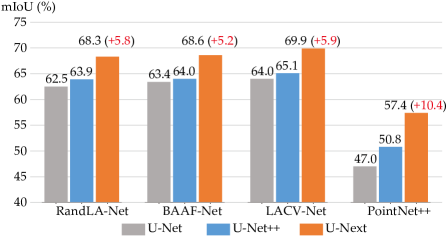
This paper proposes U-Next, a novel, lightweight 3D point cloud semantic segmentation framework that enhances feature learning by stacking multiple U-Net $L^1$ sub-networks in a nested, densely connected manner to minimize semantic gaps. By fusing multi-scale features and applying multi-level deep supervision, U-Next achieves state-of-the-art performance on S3DIS, Toronto3D, and SensatUrban, with a 68.3% mIoU on S3DIS Area 5, demonstrating consistent gains over U-Net and U-Net++.
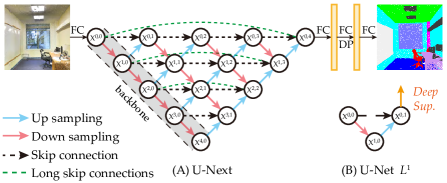
We study the problem of semantic segmentation of large-scale 3D point clouds. In recent years, significant research efforts have been directed toward local feature aggregation, improved loss functions and sampling strategies. While the fundamental framework of point cloud semantic segmentation has been largely overlooked, with most existing approaches rely on the U-Net architecture by default. In this paper, we propose U-Next, a small but mighty framework designed for point cloud semantic segmentation. The key to this framework is to learn multi-scale hierarchical representations from semantically similar feature maps. Specifically, we build our U-Next by stacking multiple U-Net $L^1$ codecs in a nested and densely arranged manner to minimize the semantic gap, while simultaneously fusing the feature maps across scales to effectively recover the fine-grained details. We also devised a multi-level deep supervision mechanism to further smooth gradient propagation and facilitate network optimization. Extensive experiments conducted on three large-scale benchmarks including S3DIS, Toronto3D, and SensatUrban demonstrate the superiority and the effectiveness of the proposed U-Next architecture. Our U-Next architecture shows consistent and visible performance improvements across different tasks and baseline models, indicating its great potential to serve as a general framework for future research.
Motivation & Objective
- To address the limitations of existing U-Net-based frameworks in 3D point cloud segmentation, particularly the semantic gap between encoder and decoder features.
- To reduce noise accumulation from aggressive downsampling and upsampling in standard U-Net architectures.
- To improve feature fusion and optimization by minimizing semantic discrepancies across scales.
- To develop a general, effective, and lightweight framework suitable for large-scale 3D point cloud segmentation.
Proposed method
- U-Next is constructed by stacking multiple U-Net $L^1$ sub-networks—each performing only one downsampling and one upsampling operation—to minimize semantic gap and noise.
- The framework uses a nested, densely arranged architecture to enable repeated, hierarchical feature fusion across scales.
- Multi-level deep supervision is applied at each decoder node to stabilize training and improve gradient flow.
- Long skip connections are used between corresponding encoder and decoder layers of each $L^1$ sub-network to preserve spatial and semantic consistency.
- Feature maps from different scales are fused through concatenation and convolutional operations to recover fine-grained details.
- The architecture avoids dense skip connections to reduce overfitting and computational cost, favoring simpler, effective long skip connections.
Experimental results
Research questions
- RQ1Can a simplified U-Net $L^1$ sub-network be stacked effectively to improve 3D point cloud semantic segmentation?
- RQ2Does minimizing the semantic gap between encoder and decoder features lead to better performance than standard U-Net or U-Net++ in 3D point clouds?
- RQ3How does multi-level deep supervision compare to full-resolution or lateral supervision in optimizing 3D segmentation networks?
- RQ4Is the proposed nested, hierarchical fusion mechanism more effective than dense skip connections in 3D point cloud segmentation?
- RQ5Can U-Next generalize across diverse large-scale 3D benchmarks like S3DIS, Toronto3D, and SensatUrban?
Key findings
- U-Next achieves a 68.3% mIoU on S3DIS Area 5, outperforming the baseline RandLA-Net and showing consistent gains over U-Net and U-Net++.
- The ablation study confirms that multi-level deep supervision yields better performance than full-resolution or lateral supervision alone.
- The use of long skip connections in U-Next provides comparable performance to dense skip connections but with reduced parameters and lower risk of overfitting.
- Visual comparisons on S3DIS, Toronto3D, and SensatUrban show that U-Next produces sharper, more accurate boundaries and better handles complex structures like railings, crosswalks, and railroads.
- U-Next demonstrates robustness and generalization across diverse datasets with varying point cloud densities and object distributions.
- The framework achieves state-of-the-art performance without architectural complexity, proving that minimal semantic gap and effective feature fusion are key to high accuracy.
Read this paper
Open the full text in the Nubint reader and ask about any passage as you read.
Read this paper on NubintThis review was generated by AI from the original paper. Please check the paper before citing it.