
[Paper Review] SmolLM2: When Smol Goes Big -- Data-Centric Training of a Small Language Model
SmolLM2 is a 1.7B parameter language model trained on ~11T tokens using a multi-stage, data-centric approach with new datasets (FineMath, Stack-Edu, SmolTalk); it achieves state-of-the-art performance among similarly sized LMs and is released with its data.
While large language models have facilitated breakthroughs in many applications of artificial intelligence, their inherent largeness makes them computationally expensive and challenging to deploy in resource-constrained settings. In this paper, we document the development of SmolLM2, a state-of-the-art "small" (1.7 billion parameter) language model (LM). To attain strong performance, we overtrain SmolLM2 on ~11 trillion tokens of data using a multi-stage training process that mixes web text with specialized math, code, and instruction-following data. We additionally introduce new specialized datasets (FineMath, Stack-Edu, and SmolTalk) at stages where we found existing datasets to be problematically small or low-quality. To inform our design decisions, we perform both small-scale ablations as well as a manual refinement process that updates the dataset mixing rates at each stage based on the performance at the previous stage. Ultimately, we demonstrate that SmolLM2 outperforms other recent small LMs including Qwen2.5-1.5B and Llama3.2-1B. To facilitate future research on LM development as well as applications of small LMs, we release both SmolLM2 as well as all of the datasets we prepared in the course of this project.
Motivation & Objective
- Motivate the development of performant small LMs to reduce computational costs while maintaining capabilities across knowledge, reasoning, code, and mathematics.
- Investigate how careful data curation and staged training can maximize small LM performance.
- Assess the impact of specialized datasets (math, code, instruction-following) on domain-specific and general capabilities.
- Provide a reproducible training pipeline and released datasets to facilitate future research on small LMs.
Proposed method
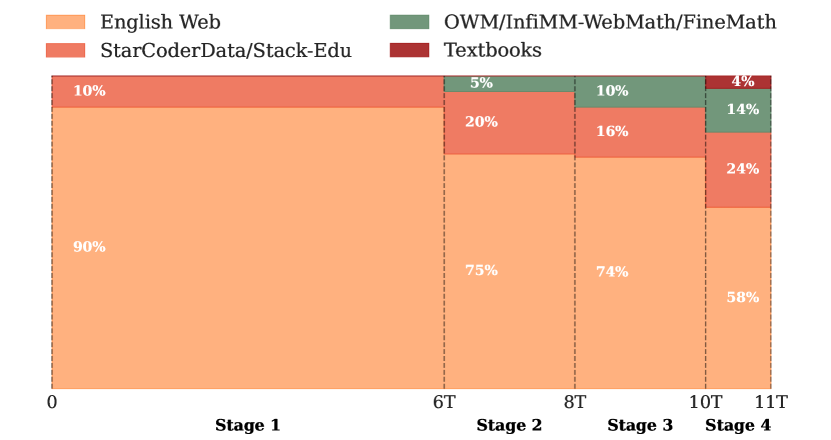
- Train a 1.7B parameter Transformer (LLama2-based) on ~11T tokens with a multi-stage training schedule.
- Systematically evaluate English web data ablations to guide dataset mixtures and introduce on-the-fly rebalancing.
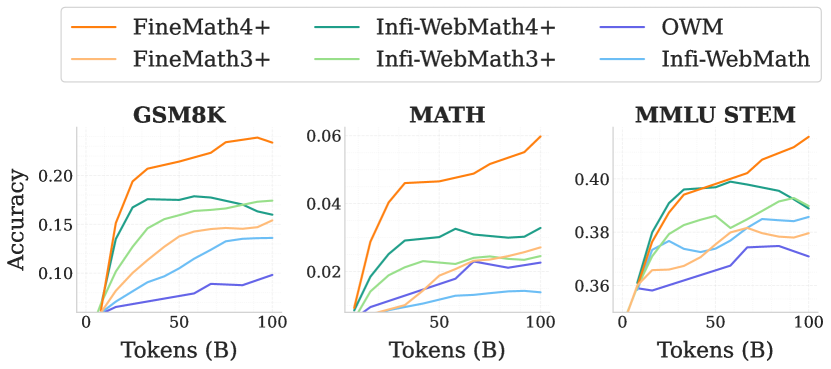
- Create and integrate new specialized datasets FineMath, Stack-Edu, and SmolTalk to address gaps in math, code, and instruction-following.
- Perform stage-wise annealing and dataset upsampling of high-quality domains (math, code) at later stages to maximize capabilities.
- Extend context length to 8k tokens via checkpointing and RoPE scaling to enable long-context tasks.
- Post-train with instruction tuning (SmolTalk) and preference learning (DPO) to produce instruction-following variants.
Experimental results
Research questions
- RQ1How does dataset composition and staged training affect performance of a small LM across benchmarks?
- RQ2Do specialized data (math, code, instruction-following) improve reasoning and domain-specific capabilities in small LMs?
- RQ3What is the impact of data upsampling and late-stage incorporation of high-quality datasets on overall performance?
- RQ4Can a 1.7B model trained with a data-centric approach reach state-of-the-art performance among similarly sized LMs?
Key findings
- SmolLM2 (1.7B) outperforms Qwen2.5-1.5B and Llama3.2-1B on several benchmarks in the 1–2B size range.
- Final base SmolLM2 shows strong generalization, with notable gains on MMLU-Pro, TriviaQA, Natural Questions, GSM8K, MATH, and HumanEval compared to peer models.
- Performance remains robust after extending context length from 2k to 8k tokens (no degradation observed).
- Stage-wise data mixing with emphasis on math and code at later stages yields large improvements in math and coding abilities.
- The SmolLM2 instruction-tuned variant (SmolTalk) and alignment via Direct Preference Optimization further enhance instruction-following performance.
- The study releases SmolLM2 and all prepared datasets (FineMath, Stack-Edu, SmolTalk) to support future research.
Read this paper
Open the full text in the Nubint reader and ask about any passage as you read.
Read this paper on NubintThis review was generated by AI from the original paper. Please check the paper before citing it.