
[Paper Review] SN2023ixf in Messier 101: A Variable Red Supergiant as the Progenitor Candidate to a Type II Supernova
This study identifies a variable red supergiant (RSG) with a massive, dusty circumstellar shell as the progenitor of Type II supernova SN 2023ixf in M101. Using pre-explosion Hubble, Spitzer, and ground-based imaging, the authors find the source has a luminosity of log(L/L☉) = 4.74 ± 0.07, effective temperature of 3920 K, and a 5×10⁻⁵ M☉ dust shell at 8600 R☉, consistent with a ~11 M☉ RSG progenitor. The source exhibited 70% variability over 9 years, likely due to κ-mechanism pulsations.
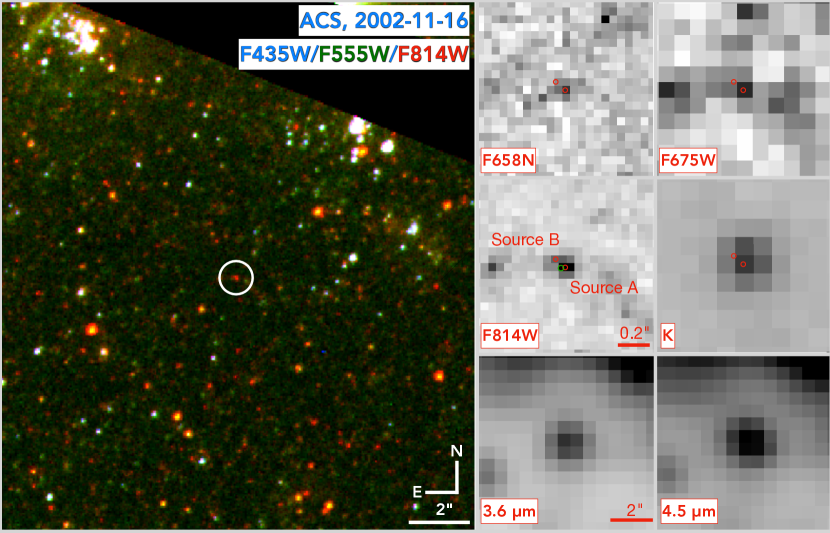
We present pre-explosion optical and infrared (IR) imaging at the site of the type II supernova (SN II) 2023ixf in Messier 101 at 6.9 Mpc. We astrometrically registered a ground-based image of SN 2023ixf to archival Hubble Space Telescope (HST), Spitzer Space Telescope (Spitzer), and ground-based near-IR images. A single point source is detected at a position consistent with the SN at wavelengths ranging from HST $R$-band to Spitzer 4.5 $μ$m. Fitting to blackbody and red supergiant (RSG) spectral-energy distributions (SEDs), we find that the source is anomalously cool with a significant mid-IR excess. We interpret this SED as reprocessed emission in a 8600 $R_{\odot}$ circumstellar shell of dusty material with a mass $\sim$5$ imes10^{-5} M_{\odot}$ surrounding a $\log(L/L_{\odot})=4.74\pm0.07$ and $T_{ m eff}=3920\substack{+200\\-160}$ K RSG. This luminosity is consistent with RSG models of initial mass 11 $M_{\odot}$, depending on assumptions of rotation and overshooting. In addition, the counterpart was significantly variable in pre-explosion Spitzer 3.6 $μ$m and 4.5 $μ$m imaging, exhibiting $\sim$70% variability in both bands correlated across 9 yr and 29 epochs of imaging. The variations appear to have a timescale of 2.8 yr, which is consistent with $κ$-mechanism pulsations observed in RSGs, albeit with a much larger amplitude than RSGs such as $α$ Orionis (Betelgeuse).
Motivation & Objective
- To identify the progenitor star of Type II supernova SN 2023ixf in Messier 101 using pre-explosion imaging data.
- To resolve the 'red supergiant problem' by investigating why high-mass RSGs (>20 M☉) are underrepresented as SN II progenitors.
- To characterize the physical properties of the progenitor, including luminosity, temperature, and circumstellar environment.
- To investigate the nature of the progenitor's variability and its implications for pulsational instability and mass loss.
- To test whether the progenitor's properties align with theoretical models of RSG evolution and core-collapse supernovae.
Proposed method
- Astrometric registration of pre-explosion ground-based, Hubble Space Telescope (HST), and Spitzer Space Telescope images to precisely locate the SN position.
- Spectral energy distribution (SED) fitting using blackbody and RSG models to derive the progenitor's effective temperature and luminosity.
- Modeling of the mid-infrared excess as reprocessed emission from a circumstellar dust shell using a 3D radiative transfer approach.
- Analysis of long-term Spitzer 3.6 μm and 4.5 μm light curves over 9 years (29 epochs) to measure variability amplitudes and timescales.
- Comparison of the progenitor's luminosity and temperature with theoretical RSG evolutionary models to estimate initial mass.
- Use of Bayesian inference (emcee) to constrain uncertainties in SED fitting and variability parameters.
Experimental results
Research questions
- RQ1What is the nature of the progenitor star of SN 2023ixf, and does it match the expected properties of a red supergiant?
- RQ2Why is there a significant mid-infrared excess in the progenitor's SED, and what does it reveal about the circumstellar environment?
- RQ3How do the long-term photometric variations in the progenitor’s light curve relate to pulsational instability mechanisms?
- RQ4What is the initial mass of the progenitor star, and how does it compare to theoretical expectations for SN II progenitors?
- RQ5Does the progenitor’s variability and mass loss history support the hypothesis that it is a high-mass RSG on the verge of collapsing?
Key findings
- A single point source was detected at the SN 2023ixf position across optical to mid-infrared wavelengths, confirming a luminous, cool progenitor.
- The progenitor has a luminosity of log(L/L☉) = 4.74 ± 0.07 and an effective temperature of 3920 K, consistent with a red supergiant.
- The mid-infrared excess is best explained by reprocessing of stellar light in a circumstellar dust shell with a radius of 8600 R☉ and mass ∼5×10⁻⁵ M☉.
- The progenitor exhibited 70% variability in both Spitzer 3.6 μm and 4.5 μm bands over 9 years, with a characteristic timescale of 2.8 years.
- The variability is consistent with κ-mechanism pulsations, though with a much larger amplitude than typical RSGs like Betelgeuse.
- The progenitor’s luminosity and temperature are consistent with a 11 M☉ initial mass RSG, depending on assumptions of rotation and overshooting.

Read this paper
Open the full text in the Nubint reader and ask about any passage as you read.
Read this paper on NubintThis review was generated by AI from the original paper. Please check the paper before citing it.