
[Paper Review] Soft graviton exchange and the information paradox
This paper proposes that soft graviton exchange mediates quantum information transfer from infalling matter to outgoing Hawking radiation near black hole horizons, resolving the information paradox via non-perturbative resummation of ladder diagrams in effective field theory. The S-matrix becomes a pure phase insensitive to UV physics, preserving unitarity and enabling information retrieval despite Hawking's thermal approximation.
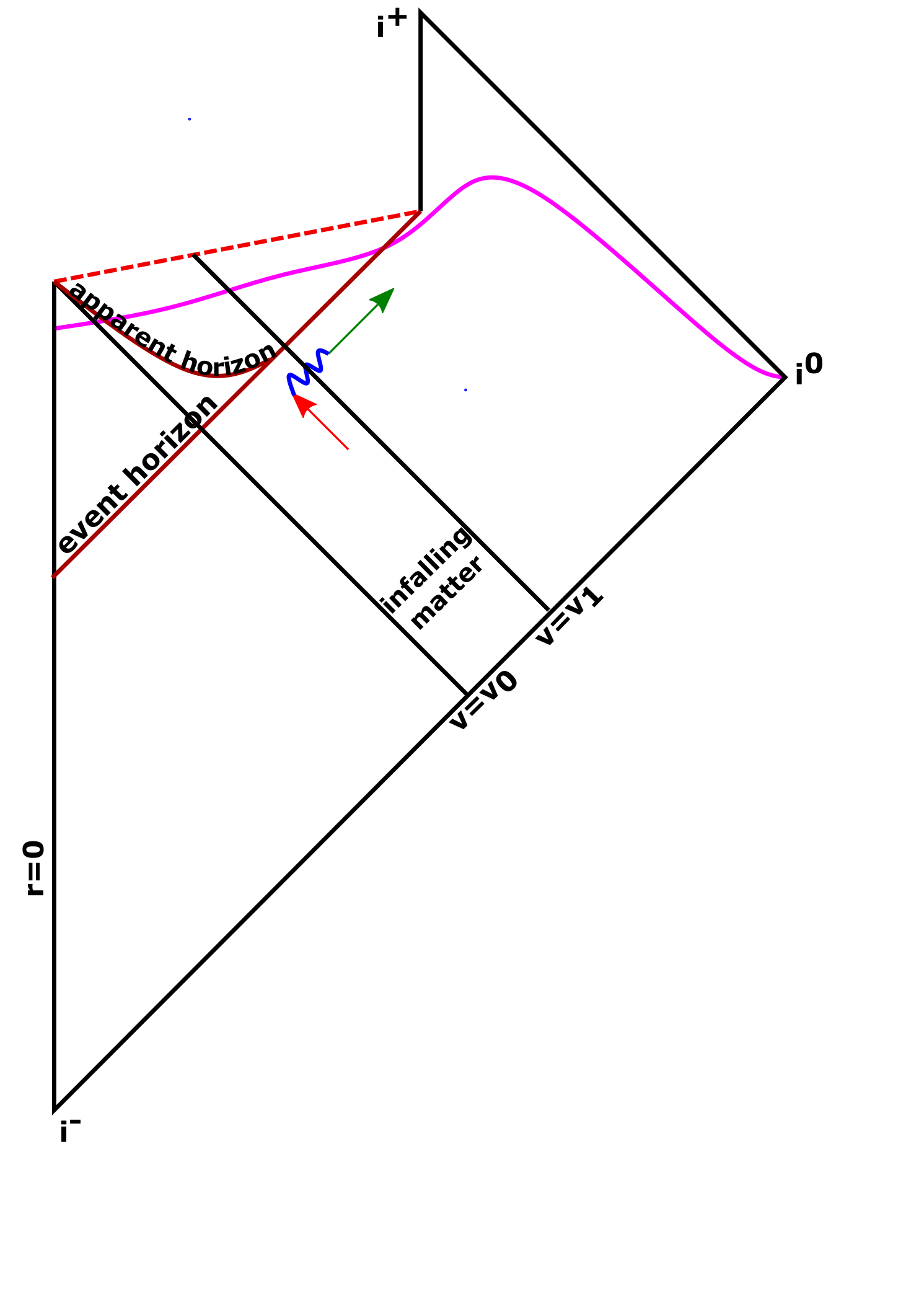
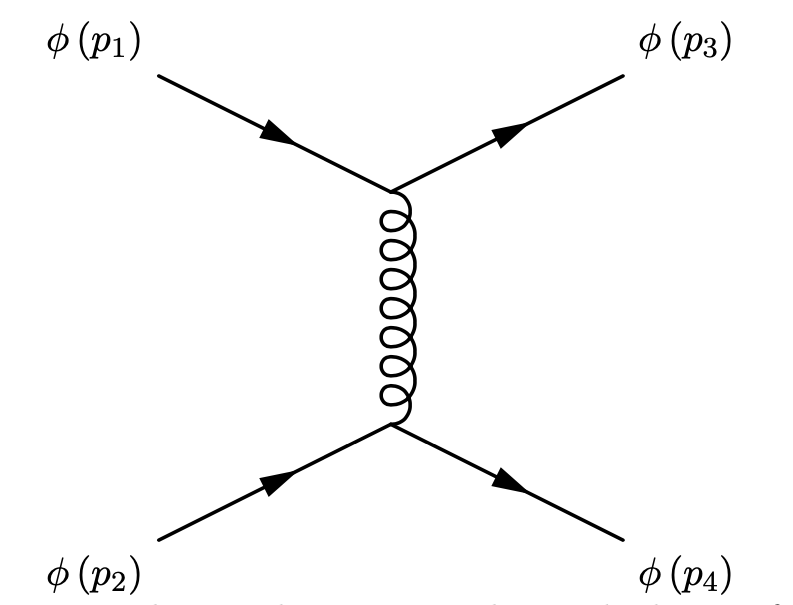
We show that there is a remarkable phase in quantum gravity where gravitational scattering amplitudes mediated by virtual gravitons can be calculated explicitly in effective field theory, when the impact parameter $b$ satisfies $L_{Pl}\ll b \lesssim R_S$, with $R_S$ being the Schwarzschild radius. This phase captures collisions with energies satisfying $\sqrt{s}\gg γM_{Pl}$ (with $γ\sim M_{Pl}/M_{BH}$) near the horizon. We call this the black hole eikonal phase, in contrast to its flat space analogue where collisions are trans-Planckian. Hawking's geometric optics approximation neglects gravitational interactions near the horizon, and results in thermal occupation numbers in the Bogoliubov coefficients. We show that these interactions are mediated by graviton exchange in $2 ightarrow 2$ scattering near the horizon, and explicitly calculate the S-matrix non-perturbatively in $M_{Pl}/M_{BH}$. This involves a re-summation of infinitely many ladder diagrams near the horizon, all mediated by virtual soft gravitons. The S-matrix turns out to be a pure phase upon this re-summation and is agnostic of Planckian physics and any specific ultraviolet completion. In contrast to the flat space eikonal limit, the black hole eikonal phase captures collisions of extremely low energy near the horizon.
Motivation & Objective
- To resolve the black hole information paradox by incorporating strong gravitational interactions near the horizon that are neglected in Hawking's semi-classical approximation.
- To demonstrate that quantum coherence is preserved through virtual soft graviton exchange in 2→2 scattering processes near the horizon.
- To compute the S-matrix non-perturbatively in $ M_{Pl}/M_{BH} $ by resumming infinite ladder diagrams mediated by soft gravitons.
- To show that the resulting S-matrix is a pure phase, agnostic to Planck-scale physics and independent of UV completion.
- To establish a regime where information from infalling matter is imprinted on outgoing radiation via gravitational interactions in the eikonal limit near the horizon.
Proposed method
- Uses effective field theory to compute gravitational scattering amplitudes in the regime $ L_{Pl} \ll b \lesssim R_S $, where $ b $ is the impact parameter and $ R_S $ the Schwarzschild radius.
- Applies the eikonal approximation to resum an infinite series of ladder diagrams involving virtual soft gravitons in $ 2\rightarrow 2 $ scattering near the horizon.
- Derives the S-matrix as a pure phase by solving the resummation problem non-perturbatively in $ M_{Pl}/M_{BH} $, valid when $ \gamma = M_{Pl}/M_{BH} \ll 1 $.
- Constructs the graviton propagator in a curved background using a modified Laplacian and radial operators, including terms like $ \tilde{\Delta}^{-1}_{ab} $ and $ \ell(\ell+1)/r^2 $, to capture horizon-scale physics.
- Implements shockwave techniques via metric perturbations with $ h_{xx} = 2A(x,y)\delta(x)F(\Omega) $, solving Einstein's equations in harmonic gauge with delta-function sources.
- Derives the equation of motion for $ F(\Omega) $ using the Ricci tensor variation and sphere Laplacian $ \Delta_\Omega $, yielding $ \frac{\delta(x)}{R^2}(\Delta_\Omega - 1)F = 8\pi G_N T_{xx} $.
Experimental results
Research questions
- RQ1Can gravitational interactions near the black hole horizon preserve quantum information that would otherwise be lost in Hawking's thermal radiation model?
- RQ2How can the S-matrix for black hole scattering be computed non-perturbatively in the $ M_{Pl}/M_{BH} $ expansion near the horizon?
- RQ3What is the role of soft graviton exchange in mediating information transfer between infalling matter and outgoing radiation?
- RQ4Why does the standard eikonal approximation fail at small impact parameters, and can a new eikonal phase be defined in the black hole regime?
- RQ5Does the resulting S-matrix remain unitary and independent of UV completion when gravitational interactions are fully resummed?
Key findings
- The S-matrix for 2→2 scattering near the black hole horizon is a pure phase upon resummation of all ladder diagrams mediated by virtual soft gravitons.
- This phase is insensitive to Planck-scale physics and does not depend on any specific ultraviolet completion of quantum gravity.
- The regime $ L_{Pl} \ll b \lesssim R_S $ allows explicit computation of scattering amplitudes via effective field theory, capturing collisions with $ \sqrt{s} \gg \gamma M_{Pl} $.
- The soft graviton exchange mechanism enables information from infalling matter to be imprinted on the outgoing radiation, as seen on a Cauchy slice near the horizon.
- The resummation procedure yields a finite, non-perturbative S-matrix that avoids the divergence seen in trans-Planckian eikonal approximations at $ b \sim G_N\sqrt{s} $.
- The equation of motion for the shockwave perturbation reduces to $ \frac{\delta(x)}{R^2}(\Delta_\Omega - 1)F = 8\pi G_N T_{xx} $, confirming the consistency of linearized gravity in the shockwave limit.
Read this paper
Open the full text in the Nubint reader and ask about any passage as you read.
Read this paper on NubintThis review was generated by AI from the original paper. Please check the paper before citing it.