
[Paper Review] SoK: Decoding the Super App Enigma: The Security Mechanisms, Threats, and Trade-offs in OS-alike Apps
A systematic study of the security mechanisms, threats, and trade-offs in super apps (miniapps) that run inside OS-like platforms such as WeChat and AliPay.
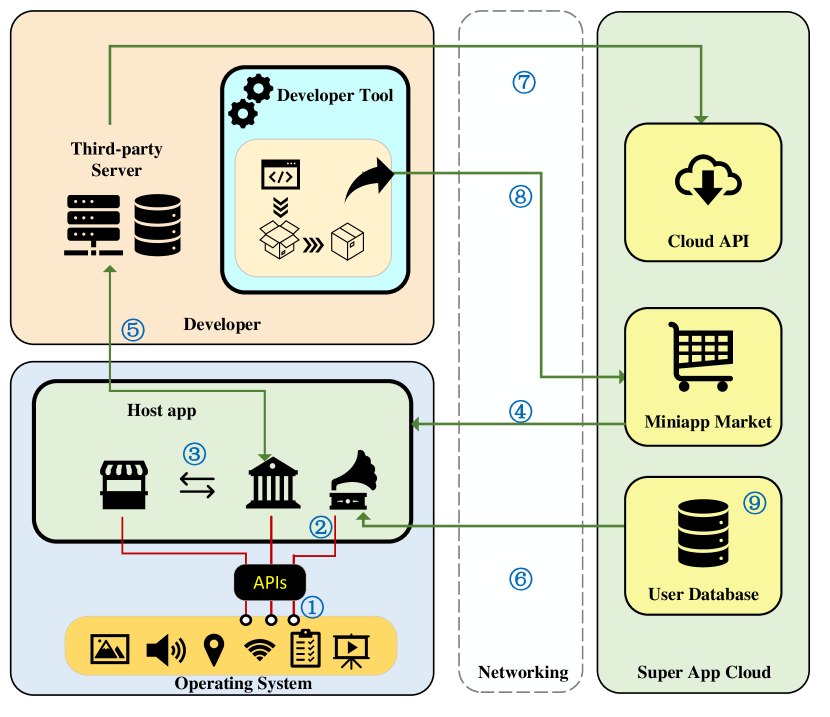
The super app paradigm, exemplified by platforms such as WeChat and AliPay, has revolutionized the mobile app landscape by enabling third-party developers to deploy add-ons within these apps. These add-ons, known as miniapps, leverage user data hosted by the super app platforms to provide a wide range of services, such as shopping and gaming. With the rise of miniapps, super apps have transformed into "operating systems", offering encapsulated APIs to miniapp developers as well as in-app miniapp stores for users to explore and download miniapps. In this paper, we provide the first systematic study to consolidate the current state of knowledge in this field from the security perspective: the security measures, threats, and trade-offs of this paradigm. Specifically, we summarize 13 security mechanisms and 10 security threats in super app platforms, followed by a root cause analysis revealing that the security assumptions still may be violated due to issues in underlying systems, implementation of isolation, and vetting. Additionally, we also systematize open problems and trade-offs that need to be addressed by future works to help enhance the security and privacy of this new paradigm.
Motivation & Objective
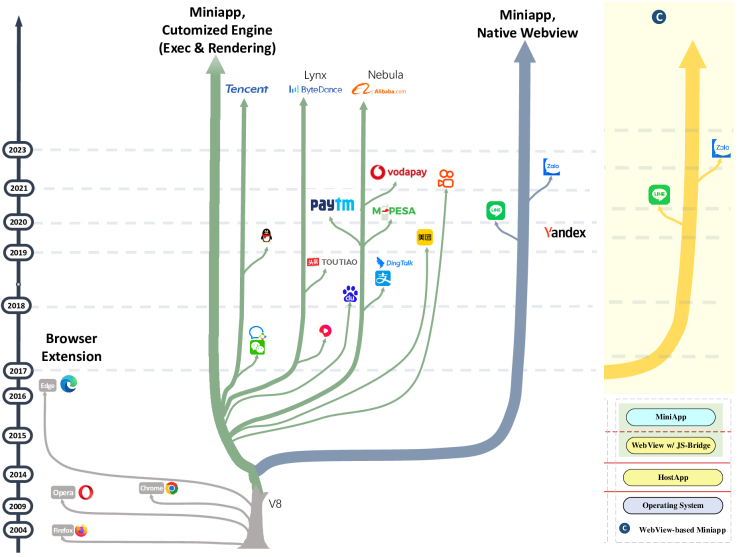
- Summarize the evolution and architecture of the super app ecosystem and miniapps.
- Catalog and analyze the security mechanisms enforcing isolation, access control, and vetting.
- Identify security threats and root causes arising from underlying systems, implementation, and vetting.
- Synthesize lessons learned and outline open problems to guide future security research.
Proposed method
- Thorough literature and platform-specific analysis of 13 security mechanisms across front-end and back-end components.
- Root-cause analysis linking mechanisms to potential violations (e.g., isolation, vetting gaps, platform trust).
- Taxonomic comparison of super apps with web and native app paradigms to identify unique security challenges.
Experimental results
Research questions
- RQ1What are the security mechanisms implemented in super apps to protect resources and data?
- RQ2What threats affect super apps, and what root causes enable these threats?
- RQ3What lessons and open problems emerge for improving the security and privacy of miniapp ecosystems?
Key findings
- There are 13 security mechanisms across front-end and back-end components in super apps.
- There are 10 identified security threats with root causes including system underlying issues, isolation, and vetting gaps.
- The analysis provides 5 lessons learned and 4 open problems to guide future work on automated analysis, standardization, developer education, and semantic vetting.
Read this paper
Open the full text in the Nubint reader and ask about any passage as you read.
Read this paper on NubintThis review was generated by AI from the original paper. Please check the paper before citing it.